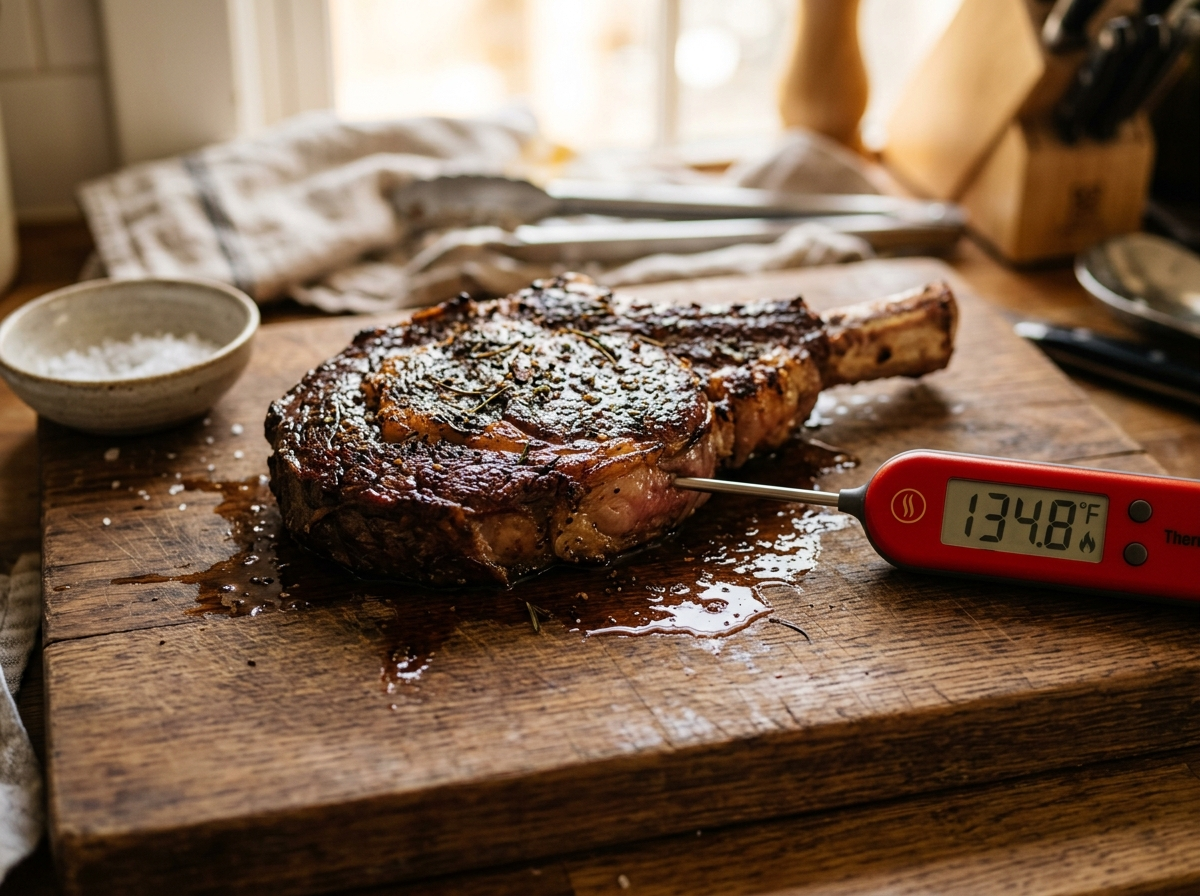
You nailed it. The thermometer reads 130°F on your thick ribeye, right where you want it for medium-rare. You pull it off the grill, let it rest for five minutes, and cut into it. Except now it’s medium-well. The center is gray, the juices are gone, and you’re staring at a $25 steak that tastes like disappointment.
Your grill didn’t betray you. Your thermometer wasn’t wrong. What happened is carryover cooking — the invisible temperature rise that keeps working on your food long after you’ve killed the heat.
Carryover cooking is the continued rise in a food’s internal temperature after it’s been removed from its heat source, caused by residual heat moving from the hotter exterior toward the cooler center.
Understanding this single concept will change the way you cook meat forever. So grab a cup of chai, and let me walk you through exactly what’s going on inside that steak, roast, or chicken thigh while it sits on your cutting board.
What Is Carryover Cooking, Really?
Think of carryover cooking as your food’s momentum. When you slam on the brakes in your car, you don’t stop instantly. Your body keeps lurching forward. Meat does the same thing with heat.
When you cook a piece of meat, the outside gets much hotter than the inside. A steak searing on a 500°F grill might have a surface temperature well above 300°F while the center is still at 120°F. That’s a massive temperature gap. The moment you take that steak off the grill, the heat stored in the outer layers doesn’t just disappear. It keeps traveling inward, pushing the center temperature higher.
This is why experienced cooks talk about pull temperature — the temperature at which you remove meat from the heat — as something different from your target temperature, the final doneness you actually want to eat. If you wait until your thermometer shows the final number, you’ve already overshot. By the time you sit down to eat, that perfectly pink center will have crept past the finish line.
Carryover cooking explained in the simplest terms: the outside of your meat is a heat battery, and during the resting period, it discharges that stored energy right into the middle.
Why Does Meat Temperature Rise After Cooking?
The science behind carryover cooking comes down to something called a thermal gradient. That’s a fancy way of saying heat always moves from hot areas to cool areas, and it keeps moving until everything reaches the same temperature.
When your meat is on the grill, in the oven, or in a pan, the heat source is pumping energy into the exterior. The outside layers absorb that energy and get hot. The center lags behind because meat is actually a pretty poor conductor of heat. It takes time for that thermal energy to work its way to the middle. This is the same reason a thick roast can be well-done on the outside and nearly raw in the center if you cook it too fast.
Once you remove the heat source, the thermal gradient doesn’t vanish. The outer layers are still packed with energy, and the center is still relatively cool. So the heat keeps flowing inward. The exterior temperature actually drops while the interior temperature climbs. Eventually, they meet somewhere in the middle, and that meeting point is higher than where the center started.
A good analogy is a cast iron pan. You know how you can turn off the burner and still fry an egg on the pan five minutes later? The pan stored all that heat energy, and it releases it slowly. Your meat does the exact same thing, just on a smaller scale. The thicker the meat, the more “cast iron” it acts.
If you want to dig deeper into what heat is actually doing to the proteins inside your meat, how heat affects muscle fibers in meat is a great read that explains the structural changes happening at each temperature stage.
How Much Does Temperature Rise? The Factors That Matter
Here’s where things get a little tricky, because there’s no single number that works for every piece of meat. I’ve seen articles casually toss out “meat rises 5 to 10 degrees” as if that’s a universal law. It’s not. The actual carryover rise depends on several factors working together, and understanding them will help you make better judgment calls at the grill.
The size and thickness of the cut is the biggest factor. A thin skirt steak might only rise 3 to 5°F during resting because there’s not much distance between the hot exterior and the cool center. The heat equalizes quickly, and the rise is small. A massive 15-pound brisket or a thick prime rib roast, on the other hand, can climb 10 to 20°F or even more. There’s a huge reservoir of heat stored in all that outer meat, and it has a long way to travel to reach the center.
Your cooking method matters just as much. When you cook hot and fast — think searing a steak at 600°F — the exterior gets extremely hot relative to the center. That steep thermal gradient means more stored energy and a bigger carryover rise. You might see a 10 to 15°F jump in a thick steak cooked this way. But when you cook low and slow, like smoking a pork shoulder at 225°F for twelve hours, the temperature difference between the outside and inside is much smaller. The whole piece of meat is nearly the same temperature by the time you pull it. Carryover in that scenario might be only 2 to 5°F.
The cooking temperature itself plays a role. Higher oven or grill temps create a steeper gradient and more carryover. A roast pulled from a 450°F oven will carry over more than the same roast pulled from a 300°F oven, even if the internal temperature is identical at the moment you pull it.
Fat content and bone also affect things. Fat and bone conduct heat differently than lean muscle. A bone-in rib roast will carry over differently than a boneless one of the same weight. Fatty cuts tend to hold heat a bit longer, which can extend the carryover period slightly.
As a general rule of thumb, plan for a 5 to 10°F rise for most steaks and chops cooked at high heat, a 10 to 15°F rise for medium roasts, and a 15 to 20°F rise for very large roasts cooked at high temperatures. For low-and-slow barbecue, expect much less — sometimes barely any rise at all.
Carryover Cooking by Meat Type: When to Pull
Knowing the theory is great, but you probably want to know what to actually do when you’re standing in front of a hot grill with tongs in your hand. Here’s a practical breakdown of pull temperatures for common meats, based on the final doneness you’re aiming for.
| Meat | Target Final Temp | Pull Temperature | Expected Rise |
|---|---|---|---|
| Steak (medium-rare) | 130–135°F | 120–125°F | 8–10°F |
| Steak (medium) | 140–145°F | 130–135°F | 8–10°F |
| Chicken breast | 165°F | 155–160°F | 5–10°F |
| Chicken thigh | 175–180°F | 165–170°F | 5–10°F |
| Pork chops | 145°F | 135–140°F | 5–10°F |
| Pork loin roast | 145°F | 130–135°F | 10–15°F |
| Prime rib (medium-rare) | 130–135°F | 115–120°F | 10–15°F |
| Turkey breast | 165°F | 155–160°F | 5–10°F |
| Fish fillets | 125–130°F | 118–122°F | 3–8°F |
A few things worth calling out here. Chicken breast is the one that trips people up the most. The USDA recommends 165°F for poultry, and most home cooks leave the chicken on the heat until the thermometer hits 165°F. By the time it rests, it’s at 175°F and dry as cardboard. Pull it at 155 to 160°F, let it rest for five to ten minutes, and carryover will bring it right to the safe zone while keeping the meat juicy.
Fish is the opposite extreme. Fillets are thin and delicate, so the carryover rise is small and fast. You only have a narrow window, and pulling a few degrees early makes the difference between silky, flaky salmon and an overcooked rubber puck.
Large roasts like prime rib are where carryover cooking really flexes its muscles. A 10-pound prime rib pulled at 120°F can easily coast up to 135°F during a 20- to 30-minute rest. If you waited until the thermometer read 135°F before pulling, you’d end up with medium-well roast beef and some very sad dinner guests.
For a deeper look at reading doneness without relying solely on numbers, how to know when meat is done without cutting covers the touch tests and visual cues that complement your thermometer readings.
Resting Meat and Carryover: How They Work Together
People often confuse resting meat with carryover cooking, and it’s easy to see why since they happen at the same time. But they’re actually two separate things that overlap.
Carryover cooking is the temperature rise. Resting is the broader process of letting the meat sit after cooking so the muscle fibers can relax and reabsorb their juices. During resting, two things happen simultaneously: the internal temperature climbs (that’s carryover), and the juices that got squeezed to the center of the meat by contracting proteins start to redistribute back toward the edges.
If you cut into a steak the second it comes off the grill, those juices pour out onto the cutting board. Give it five to ten minutes, and the fibers relax enough to hold onto that moisture. The result is a juicier bite even though the meat technically got a few degrees hotter.
Why resting meat matters goes into the full science of juice redistribution, but the short version is this: resting isn’t just a polite suggestion from fancy chefs. It’s a functional step that directly affects how your food tastes and feels.
The practical takeaway is that your resting time needs to account for carryover. For a thin steak, five minutes of rest is plenty, and the carryover rise will be modest. For a big roast, you might rest for 20 to 30 minutes, and the carryover rise will be significant. The bigger the cut, the longer the rest, and the more temperature rise you need to plan for.
One thing I’ve learned from years of cooking for groups: tent your resting meat loosely with foil if you’re in a cool environment or there’s a breeze. You don’t want to wrap it tightly — that traps steam and softens your crust — but a loose foil tent slows the surface cooling just enough to let carryover do its work evenly. In a warm kitchen, you can skip the foil entirely.
Carryover Cooking and Food Safety
Important note: The temperature information in this section is general guidance for home cooking and is not a substitute for official food safety advice. Always follow current USDA guidelines, especially when cooking for children, elderly individuals, pregnant people, or anyone with a compromised immune system.
Carryover cooking actually plays a surprisingly useful role in food safety. The USDA recommends cooking poultry to a minimum internal temperature of 165°F and ground meats to 160°F to kill harmful bacteria like Salmonella and E. coli. But here’s the nuance that most people miss: bacterial kill is a function of both temperature and time.
According to USDA food safety guidelines, holding chicken at 155°F for about 50 seconds achieves the same bacterial reduction as hitting 165°F instantly. So when you pull a chicken breast at 158°F and let it rest for five to ten minutes, the carryover rise takes it past 165°F, and the extended time at elevated temperatures provides an additional safety margin.
This is why pulling poultry a few degrees early isn’t reckless — it’s actually a smart strategy that gives you safer and juicier meat, as long as you let the rest time do its job. The key is that you need a reliable instant-read thermometer to verify the final temperature after resting, not just guess.
That said, carryover cooking is not a magic food safety wand. If you pull chicken at 140°F and only let it rest for two minutes, the center may never reach a safe temperature. The carryover rise has limits, and you can’t count on it to make up for severely undercooked meat. Understanding the food safety temperature danger zone — the range between 40°F and 140°F where bacteria multiply fastest — will help you make smarter decisions about when carryover is enough and when you need to put the meat back on the heat.
For large roasts and whole birds, I always recommend checking the temperature in the thickest part of the meat after the full resting period. If it hasn’t reached the safe minimum, pop it back in the oven for a few minutes. Better safe than sorry, especially when you’re feeding a crowd.
Frequently Asked Questions
How much does meat temperature rise during resting?
For most steaks, chops, and chicken pieces cooked at high heat, expect a 5 to 10°F rise during a 5- to 10-minute rest. Large roasts like prime rib or whole turkey can rise 10 to 20°F over a longer rest of 20 to 30 minutes. Low-and-slow barbecue cuts like brisket and pork shoulder typically see minimal rise, often just 2 to 5°F, because the entire piece of meat is already close to the same temperature when you pull it.
Does carryover cooking happen with all meats?
Yes, carryover cooking happens with every type of meat, but the amount varies dramatically. Thin cuts like fish fillets, shrimp, and skirt steak experience a small, fast rise of just a few degrees. Thick, dense cuts like roasts and whole poultry experience a much larger and slower rise. The thicker the meat and the higher the cooking temperature, the more carryover you’ll see. Even vegetables and baked goods experience a form of carryover — a loaf of bread continues to cook internally for several minutes after you pull it from the oven.
How long does carryover cooking last?
The active temperature rise typically lasts anywhere from 5 to 20 minutes, depending on the size of the cut. For a standard steak, most of the rise happens in the first 5 to 7 minutes of resting. For a large roast, the temperature can keep climbing for 15 to 20 minutes before it peaks and starts to slowly drop. Once the internal temperature stops rising and begins to fall, carryover cooking is done. This is your signal that it’s time to carve and serve.
Pull Early, Rest Well, Eat Better
The biggest mistake home cooks make is treating the thermometer reading on the grill as the final word. It’s not. It’s a snapshot of a process that’s still in motion. The heat stored in the outer layers of your meat is going to keep working whether you want it to or not, and fighting that reality is a losing battle.
The fix is simple. Start pulling your meat 5 to 10°F below your target temperature. Let it rest on a warm plate or cutting board, loosely tented if needed. Check the temperature again after resting to confirm it hit the mark. After a few tries, you’ll develop an instinct for how much carryover to expect from the cuts you cook most often, and you’ll stop serving overcooked meat to confused dinner guests.
Your next cookout is the perfect time to try this. Pick one cut — a thick steak is the easiest to start with — pull it a little earlier than you normally would, and let the resting period finish the job. You might just find that the best cooking you do happens after the fire goes out.