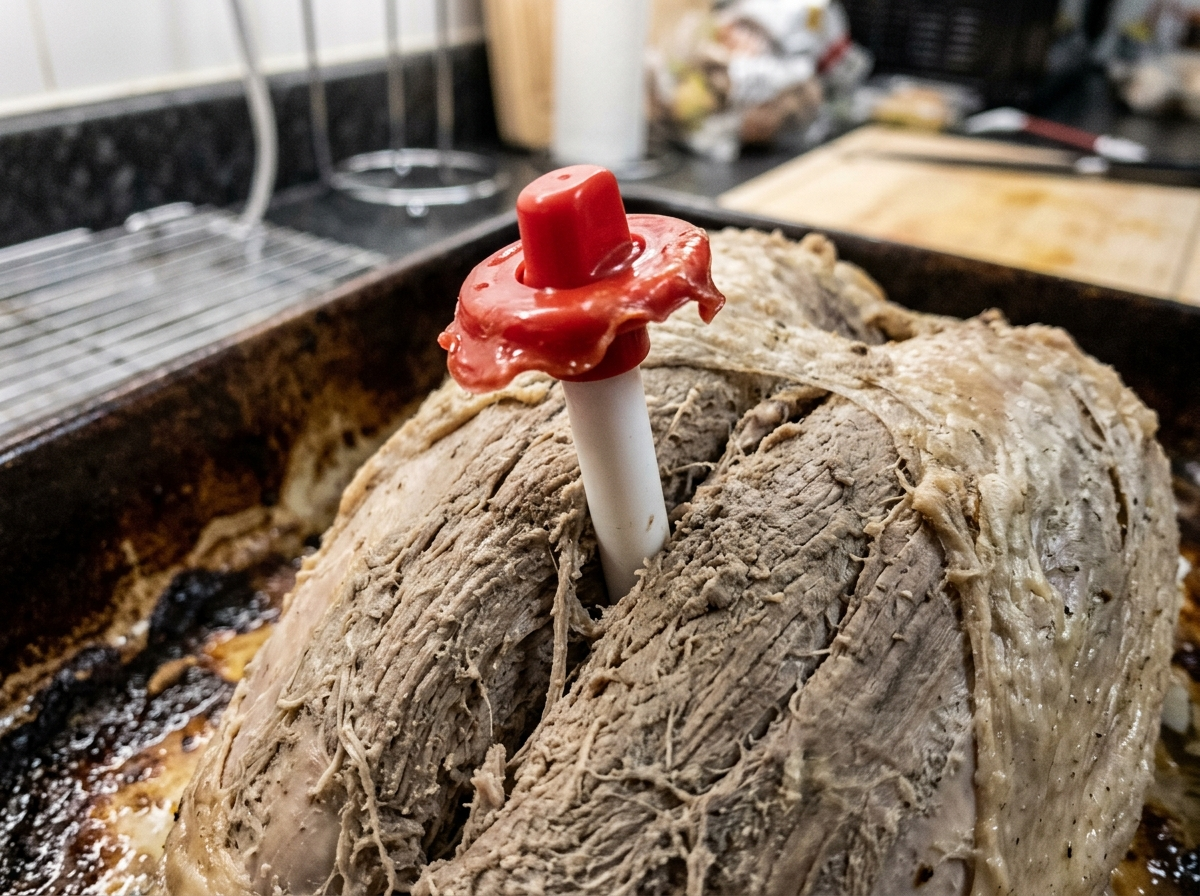
You pull the turkey out of the oven. The little plastic button has popped up, so it must be done, right? You carve into the breast and — dry as a desert. Sound familiar? That tiny plastic timer sticking out of your bird is one of the most trusted and least reliable tools in your kitchen. Let’s talk about what’s actually going on with it and what you should do instead.
What’s Actually Inside a Pop-Up Timer
That little plastic nub in your turkey isn’t some high-tech sensor. It’s a surprisingly simple device. Inside the plastic housing, there’s a small metal spring held down by a blob of food-grade soft metal or wax. When the temperature around that blob hits a specific point, the metal or wax melts. The spring releases. The red stick pops up. That’s the whole mechanism.
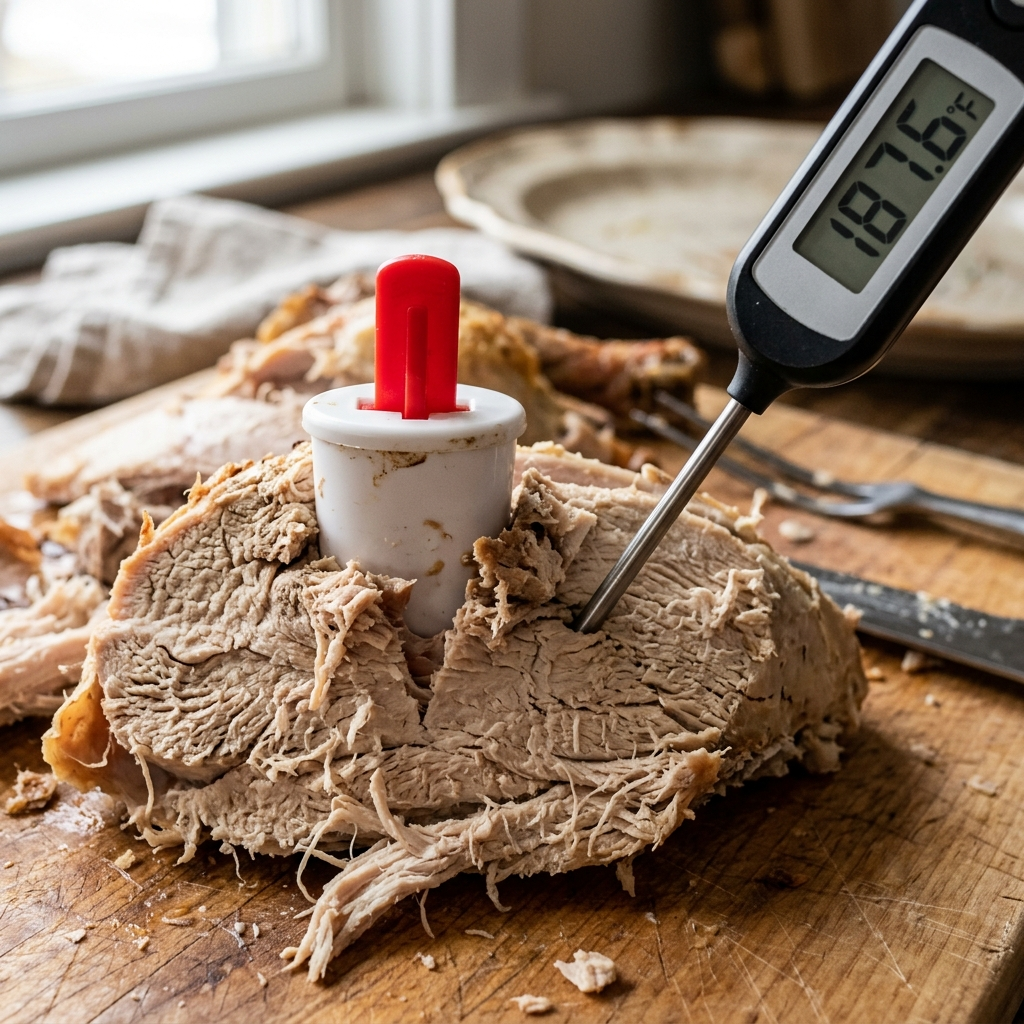
The idea sounds reasonable on paper. You put the turkey in the oven, heat surrounds it, and when the internal temperature reaches a certain threshold near the timer, the thing pops. Dinner’s ready. Simple.
But here’s where the trouble starts. The pop-up timer is embedded in the thickest part of the breast by the turkey processor — the same company that packaged and wrapped your bird at the plant. It’s placed there during production, not by you. You didn’t choose the spot. You didn’t calibrate the device. And you have no real way of knowing exactly what temperature it’s set to trigger at.
Most pop-up timers are calibrated to pop somewhere between 170°F and 180°F. Some manufacturers set them even higher. That number matters a lot more than most people realize, and it’s the root of the entire problem.
Why Pop-Up Timers Are Inaccurate
The short version? A pop-up timer turkey setup is designed to protect the manufacturer from liability, not to give you the best eating experience. Let’s break that down.
They’re Set Way Too High
The USDA recommends cooking turkey to a minimum internal temperature of 165°F. That’s the threshold where harmful bacteria like Salmonella are destroyed almost instantly. Once your turkey hits 165°F in the right spots, it’s safe to eat. Full stop.
But remember, most pop-up timers don’t trigger until 170°F to 180°F — and sometimes higher. That means by the time the little red button pops up, your turkey has already sailed past the safe temperature and is well into overcooked territory.
Why do manufacturers do this? Because they’d rather your turkey be a little dry than undercooked. A dry turkey is disappointing. An undercooked turkey that makes someone sick is a lawsuit. So they err heavily on the side of overcaution, and your breast meat pays the price.
Think of it like setting your smoke detector to go off only when there’s an actual raging fire in the room. Sure, you’ll never get a false alarm, but by the time it sounds, the damage is already done.
They Only Measure One Tiny Spot
A turkey is not a uniform block of meat. The breast is lean and cooks faster. The thighs and drumsticks are dark meat with more fat and connective tissue, and they need more time to break down properly. The area near the bone heats differently than the center of the meat.
Your pop-up timer sits in one spot — usually the breast. It tells you the temperature in that one small area, and that’s it. It can’t tell you whether the thigh joint has reached a safe temperature. It can’t tell you whether the area near the backbone is still undercooked.
This is a real food safety concern. You could have a situation where the breast is overcooked (timer popped) but the thigh near the bone is still below 165°F. That’s exactly the kind of uneven cooking that leads to both dry meat and potential foodborne illness in the same bird.
Food safety note: The temperature guidance in this article reflects general USDA recommendations for home cooking. Always follow current USDA food safety guidelines for the most up-to-date safe minimum internal temperatures, and use a calibrated meat thermometer to verify doneness. This information is not a substitute for professional food safety advice.
The Timer Can Get Stuck or Fail
Pop-up timers are cheap plastic devices mass-produced by the millions. Sometimes the mechanism sticks. Sometimes the wax doesn’t melt evenly. Sometimes the timer simply never pops even though the turkey is well past done. I’ve personally pulled a turkey from the oven after four hours, found the timer hadn’t budged, and checked with a thermometer to discover the bird was already at 175°F in the breast. The timer was a dud.
If you’re relying solely on that little plastic button, a mechanical failure means you’re flying blind.
Turkey Thermometer vs Pop-Up Timer: The Real Difference
So what makes a proper meat thermometer better than the built-in pop-up? Everything, honestly.
A good instant-read thermometer or probe thermometer gives you a precise digital temperature reading in seconds. You can check multiple spots — the thickest part of the breast, the innermost part of the thigh, the wing joint. You get actual numbers, not a vague “popped” or “not popped” signal.
With a thermometer, you control the process. You decide when to pull the bird based on real data. You can account for the fact that carryover cooking will raise the internal temperature by another 5 to 10 degrees after the turkey comes out of the oven. That means you can pull the bird at around 160°F in the breast, let it rest, and watch it coast up to the safe 165°F mark on its own — giving you juicy, perfectly cooked meat instead of sawdust.
A pop-up timer can’t do any of that. It gives you a single binary signal at a temperature that’s already too high, in a single location you didn’t choose, with a mechanism you can’t verify.
Here’s the comparison in plain terms. A pop-up timer is like asking a stranger on the street to guess the time. A meat thermometer is like checking your phone. One might occasionally be close. The other actually tells you what you need to know.
| Feature | Pop-Up Timer | Meat Thermometer |
|---|---|---|
| Temperature accuracy | ±5–10°F (rough estimate) | ±1–2°F (precise) |
| Trigger temperature | Usually 170–180°F | You choose when to check |
| Locations measured | One spot (breast) | Anywhere you place the probe |
| Accounts for carryover cooking | No | Yes, because you read the number |
| Reusable | No | Yes |
| Cost | Free (included with turkey) | $10–$30 |
That ten-to-thirty-dollar investment is the single biggest upgrade you can make for your holiday cooking.
How to Actually Know When Your Turkey Is Done
Knowing when your turkey is ready doesn’t have to be a guessing game. Figuring out when meat is done without cutting into it is a skill that comes down to one tool and a few key spots to check.
Where to Place Your Thermometer
The most important spots to check on a turkey are the thickest part of the breast, the innermost part of the thigh, and the thickest part of the wing. You want the probe tip sitting in the center of the meat, not touching bone, fat, or the pan. Bone conducts heat differently and will give you a false high reading.
Start checking the breast about 30 to 45 minutes before you think the turkey should be done. If the breast is approaching 160°F, start checking the thighs. Dark meat is more forgiving and can handle higher temperatures — many cooks prefer their thighs around 175°F to 180°F because that’s where the collagen breaks down and the meat turns tender instead of rubbery.
The key insight is that different parts of the bird finish at different times. Understanding how heat affects muscle fibers in meat helps explain why the lean breast dries out so much faster than the fatty thigh. The breast has very little fat or connective tissue to protect it, so once it passes 165°F, the muscle fibers contract aggressively and squeeze out moisture. That’s your window. Miss it, and no amount of gravy will save the texture.
Don’t Forget Carryover Cooking and Resting
This is the part most home cooks miss. When you pull a turkey out of a 325°F or 350°F oven, the outside of the bird is much hotter than the inside. That heat doesn’t just stop. It continues to travel inward, raising the internal temperature even after the turkey is sitting on the counter.
This is called carryover cooking, and on a large bird like a turkey, it can add 5 to 10 degrees to the internal temperature over the first 20 to 30 minutes of resting. So if you wait until the thermometer reads 165°F in the breast before pulling the bird, it’ll likely climb to 170°F or higher by the time you carve. You’ve just overcooked it by accident.
The smarter move is to pull the turkey when the breast reads about 158°F to 160°F. Let it rest for at least 20 to 30 minutes — resting meat matters more than most people think — and the temperature will rise to the safe 165°F zone on its own. You get safe meat and juicy meat at the same time.
This is also one of the most common food safety mistakes people make around the holidays: either pulling the bird too early because they’re nervous, or leaving it in way too long because they don’t trust their thermometer readings. A calibrated instant-read thermometer removes the guesswork from both ends of that spectrum.
Calibrate Your Thermometer Once a Year
A thermometer is only useful if it’s accurate. Fill a glass with ice water, stir it, and stick the probe in without touching the sides or bottom. It should read 32°F (0°C). If it’s off by more than a degree or two, most digital thermometers have a calibration button or a reset function. Check the manual. It takes about 60 seconds and it’s the difference between trusting your readings and guessing.
What to Do With the Pop-Up Timer
So should you yank the pop-up timer out before cooking? You can, but you don’t have to. Leaving it in won’t hurt anything. It’s food-safe plastic and metal, and it won’t affect the flavor or safety of your turkey.
The best approach is to simply ignore it. Let it pop or not pop — it doesn’t matter. Use your meat thermometer to make the actual decision about when to pull the bird from the oven. If the timer pops and your thermometer says the thigh is still at 150°F, keep cooking. If the timer hasn’t popped but your breast is at 160°F and your thighs are at 175°F, pull the bird and let it rest.
Think of the pop-up timer as a rough backup signal, not your primary tool. It’s the kitchen equivalent of a check engine light — it might mean something, but you still need to pop the hood and actually look.
Frequently Asked Questions
At what temperature does a pop-up timer pop?
Most pop-up timers are calibrated to trigger between 170°F and 180°F, though some may pop at slightly higher temperatures depending on the manufacturer. This is notably higher than the USDA’s recommended safe minimum internal temperature of 165°F for poultry, which is why relying on the timer alone often leads to overcooked breast meat.
Can a pop-up timer be wrong?
Yes. Pop-up timers can fail to pop even when the turkey is fully cooked, or they can pop prematurely if the mechanism is defective. They also only measure the temperature in one small area of the breast, so the timer might pop while other parts of the bird — especially near the thigh joint — are still below a safe temperature. Always verify doneness with a calibrated meat thermometer in multiple locations.
Should I remove the pop-up timer from my turkey before cooking?
You don’t need to. The pop-up timer is made from food-safe materials and won’t affect the taste or safety of your turkey. The simplest approach is to leave it in place but ignore it. Use an instant-read or probe thermometer to check the actual internal temperature in the breast, thigh, and wing to determine when your turkey is truly done.
Your turkey deserves better than a ten-cent piece of plastic making the biggest decision of your holiday meal. Grab a decent instant-read thermometer, check the breast and the thighs, pull the bird a few degrees early, and let carryover cooking do the rest. You’ll get a bird that’s both safe to eat and actually enjoyable to eat — which, honestly, is the whole point. Now go make the best turkey you’ve ever cooked.