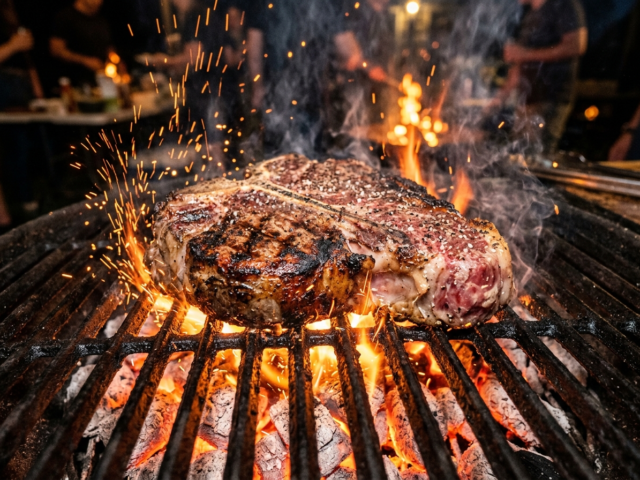
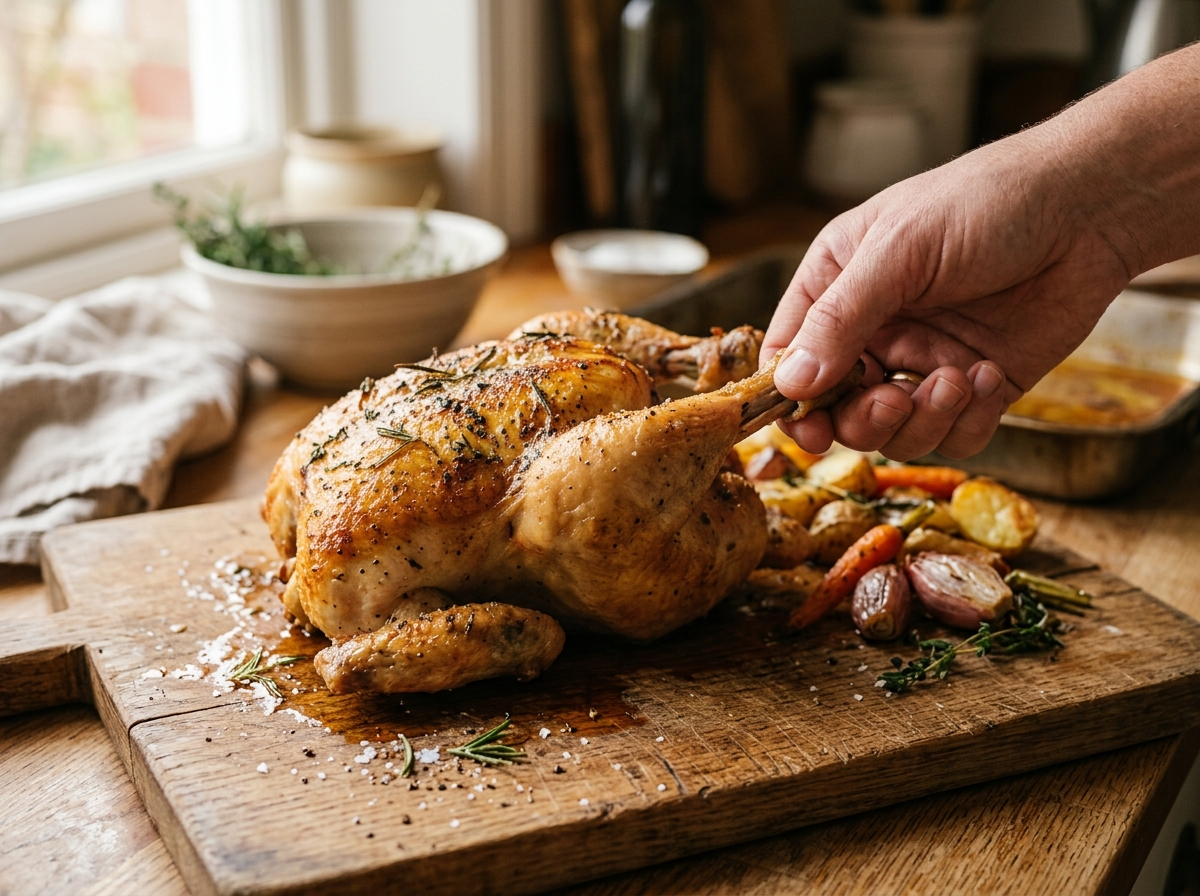
You know the scene. The steak is sizzling, the grill marks look gorgeous, and you’re dying to know if the center is actually medium-rare or still raw. So you grab a knife, slice right into the middle, and watch a little river of juices pool on the cutting board. The inside looks fine, but now your steak is drier than it needed to be — and you still aren’t totally sure you nailed it.
Cutting into meat to check doneness is one of the most common habits in home cooking, and it’s one of the most counterproductive. Every slice lets out moisture that your meat worked hard to hold onto. The good news is that you can learn to read your meat using your hands, your eyes, and a basic sense of timing. It takes a little practice, but once the feel clicks, you’ll wonder why you ever reached for the knife.
Why You Should Stop Cutting Into Your Meat
When heat hits a piece of meat, the muscle fibers start to contract and squeeze out moisture. That’s a normal part of cooking, and it happens whether you cut into the meat or not. But when you slice into a steak or chicken breast while it’s still on the heat, you create an escape route for juices that would otherwise stay trapped inside the fibers.
Think of a piece of meat like a wet sponge wrapped in a thin plastic bag. As long as the bag is sealed, the water stays put even when you squeeze it. Poke a hole in the bag, though, and water starts leaking out fast. That’s essentially what happens when you cut into cooking meat. You break the surface tension and the internal structure, and the moisture rushes toward the opening.
One small cut might not ruin a thick ribeye, but it adds up. If you’re checking a thinner chicken breast or a pork chop, that single slice can be the difference between a juicy dinner and something that tastes like cardboard. The goal of checking meat doneness without cutting is to preserve as much of that internal moisture as possible while still making sure your food is safe to eat.
If you want to understand the science behind what heat actually does to those muscle fibers, our breakdown of how heat affects muscle fibers in meat goes deeper into the chemistry.
The Touch Test: Feeling for Doneness
The touch test — sometimes called the finger test — is the most popular way to check meat doneness without a thermometer or a knife. The idea is simple: as meat cooks, its proteins firm up. Raw meat feels soft and squishy. Well-done meat feels firm and springy. Everything in between falls on a spectrum you can learn to feel with your fingers.
How the Touch Test Actually Works
Here’s the trick most people use. Hold your dominant hand out, relaxed, palm facing up. Now touch the fleshy pad at the base of your thumb with the index finger of your other hand. That soft, squishy feeling is roughly what raw meat feels like.
Now press your thumb and index finger together on the same hand. Feel that pad again — it’s a little firmer now. That’s your rare-to-medium-rare target. Touch your thumb to your middle finger, and the pad gets firmer still. That’s medium. Thumb to ring finger is medium-well, and thumb to pinky is well-done.
The reason this works is that the proteins in meat — primarily myosin and actin — denature and tighten as they heat up. At around 120°F, the proteins start to coagulate, and the meat transitions from soft to springy. By 160°F and above, most of the proteins have fully contracted, and the meat feels quite firm. Your palm mimics this progression because the muscles in your hand tighten in a similar way as you press your fingers together.
What Each Doneness Level Feels Like
| Doneness | Finger Position | How It Feels | Best For |
|---|---|---|---|
| Rare | Thumb to index | Very soft, barely springs back | Thin steaks, tuna |
| Medium-rare | Thumb to middle (loose) | Soft with gentle resistance | Ribeye, strip, filet |
| Medium | Thumb to middle (firm) | Springy, bounces back quickly | Most steaks, pork chops |
| Medium-well | Thumb to ring | Firm, slight give | Burgers, thicker chops |
| Well-done | Thumb to pinky | Very firm, almost no give | Poultry, ground meat |
A word of honesty here: the touch test works best on steaks and chops that are at least an inch thick. If you’re cooking a thin skirt steak or a smashed burger patty, the window between rare and well-done is so small that the touch test becomes almost useless. And if you’re a beginner, your calibration will be off at first. I remember the first summer I tried to rely on the finger test for chicken thighs — I pulled them off the grill convinced they were done because they felt firm, only to find they were still pink near the bone. It takes repetition to build that muscle memory, and even experienced cooks use it as a rough guide, not a guarantee.
Reading the Juices and Surface Cues
Your eyes can tell you a lot about meat doneness without a thermometer, especially once you know what to look for.
For poultry, the classic test is to pierce the thickest part of the thigh or breast with a fork or the tip of a knife and look at the color of the juices that run out. Clear juices generally mean the chicken is cooked through. Pink or red-tinged juices mean it needs more time. This is one of the few visual cues that’s reasonably reliable, though it’s not foolproof — younger birds can sometimes have slightly pink juices even at safe temperatures because of the myoglobin in their bones.
For steaks and red meat, watch the surface. As a steak cooks, the exterior changes from glossy and wet to matte and slightly crusted. The meat also starts to shrink. A raw steak might be six inches across, but by the time it hits medium, it will have pulled in noticeably at the edges. That shrinkage is the muscle fibers contracting, and it’s a decent visual indicator that the interior is progressing.
One thing to stop doing right now is judging doneness by the color of the meat’s interior alone. The USDA has confirmed that color is an unreliable indicator of safety. Ground beef can turn brown before it reaches a safe internal temperature, and chicken can remain slightly pink even after it’s fully cooked. Myoglobin, the protein that gives meat its red color, reacts to heat, pH, and even the packaging atmosphere in unpredictable ways. So if you cut into a chicken thigh and see a faint pink tint near the bone but the juices run clear and the meat feels firm, it may very well be safe. Relying on color alone is a gamble you don’t need to take.
Timing, Thickness, and Heat Level
If you don’t have a thermometer and the touch test still feels uncertain, your best backup is a combination of timing and an understanding of your heat source.
Thickness matters far more than weight. A one-inch-thick steak and a two-inch-thick steak of the same weight will cook at completely different rates because heat has to travel twice as far to reach the center of the thicker cut. As a rough starting point, a one-inch steak over high direct heat will reach medium-rare in about four to five minutes per side. A two-inch steak might need six to eight minutes per side, plus some time over indirect heat to finish without burning the exterior.
The heat level changes everything, too. If you’re searing over a roaring charcoal fire, the outside of the meat will cook much faster than the inside. That means you can get a beautiful crust while the center is still cold. If you’re cooking low and slow — say, a pork shoulder at 250°F — the internal temperature rises gradually and evenly, and timing becomes more predictable. Understanding the difference between hot and fast versus low and slow cooking will help you set realistic expectations for how long your meat needs.
A practical trick I use for chicken breasts on the grill: I pound them to an even thickness before cooking, usually about three-quarters of an inch. That way, the whole piece cooks at the same rate, and I can estimate roughly six to seven minutes per side over medium-high heat. Uniform thickness eliminates the biggest variable that makes timing unreliable.
Don’t Forget Carryover Cooking
This is the part most home cooks overlook, and it’s the reason so many steaks end up overcooked even when they were pulled off the grill at the right moment.
Carryover cooking is the phenomenon where the internal temperature of meat continues to rise after you remove it from the heat source. The outer layers of the meat are hotter than the center, and once the meat is off the flame, that residual heat keeps migrating inward. For a thick steak or roast, the internal temperature can climb anywhere from 5°F to 15°F during the resting period. A thinner cut might only rise a few degrees, but it still matters.
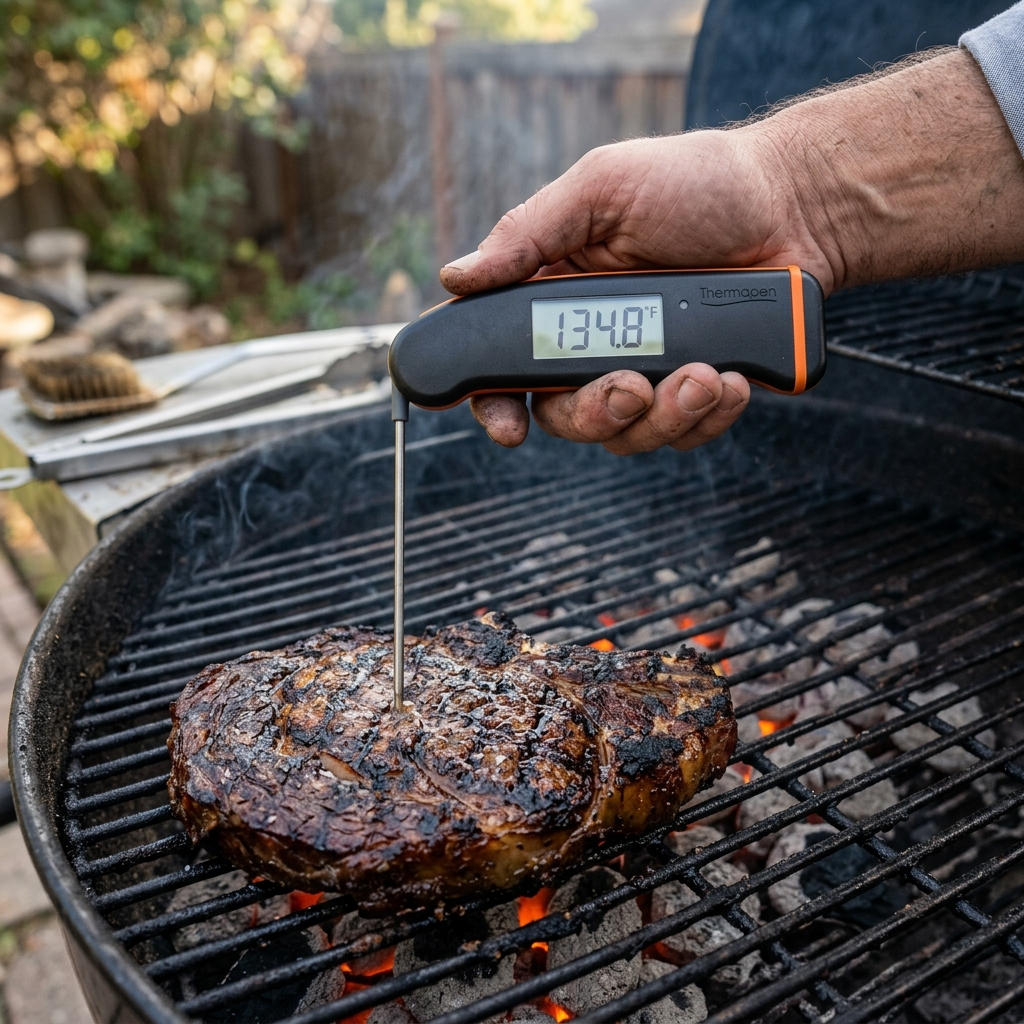
What this means for checking doneness is that you should pull your meat off the heat before it reaches your target temperature. If you want a medium-rare steak at 135°F, take it off the grill when the touch test suggests it’s closer to rare — around 125°F to 130°F. Let it rest for five to ten minutes, and the carryover heat will bring it up to where you want it.
Our full explainer on carryover cooking and what happens after you pull meat off the heat walks through the science in more detail, but the practical takeaway is this: if the meat feels like it’s almost done, it probably is. Give it a rest and let physics finish the job.
And speaking of resting, don’t skip it. Resting meat matters because it gives the muscle fibers time to relax and reabsorb some of the moisture that got pushed toward the center during cooking. Cut into a steak the second it comes off the grill, and you’ll lose a noticeable amount of juice on the plate. Wait five minutes, and that juice stays in the meat where it belongs.
The Honest Truth About Meat Thermometers
I’ve spent this whole article teaching you how to check doneness without cutting and without a thermometer, and now I’m going to tell you something that might feel contradictory: you should probably own a meat thermometer anyway.
Sensory methods like the touch test and visual cues are genuinely useful, and experienced cooks rely on them all the time. But they have real limitations, especially for beginners and especially with poultry and ground meat. The margin between safe and unsafe is much smaller with chicken than with a whole beef steak, and the consequences of getting it wrong are more serious.
A good instant-read thermometer costs about fifteen to twenty dollars and gives you an accurate reading in three to five seconds. And before you worry about poking holes in your meat and letting the juices out, that concern has been largely debunked. Poking meat with a thermometer probe does not drain a meaningful amount of juice — the tiny puncture is nothing compared to the damage a knife slice causes.
One more thing to avoid: those little pop-up timers that come pre-inserted in grocery store turkeys and roasts. They’re calibrated to pop at temperatures well above what you actually need, which means your bird will be overcooked and dry by the time the timer triggers. Pop-up timers are unreliable and have given generations of home cooks the false impression that dry turkey is just how turkey is supposed to taste. It isn’t.
Food Safety Note: The USDA recommends cooking poultry to an internal temperature of 165°F, ground meats to 160°F, and whole cuts of beef, pork, lamb, and veal to 145°F followed by a three-minute rest. These are safety guidelines based on pathogen kill rates, and they matter — especially for pregnant individuals, young children, older adults, and anyone with a compromised immune system. The sensory methods described in this article are helpful tools for everyday cooking, but they are not a substitute for a calibrated meat thermometer when food safety is the priority. For more on safe temperature ranges, see our guide to the food safety temperature danger zone.
Frequently Asked Questions
Can you tell if chicken is done without a thermometer?
Yes, but it takes practice and carries more risk than with red meat. The most reliable sensory method for chicken is the juice test — pierce the thickest part of the thigh and check that the juices run clear, not pink. The meat should also feel firm to the touch and pull away slightly from the bone. That said, because poultry carries a higher risk of salmonella, a meat thermometer is strongly recommended until you’re very confident in your technique.
Is the finger test for steak actually accurate?
It’s a useful approximation, not a precision tool. The finger test works well for steaks that are at least one inch thick and cooked over direct heat. It becomes less reliable with very thin cuts, bone-in cuts, or meats cooked using indirect methods. Most professional chefs use the touch test as a quick first check and then confirm with a thermometer for anything they’re serving to guests. Think of it as a skill that gets better with repetition — your tenth steak will feel very different from your hundredth.
How long should I let meat rest before checking doneness?
For steaks and chops, five to ten minutes is usually enough. For larger roasts and whole birds, plan on fifteen to thirty minutes. The resting period is when carryover cooking does its work, so the meat will continue to firm up and the internal temperature will rise slightly during this time. If you check doneness immediately after pulling the meat off the heat, you’ll get a false reading — the center hasn’t finished cooking yet.
Learning to read your meat without slicing into it is one of those skills that feels mysterious at first and then suddenly becomes second nature. Start with the touch test on steaks, practice reading the juices on chicken, and pay attention to how timing and thickness interact on your specific grill or stovetop. You won’t nail it perfectly the first few times, and that’s completely fine — every cook who’s ever pulled a perfect medium-rare ribeye off the grill went through the same learning curve.
The single best next step you can take tonight is this: cook two steaks of the same thickness side by side. Use the touch test on one and cut into the other to compare. You’ll calibrate your fingers faster in one dinner than in a month of reading about it. And once that feel clicks, you’ll never look at your steak knife the same way again.