
Most people picture honey as that golden, sticky liquid dripping off a spoon. So the first time you see a jar of thick, almost butter-like honey at a farmer’s market, it throws you off. Is it whipped? Is something added to it? Is it even real honey?
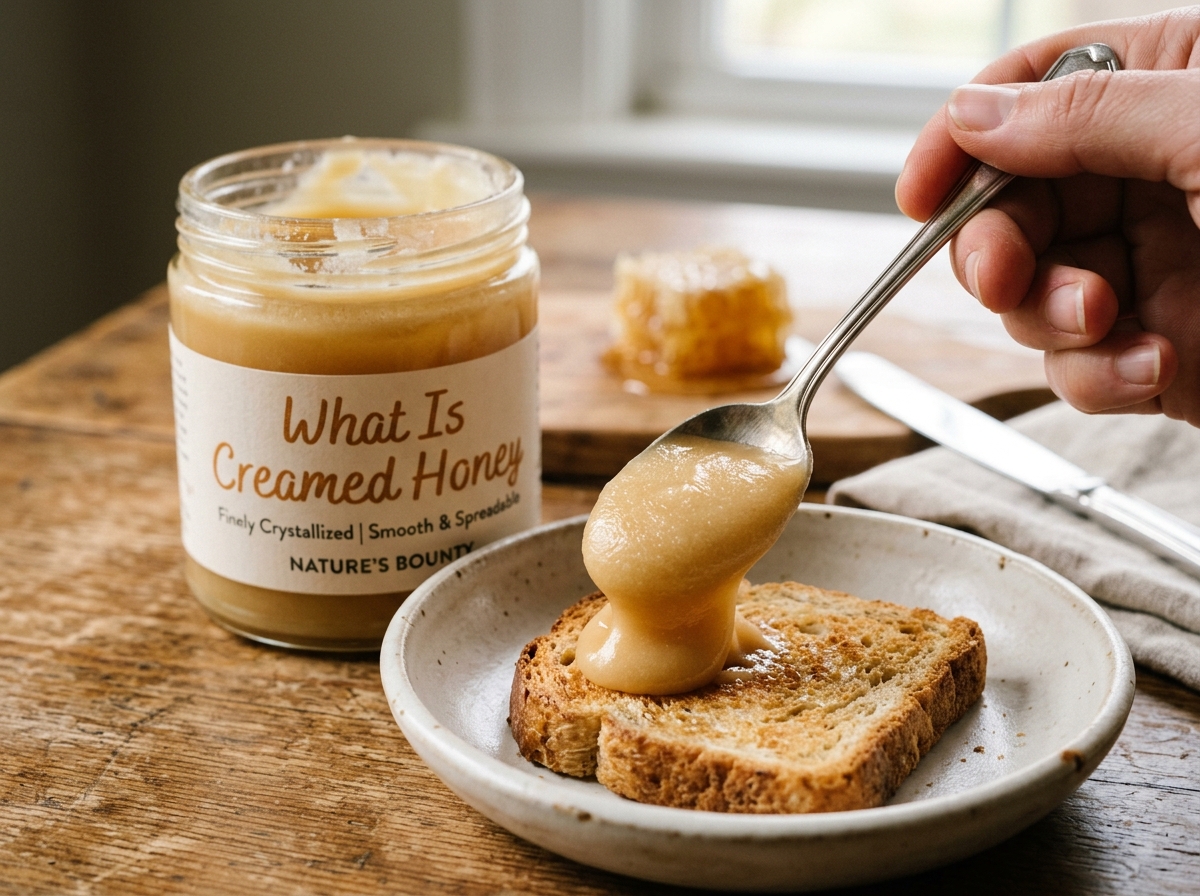
That creamy, spreadable stuff is called creamed honey — and it’s 100% real honey. No cream, no butter, no additives. Just honey that’s been processed in a specific way to control how it crystallizes. The result? A smooth, velvety texture that spreads like soft butter on toast without dripping everywhere.
If you’ve been curious about what creamed honey actually is, how it’s different from regular liquid honey, and whether it’s worth trying, you’re in the right place. Let’s break it all down.
How Creamed Honey Gets Its Texture
Here’s the thing most people don’t realize — all raw honey crystallizes eventually. That jar of liquid honey sitting in your pantry? Give it enough time, and it’ll start forming chunky, gritty crystals. That’s completely natural. Honey is a supersaturated sugar solution, and crystallization is just sugar molecules finding each other and clumping together.
The difference with creamed honey is that someone has controlled that crystallization process instead of letting it happen randomly.
Here’s how it works in simple terms. When honey crystallizes on its own, the sugar crystals form in different sizes — some big, some small. Those large, uneven crystals are what make old honey feel gritty and hard on your tongue. Nobody loves that texture.
Creamed honey flips the script. A beekeeper or honey producer takes liquid honey and mixes in a small amount of already-crystallized honey that has very fine, uniform crystals. This “seed honey” acts like a template. As the rest of the honey crystallizes, it follows the pattern of those tiny seed crystals instead of forming big, random chunks.
The honey is then kept at a cool temperature — usually around 55-57°F (13-14°C) — and stirred regularly over several days. Some producers stir it daily for one to two weeks. Others use mechanical agitation.
The end product? Honey with crystals so incredibly small — we’re talking 25 microns or less — that your tongue can’t detect them individually. It just feels smooth and creamy.
Quick Fact: The Dyce method, developed by Professor Elton J. Dyce at Cornell University in the 1930s, is still the most widely used technique for making creamed honey commercially. His patent was one of the earliest food processing patents in honey production history.
Creamed Honey vs. Regular Liquid Honey
People often wonder if creamed honey is somehow a “different product” from regular honey. It’s not. Think of it this way — ice and water are both H₂O, just in different physical states. Creamed honey and liquid honey are both pure honey, just in different crystallization states.
But the practical differences between them are worth knowing.
Texture and consistency is the most obvious one. Liquid honey flows freely. You drizzle it. Creamed honey sits on a knife or spoon like soft butter. You spread it. This makes creamed honey way easier to use on toast, biscuits, crackers, or anything where you don’t want honey running off the edges and making a sticky mess.
Flavor profile also shifts slightly. Many honey lovers say creamed honey tastes a little milder and smoother on the palate compared to the same honey in liquid form. The crystallization process doesn’t change the actual flavor compounds, but the way the honey interacts with your taste buds changes because of the texture. It melts on your tongue differently, so you perceive it differently.
Shelf behavior is another practical difference. Liquid honey will eventually crystallize into that chunky, unappetizing mess in your pantry. Creamed honey stays stable in its smooth form for months — even years — if stored properly. It’s already crystallized, so it doesn’t go through that awkward transformation.
If you’re curious about how creamed honey stacks up against raw honey specifically, you might want to read about the differences between creamed honey and raw honey for a deeper comparison.
Does creamed honey lose nutrients? This is something people ask a lot. The answer is no — as long as the honey isn’t heated excessively during the creaming process. Responsible producers keep temperatures low to preserve the natural enzymes, pollen, and antioxidants. If you buy from a quality source, your creamed honey retains the same nutritional profile as the liquid version.
How Creamed Honey Is Made (Step by Step)
You don’t need a factory to make creamed honey. Plenty of small-batch beekeepers and even home hobbyists make it. The process is surprisingly straightforward, even though it requires patience.
Step 1: Start with quality liquid honey. The base honey should be freshly extracted and free of any existing crystals. Most producers lightly warm the honey — just enough to dissolve any early crystal formations — but not so hot that it damages the beneficial enzymes. Temperatures above 104°F (40°C) start breaking down those good compounds.
Step 2: Prepare or source seed honey. Seed honey is simply creamed honey that already has the perfect fine-crystal texture. You only need about 5-10% seed honey relative to your batch size. So for 10 pounds of liquid honey, you’d mix in roughly half a pound to one pound of seed honey.
Step 3: Mix thoroughly. The seed honey gets blended into the liquid honey until it’s evenly distributed. Some people use a stand mixer. Commercial operations use specialized honey creaming machines. The goal is uniform distribution without whipping in too much air.
Step 4: Store at a cool, stable temperature. The mixed honey goes into containers and sits at around 55-57°F for about one to two weeks. During this time, the fine crystals from the seed honey “teach” the rest of the honey how to crystallize. Some producers stir the batch once daily during this period to keep the crystal formation even.
Step 5: The honey sets. After roughly 10-14 days, the honey has transformed into a firm, smooth, spreadable consistency. It’s done.
Pro Tip: If you’re trying this at home and don’t have seed honey, you can buy a small jar of commercially made creamed honey to use as your starter. Just make sure it has a smooth, fine texture — not gritty. One good jar can seed dozens of future batches.
The process sounds simple, and it is. But temperature control matters a lot. If the honey gets too warm during the setting phase, the crystals won’t form properly. Too cold, and it sets too fast with uneven texture. That sweet spot around 55°F is the magic number.
Why Do People Prefer Creamed Honey?
There’s a reason creamed honey has exploded in popularity over the last decade, especially at farmer’s markets, specialty food stores, and artisan honey brands. It solves real, everyday annoyances that people have with liquid honey.
It doesn’t drip. Honestly, this alone is enough reason for most people. If you’ve ever tried to put liquid honey on a warm biscuit and watched it run off onto your plate, your fingers, and eventually your shirt — you understand. Creamed honey stays where you put it.
It’s easier to measure. Baking with liquid honey can be frustrating. It sticks to measuring cups and spoons. Creamed honey scoops out cleanly, almost like peanut butter.
Kids actually eat it without making a disaster. Parents, you know what I’m talking about. Handing a child a honey bear bottle is an invitation for chaos. A butter knife with creamed honey on bread? Much more manageable.
It works as a standalone spread. You can literally eat creamed honey on toast the same way you’d use jam or butter. No need to pair it with something else to make it “stick.” This makes it a genuinely useful pantry staple rather than just a sweetener.
The texture is just… satisfying. There’s something about that smooth, melt-on-your-tongue quality that liquid honey can’t replicate. People who try creamed honey for the first time often say it feels more like a treat than regular honey does.
If you’re interested in exploring different ways to actually use it in your kitchen, check out 15 everyday ways to use creamed honey. Some of those ideas might surprise you.
Does Creamed Honey Go Bad?
Short answer — no, not really. Honey in general is one of the most shelf-stable foods on the planet. Archaeologists have found 3,000-year-old honey in Egyptian tombs that was still technically edible. Creamed honey shares that same remarkable longevity.
That said, storage conditions affect quality more than safety. Creamed honey won’t spoil or become dangerous to eat, but it can change in texture or appearance if you store it poorly.
Heat is the enemy. If you leave creamed honey in a hot kitchen, near a stove, or in direct sunlight, it can start to soften and partially liquify. It won’t go bad, but you’ll lose that smooth, spreadable consistency you’re paying for. Keep it in a cool, dark spot — a pantry shelf away from heat sources works perfectly.
Can you refrigerate it? Yes, and some people prefer to. Refrigeration firms it up a bit more, making it almost fudge-like. It’s still spreadable, just denser. If you live in a warm climate without air conditioning, the fridge is probably your best bet.
What about freezing? You can freeze creamed honey without any problems. Honey doesn’t freeze solid because of its low water content and high sugar concentration. It just gets very thick. Thaw it at room temperature and it’ll return to its normal creamy state.
Did You Know? Honey has natural antibacterial properties thanks to its low moisture content, low pH, and the presence of hydrogen peroxide produced by an enzyme called glucose oxidase. These same properties exist in creamed honey, which is why it doesn’t spoil.
One more thing — if you ever see a slightly darker layer forming on top of your creamed honey, don’t panic. That’s just a thin layer where some liquid honey has separated slightly. Stir it back in and it’s fine.
What Kind of Honey Makes the Best Creamed Honey?
Not all honeys cream equally well. The floral source — meaning what flowers the bees visited — affects how the final creamed product turns out.
Clover honey is probably the most popular choice for creaming. It has a mild, universally appealing flavor and a glucose-to-fructose ratio that encourages smooth crystallization. Most commercial creamed honey you’ll find on store shelves starts with clover.
Wildflower honey is another excellent option, especially if you want more complex flavor. Wildflower honeys vary by region and season, so every batch tastes a little different. That’s part of the charm. If you’ve never explored what makes regional wildflower honey special, this piece on Arkansas wildflower honey gives a really good picture.
Alfalfa honey creams beautifully because of its high glucose content. Glucose crystallizes faster than fructose, so honeys with more glucose tend to produce finer, smoother crystals.
Canola (rapeseed) honey crystallizes almost aggressively fast on its own, which actually makes it a strong candidate for creaming. If you can catch it before it crystallizes naturally and add seed honey, it sets up very smoothly.
Acacia honey, on the other hand, doesn’t cream as easily. It’s very high in fructose and naturally stays liquid for a long time. You can still cream it, but it takes longer and the texture might not be quite as firm.
Buckwheat and darker honeys can be creamed, but their bold, almost molasses-like flavors aren’t everyone’s cup of tea in creamed form. They’re an acquired taste. Some people absolutely love them though — especially drizzled over sharp cheeses or stirred into oatmeal.
Flavored Creamed Honey: Worth the Hype?
Walk through any farmer’s market in 2025, and you’ll see creamed honey in flavors you never imagined. Cinnamon. Lavender. Vanilla bean. Espresso. Habanero. Lemon zest. Bourbon pecan. The list keeps growing.
Flavored creamed honey has become a legitimate category in the artisan food world, and honestly? Most of it is really good.
The creaming process is actually ideal for incorporating flavors. Because the honey is being mixed and stirred during production anyway, adding ground spices, extracts, or infusions is easy and results in even distribution throughout the jar. You don’t get clumps of cinnamon at the bottom — it’s blended evenly.
Cinnamon creamed honey is the gateway flavor for most people. It tastes like autumn in a jar. Spread it on warm toast or a fresh biscuit and you’ll understand why it’s the best seller at almost every honey stand.
If you enjoy spicy-sweet combos — and if you’re a fan of hot honey drizzled on things — habanero or chili-infused creamed honey is worth trying. It’s got that same addictive heat-meets-sweet thing going on, but in a spreadable format.
A word of caution on quality: Some flavored creamed honeys on the market use artificial flavors or excessive additives. Always read the label. The best ones use real ingredients — actual vanilla beans, real ground cinnamon, genuine fruit purees. If the ingredient list is long and full of words you can’t pronounce, pass.
How to Spot Good Creamed Honey (and Avoid Bad Stuff)
Not all creamed honey is created equal. The market has grown fast, and like any popular food trend, there’s a range of quality out there — from exceptional small-batch products to mediocre mass-produced jars.
Here’s what to look for.
Texture should be consistently smooth. If you open a jar and find gritty patches, sandy spots, or large visible crystals, the creaming process wasn’t done well. Good creamed honey feels like frosting or soft butter across the entire jar.
Color should be lighter than the liquid version. Creamed honey naturally appears lighter and more opaque than the same honey in liquid form. That’s because the tiny crystals scatter light differently. If it looks exactly like liquid honey but thick, something might be off.
It should spread, not pour. Proper creamed honey holds its shape on a knife. If it’s runny or pourable, it either wasn’t creamed properly or it’s been stored too warm.
Check the ingredients. Real creamed honey has one ingredient: honey. Maybe two if it’s flavored (honey + the flavor ingredient). If you see corn syrup, sugar, stabilizers, or emulsifiers on the label, put it back on the shelf. That’s not creamed honey — that’s honey-flavored spread.
Buy from trusted sources. Small-batch beekeepers, reputable brands, and local apiaries typically produce the best creamed honey. Ask where the honey comes from. Good producers are proud of their sourcing and happy to tell you about it.
Can You Make Creamed Honey at Home?
Absolutely. And it’s one of those satisfying kitchen projects that feels almost magical when it works.
You’ll need liquid honey (raw is ideal), a small jar of store-bought creamed honey to use as seed, a mixing vessel, and a cool place to store it. That’s really it.
The process follows the same steps outlined earlier — blend about 10% seed honey into 90% liquid honey, mix it thoroughly, pour it into jars, and let it sit at a cool temperature for one to two weeks.
A few tips from people who’ve done it successfully:
Make sure your liquid honey is completely free of existing crystals before you start. If it’s already partially crystallized, gently warm it in a water bath (keep it under 100°F) until all the crystals dissolve. Then let it cool back down before adding your seed.
Don’t rush the setting process. If you put it somewhere too warm, it won’t set. If you stir too aggressively, you’ll introduce air bubbles that affect texture. Patience is part of the deal.
Your first batch might not be perfect — and that’s okay. The second batch usually turns out better because you can use your first batch as the seed for the next one, and the crystal structure improves over successive generations.
Pro Tip: Once you’ve got a batch you’re happy with, freeze a small portion of it. That frozen portion becomes your permanent seed stock. You’ll never need to buy seed honey again.
Creamed Honey in Cooking and Baking
Creamed honey isn’t just a spread — it’s a surprisingly versatile kitchen ingredient. Its thick consistency makes it useful in ways that liquid honey can’t match.
In baking, creamed honey measures more cleanly than liquid honey. You can scoop it into measuring cups and level it off like you would brown sugar. No sticky mess, no guessing. It dissolves readily into batters and doughs once mixed.
As a glaze, creamed honey works beautifully on roasted meats. Mix it with a little mustard, garlic, and soy sauce, then brush it on chicken or pork during the last few minutes of cooking. Because it’s thicker, it clings to the surface better than liquid honey and creates a gorgeous caramelized finish.
In salad dressings, a spoonful of creamed honey whisks into vinaigrettes smoothly. It emulsifies a bit more easily than liquid honey because of its pre-crystallized structure, so your dressing stays better combined.
On cheese boards, creamed honey is a showstopper. Put a small bowl of it next to some aged cheddar, blue cheese, or manchego, and watch people go back for seconds. The smooth texture paired with sharp or salty cheese is one of those combinations that just clicks. It pairs well with food you might not expect — much like how the right sauce transforms tacos into something memorable, the right honey elevates a simple cheese plate into something special.
In beverages, creamed honey dissolves into warm drinks (tea, coffee, warm milk) just as easily as liquid honey. Some people even stir it into smoothies. And for cocktail enthusiasts, it makes an excellent base for honey syrups because you can control the amount precisely.
Frequently Asked Questions
Is creamed honey the same as whipped honey?
They’re the same product — just different names. You’ll also hear it called churned honey, spun honey, honey butter (though it contains no actual butter), and set honey. The process and the result are identical regardless of what the label says.
Does creamed honey have more sugar than regular honey?
No. Creamed honey and liquid honey have the exact same sugar content, calorie count, and nutritional profile. The only difference is physical texture. Nothing is added or removed during the creaming process — it’s purely a change in crystal structure.
Can I turn crystallized honey into creamed honey?
Yes, you can. If you have a jar of honey that’s gone chunky and crystallized on its own, gently warm it until all the crystals dissolve, let it cool, and then follow the creaming process with seed honey. You’re essentially giving that honey a “do-over” with controlled crystallization.
How long does creamed honey last?
Indefinitely, if stored properly. Like all pure honey, creamed honey doesn’t expire. It may gradually change texture over years — getting slightly firmer or developing minor separation — but it remains safe to eat essentially forever. For the best quality and texture, most producers suggest using it within one to two years.
Is creamed honey safe for babies?
No. Creamed honey follows the same safety guidelines as all honey — never give it to children under 12 months old. Honey can contain Clostridium botulinum spores, which are harmless to older kids and adults but can cause infant botulism in babies. This applies to all forms of honey, creamed or otherwise.
Your Next Jar Is Waiting
Creamed honey is one of those foods that makes you wonder why you didn’t try it sooner. It’s real honey — nothing more, nothing less — just in a form that’s easier to use, easier to love, and way less messy than the liquid version dripping down your fingers.
Whether you grab a jar from a local beekeeper, order one from a specialty shop, or try making your own batch at home, give it a fair shot. Start simple — spread it on warm toast one morning and see what happens. That smooth, buttery melt is usually all it takes to convert someone.
And once you’re hooked, start experimenting. Try it on waffles. Stir it into yogurt. Mix it with mustard for a sandwich spread. Pair it with strong cheese. The possibilities are genuinely fun to explore.
Good honey deserves to be enjoyed, not stuck to the inside of a bear-shaped bottle at the back of your pantry. Creamed honey makes sure that doesn’t happen.