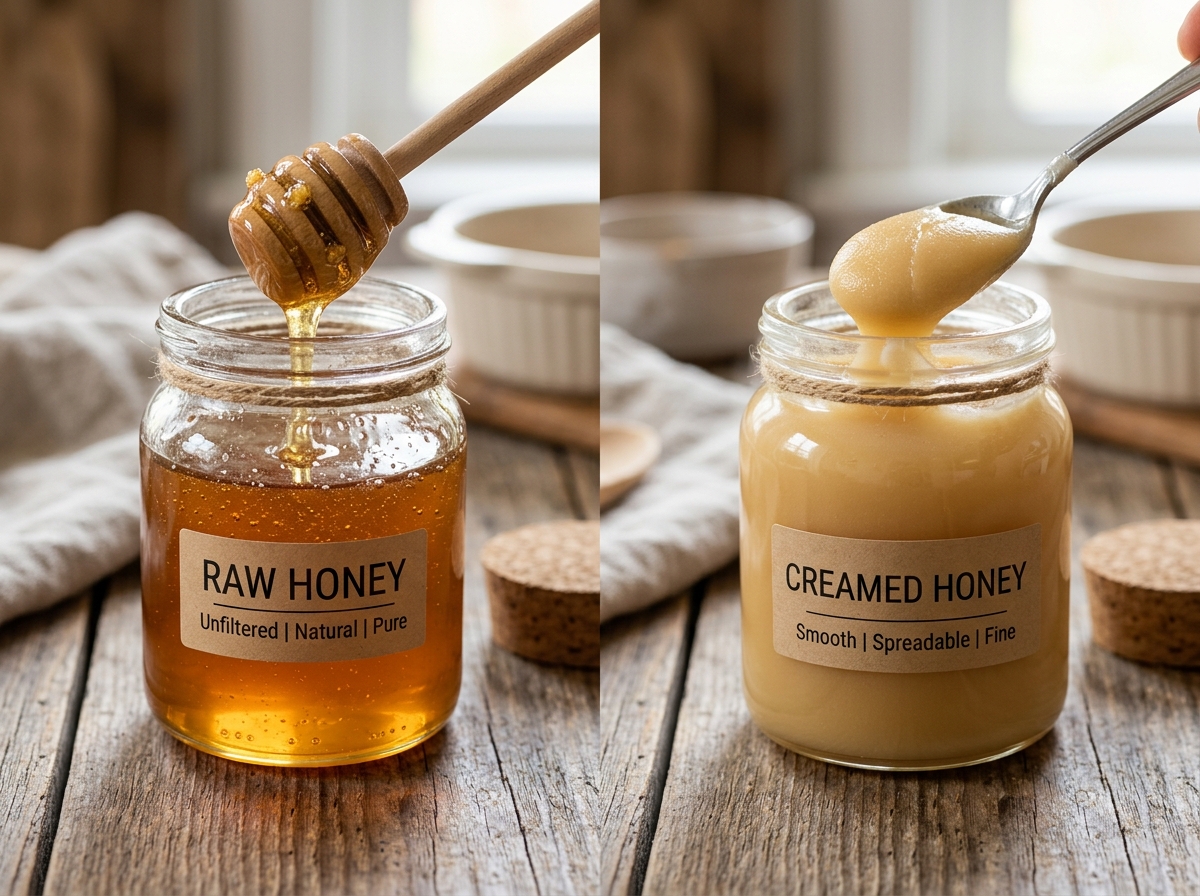
Most people grab a jar of honey off the shelf without thinking twice. It’s honey — how complicated can it be, right? But then you spot two jars sitting side by side. One is that familiar golden liquid. The other is thick, pale, almost butter-like. The label says “creamed honey.” And suddenly you’re standing in the aisle wondering if someone actually blended cream into honey.
They didn’t. No dairy involved. But the differences between creamed honey and raw honey go deeper than just looks. They differ in texture, how they’re made, how they behave in your kitchen, and even how they sit on your tongue. If you’ve been curious about which one deserves space in your pantry — or if one is genuinely “better” than the other — this is the breakdown you need.
What Exactly Is Raw Honey?
Raw honey is honey in its most natural state. Bees make it, beekeepers harvest it, and it goes through minimal processing — usually just straining to remove bits of wax and debris. That’s it. No pasteurization, no heavy filtering, no added sugars.
Because raw honey skips the heating process that commercial honey goes through, it retains things like pollen, propolis, enzymes, and antioxidants. That’s a big deal for people who buy honey specifically for its health properties. The enzymes in raw honey — like glucose oxidase and diastase — are heat-sensitive. Once you pasteurize honey at high temperatures (around 145°F or higher), those enzymes start breaking down.
Raw honey looks different from the ultra-clear, syrupy stuff you see in squeeze bottles at the grocery store. It’s often cloudier, sometimes has tiny particles floating in it, and will almost always crystallize over time. That crystallization isn’t a flaw — it’s actually a sign that your honey hasn’t been over-processed. All real honey crystallizes eventually. The speed depends on the floral source. Clover honey crystallizes faster than, say, acacia honey because of its higher glucose-to-fructose ratio.
If you’ve ever opened a jar of raw honey that’s been sitting in your cabinet for a few months and found it grainy or solid at the bottom, that’s natural crystallization doing its thing. The honey is still perfectly fine to eat. You can gently warm the jar in warm water to re-liquify it.
One thing worth knowing: the term “raw” isn’t officially regulated by the FDA in the United States. There’s no legal standard that defines what “raw honey” means on a label. So quality varies from brand to brand. Your best bet is buying from a local beekeeper or a brand that’s transparent about its sourcing and processing. If you’re curious about how specific regional honeys stand out, check out what makes Arkansas wildflower honey unique — the floral sources genuinely change the flavor and character of the honey.
What Exactly Is Creamed Honey?
Creamed honey goes by a lot of names — whipped honey, spun honey, churned honey, honey butter (confusingly, since there’s no butter in it). Whatever you call it, creamed honey is still 100% real honey. Nothing is added. Nothing is removed.
So what makes it different? The texture. And that texture comes from a process called controlled crystallization.
Here’s how it works. All honey naturally wants to crystallize. When it does on its own, the crystals are usually large and gritty — not exactly pleasant to spread on toast. Creamed honey is made by taking liquid honey and mixing in a small amount of already-crystallized honey (called a “seed”). This seed honey has very fine, smooth crystals. When you blend it into liquid honey and store the mixture at a cool temperature (around 55–57°F), those tiny seed crystals act as a template. The rest of the honey crystallizes around them, forming the same small, uniform crystal structure.
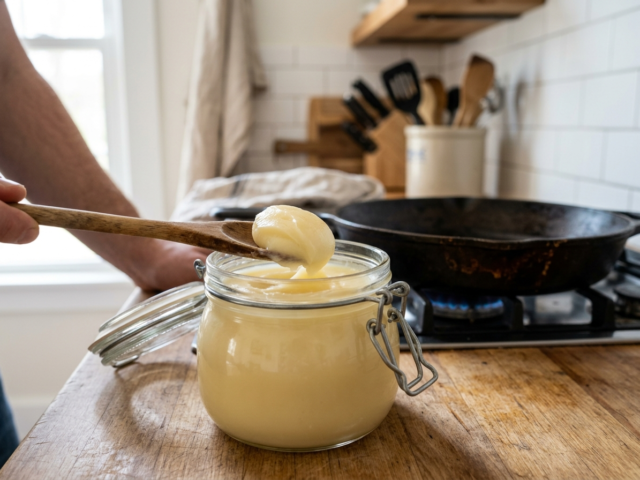
The result? A thick, spreadable honey with a texture closer to soft butter or frosting. It’s smooth on the tongue, doesn’t drip, and holds its shape on a spoon.
The process was popularized by Elton J. Dyce, a professor of apiculture at Cornell University, back in 1935. He developed what’s now known as the Dyce method, and it’s still the standard technique most producers use today. Before Dyce’s method, honey that crystallized naturally was seen as a defect — something customers would return. His innovation turned crystallization from a problem into a product.
Did you know? Creamed honey is wildly popular in Canada and across Europe. In many European countries, the spreadable form is actually preferred over liquid honey. It’s really only in the US where liquid honey dominates the market.
If you want a deeper look at what creamed honey is and why it’s gained such a following, that guide covers everything from its history to how artisan producers approach it differently.
How Do They Compare on Texture and Taste?
This is where you’ll notice the biggest difference the moment you open both jars.
Raw honey (in its liquid state) pours. It drips. It’s sticky and flows freely, especially at room temperature. The flavor can range from light and floral to deep and almost molasses-like, depending entirely on what flowers the bees visited. A jar of raw clover honey tastes nothing like a jar of raw buckwheat honey.
Creamed honey, on the other hand, sits still. You scoop it. It spreads like soft cream cheese. The texture is velvety — almost like a thick mousse. And interestingly, the creaming process seems to mellow the flavor slightly. The sweetness feels smoother and less sharp compared to the same honey in liquid form. Some people describe it as having an almost caramel-like quality, even though nothing’s been added.
Here’s something most articles won’t tell you: the flavor of creamed honey depends entirely on the raw honey it was made from. If a producer starts with wildflower honey, the creamed version carries those same floral notes — just in a softer, smoother delivery. You’re not choosing between quality levels. You’re choosing between formats.
Think of it like this: raw liquid honey is like freshly squeezed orange juice. Creamed honey is like a smoothie made from the same oranges. Same fruit, same nutrition, different experience.
Nutritional Value: Is One Healthier Than the Other?
This is the question that sparks the most debate, and honestly, the answer might surprise you.
If your creamed honey was made from raw honey — and it wasn’t heated above 95–100°F during the creaming process — the nutritional profile is essentially the same. You’re still getting the same enzymes, the same antioxidants, the same trace minerals (iron, zinc, potassium, calcium), and the same pollen content as the raw source.
The Dyce method, when done properly, relies on cool temperatures and gentle stirring. No extreme heat is involved. That means those heat-sensitive compounds — like the enzyme glucose oxidase, which gives honey its mild antibacterial properties — remain intact.
Where things get tricky is when mass-produced “creamed honey” enters the picture. Some commercial brands heat their honey aggressively before creaming it, which can degrade enzymes and reduce pollen content. Others might start with heavily filtered conventional honey rather than raw honey, which means the nutritional starting point is already lower.
So the real question isn’t “Is creamed honey as healthy as raw honey?” It’s “What kind of honey was used to make the creamed honey, and how was it processed?” A small-batch creamed honey made from local raw wildflower honey is going to be nutritionally comparable to the raw honey itself. A mass-market creamed honey from a brand that doesn’t disclose sourcing? That’s a different story.
Pro Tip: Look for producers who specifically state their creamed honey is made from raw, unfiltered honey. Bonus points if they name the floral source and the region. Transparency on the label is your best friend here.
Both raw and creamed honey contain roughly 60 calories per tablespoon, with about 17 grams of carbohydrates (almost all from natural sugars — glucose, fructose, and a smaller amount of sucrose). Neither is a significant source of protein, fat, or fiber. The health benefits come from the bioactive compounds — flavonoids, phenolic acids, hydrogen peroxide activity — not from macronutrients.
Best Uses: When to Reach for Which Honey
This is where choosing between creamed and raw honey gets practical and kind of fun. Each one shines in different situations.
Raw honey works best when you need it to dissolve or blend. Stirring it into hot tea, drizzling it over yogurt or oatmeal, using it as a glaze for grilled meats, or mixing it into salad dressings — liquid honey integrates smoothly. It also caramelizes beautifully, so it’s a go-to for baking and cooking. If you’re brushing something with honey before it hits the oven or grill, raw liquid honey is your pick.
Speaking of grilling, if you’ve ever made a honey-glazed burger, getting the temperature right matters just as much as the glaze itself. Honey burns fast at high heat, so timing is everything.
Creamed honey is a star when spreading is the goal. On toast, biscuits, pancakes, waffles, bagels — anywhere you’d use butter or jam. Because it doesn’t drip, it stays exactly where you put it. Pair it with a warm spicy chicken sandwich and you’ve got a sweet-heat combination that’s genuinely hard to beat.
Creamed honey also works surprisingly well as a topping for cheese boards. A dollop next to aged cheddar or brie looks elegant and doesn’t run all over the plate. If you’re into cookie baking, you can fold creamed honey into dough for a subtle honey flavor without adding too much liquid to the recipe — something that’s harder to control with liquid honey.
For everyday uses of creamed honey — from stirring it into coffee to using it as a face mask — the possibilities honestly go way beyond the breakfast table.
And here’s a use case people often overlook: packing lunch for kids. Creamed honey doesn’t drip through sandwich bread the way liquid honey does. It stays put. If you’ve ever opened a lunchbox to find honey-soaked, soggy bread, you know exactly why this matters.
Shelf Life and Storage
Both raw and creamed honey have essentially indefinite shelf lives when stored properly. Archaeologists have found honey in Egyptian tombs that’s over 3,000 years old — and still edible. Honey’s low moisture content and acidic pH make it inhospitable to bacteria and mold.
That said, how you store them matters for maintaining quality.
Raw liquid honey should be kept in a sealed container at room temperature. Avoid storing it in the refrigerator — cold temperatures speed up crystallization. If it does crystallize, a warm water bath (not microwaving, which creates hot spots and can overheat sections of the honey) will bring it back to liquid form.
Creamed honey is a bit different. It actually benefits from cooler storage. Many producers recommend keeping it at 50–60°F, which is cooler than most kitchens but warmer than a fridge. A basement, cellar, or cooler pantry shelf works well. If your kitchen runs warm, the fridge is fine — the texture might firm up a little more, but it won’t hurt the honey.
One important note: neither type of honey should ever be given to infants under 12 months old. Honey can contain Clostridium botulinum spores, which an infant’s digestive system isn’t mature enough to handle safely. This applies to all honey — raw, creamed, pasteurized, organic, doesn’t matter.
The Price Difference: Why Creamed Honey Costs More
You’ve probably noticed that creamed honey typically carries a higher price tag than raw liquid honey. There’s a reason for that, and it’s not just marketing.
The creaming process takes time — often 1 to 2 weeks of controlled conditions. The producer needs to prepare a seed batch with the right crystal structure, blend it with liquid honey in precise ratios (usually around 10% seed to 90% liquid honey), stir it periodically, and maintain a specific temperature range throughout. That’s labor, time, equipment, and careful monitoring — none of which is required for simply jarring raw liquid honey.
Small-batch artisan producers spend even more time, because they’re often starting with premium raw honey from specific floral sources. When you combine a high-quality starting ingredient with a labor-intensive process, the price naturally goes up.
Is it worth the premium? That depends on what you value. If you love the spreadable texture and find yourself reaching for it daily on toast or biscuits, the extra few dollars per jar probably pays for itself in enjoyment. If you primarily use honey for cooking or sweetening drinks, raw liquid honey does the job just as well — often at a lower cost.
Can You Make Creamed Honey at Home?
You absolutely can, and the process is simpler than most people expect. You just need two things: a jar of liquid raw honey and a small amount of creamed honey to use as your seed.
Mix about one part creamed honey (seed) with nine parts liquid honey. Stir thoroughly — really work it in so the tiny crystals are distributed evenly throughout. Then seal it up and store it somewhere cool (around 55°F is ideal). Over the next week or two, stir it once a day. Gradually, the entire batch will take on that smooth, spreadable texture.
The tricky part is temperature control. If your environment is too warm, the honey won’t crystallize properly. Too cold, and the crystals can form too quickly and end up coarse. That sweet spot around 55–57°F is key.
If you don’t have any creamed honey to use as a seed, some people use very finely crystallized raw honey that’s been blended smooth. The goal is just to introduce those tiny crystal structures that the rest of the honey can mimic.
Quick Warning: Don’t use pasteurized or heavily processed honey as your base. The filtration and heating process can remove the natural glucose that drives crystallization, and your creamed honey might not set properly.
Which One Should You Actually Buy?
There’s no wrong answer here — just the answer that fits your kitchen, your taste, and how you actually use honey day to day.
Go with raw honey if you mostly use honey in tea, cooking, marinades, dressings, or baking. You want maximum versatility and easy pouring. You prefer a more traditional honey experience and don’t mind occasional crystallization.
Go with creamed honey if you eat honey primarily as a spread. You love it on bread, toast, crackers, or paired with cheese. You want a consistent, smooth texture every time you open the jar. You’re looking for something that feels a little more special — maybe as a gift or a treat.
Or just buy both. Honestly, that’s what many honey enthusiasts end up doing. A jar of raw liquid honey for cooking and sweetening, a jar of creamed honey for the breakfast table. They serve different purposes, and neither one makes the other obsolete.
If hot honey is your thing, you might also want to explore the Urban Slicer Hot Honey Drizzler — it brings a spicy twist to the honey game that pairs exceptionally well with both savory and sweet dishes.
FAQ
Is creamed honey the same as whipped honey?
Yes. Creamed honey, whipped honey, spun honey, and churned honey all refer to the same product — honey that’s undergone controlled crystallization to create a smooth, spreadable texture. No air is actually “whipped” into it like whipped cream. The name varies by region and brand, but the process and result are identical.
Does creamed honey have dairy or cream in it?
No. The name is misleading, but creamed honey contains nothing but honey. “Creamed” refers to the texture — similar to how “cream” is used to describe creamed butter or creamed corn. There’s no milk, butter, or any dairy product involved. It’s safe for people with dairy allergies or those following a vegan diet (though some vegans avoid honey entirely for ethical reasons).
Can crystallized honey be turned into creamed honey?
Sort of, but not exactly. If your raw honey has crystallized with large, gritty crystals, you can blend or food-process it to break those crystals down into smaller ones, producing something similar to creamed honey. The texture might not be as uniformly smooth as honey that was creamed using the Dyce method with a proper seed batch, but it’ll be close. For best results, blend thoroughly and store at a cool temperature to maintain the smooth consistency.
How long does creamed honey last?
Creamed honey lasts just as long as raw liquid honey — essentially indefinitely if stored properly in a sealed container. Over very long periods, the texture might shift slightly (becoming a bit firmer or developing minor graininess), but the honey won’t spoil. Keep it sealed, store it in a cool spot, and it’ll stay smooth and delicious for a long time.
Your Honey, Your Call
At the end of this comparison, the honest truth is that creamed honey and raw honey aren’t really competing with each other. They’re the same ingredient wearing different outfits. One pours. One spreads. One dissolves into your tea. The other sits perfectly on warm toast without dripping down your wrist.
Your best move? Try both. Pay attention to how the honey was sourced and processed — that matters far more than whether it’s liquid or creamed. Look for transparency on the label. Support producers who start with quality raw honey and treat it with respect, whether they’re jarring it as-is or carefully crafting it into a creamy spread.
And the next time you’re standing in that aisle holding two jars, you won’t have to guess. You’ll know exactly what you’re looking at — and exactly which one belongs in your kitchen.