
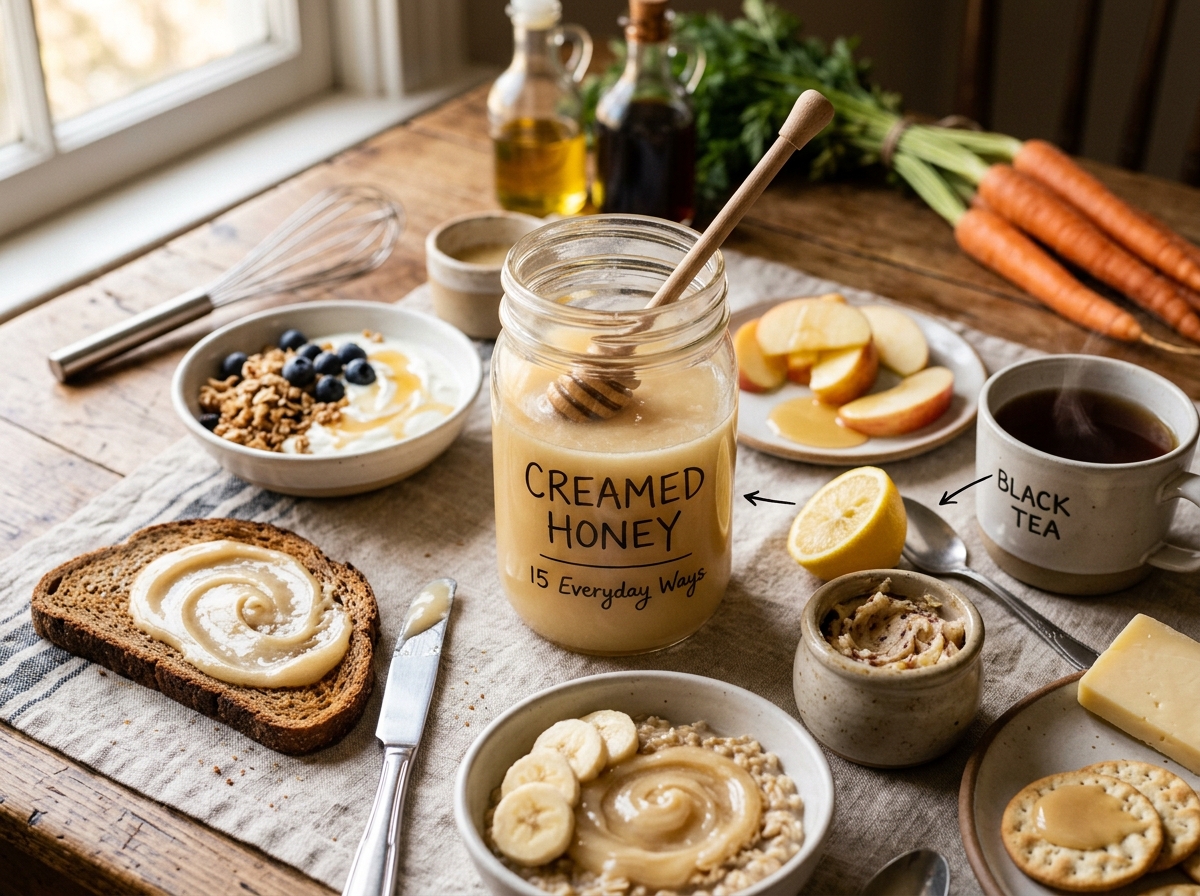
You bought a jar of creamed honey. Maybe someone gifted it to you, or you grabbed it at a farmers’ market because it looked interesting. Now it’s sitting on your counter, and you’re staring at it thinking — what do I actually do with this stuff?
You’re not alone. Most people know regular liquid honey pretty well. Drizzle it in tea, squeeze it on pancakes, done. But creamed honey? That thick, spreadable, almost butter-like texture throws people off. It feels too fancy to just scoop with a spoon, yet too simple to need a recipe.
Here’s the truth: creamed honey is one of the most versatile sweeteners in your kitchen. It doesn’t drip, doesn’t make a mess, and blends into things in ways liquid honey never could. If you’re curious about what creamed honey actually is, that’s a great starting point. But right now, let’s talk about the fun part — using it.
These 15 ideas aren’t fancy chef techniques. They’re everyday, real-life ways to work creamed honey into meals, snacks, drinks, and even your skincare routine. Some will seem obvious. Others might surprise you. All of them actually work.
Why Creamed Honey Works Differently Than Liquid Honey
Before jumping into the uses, it helps to understand why creamed honey behaves the way it does. Regular honey flows. It runs off your toast, pools at the bottom of your bowl, and makes a sticky mess on your counter. Creamed honey doesn’t do any of that.
The texture is controlled crystallization. Tiny crystals are introduced into liquid honey, and over time, those small crystals encourage the rest of the honey to crystallize uniformly. The result? A smooth, velvety spread that stays where you put it.
This isn’t just a cosmetic difference. That thick consistency changes how creamed honey interacts with food. It sits on top of warm bread without soaking through. It blends into cold liquids and batters more evenly. It holds its shape as a glaze. And it doesn’t run off a spoon when you’re trying to measure it.
That consistency is exactly what makes the following 15 uses so practical. If you’ve been wondering about the differences between creamed honey and raw honey, understanding the texture distinction is really the key.
15 Everyday Ways to Use Creamed Honey
1. Spread It on Toast (the Obvious One, but Do It Right)
Yes, this is the most basic use. But there’s a reason everyone starts here — it’s genuinely one of the best ways to enjoy creamed honey. The difference between spreading creamed honey versus drizzling liquid honey on toast is night and day.
With regular honey, you get uneven coverage. Some bites are too sweet, others have nothing. Creamed honey spreads like soft butter. Every single bite gets an even coat.
Pro Tip: Try it on warm sourdough with a pinch of flaky sea salt. The salt-sweet contrast with that tangy bread is something you won’t forget.
You can also layer it. Butter first, then a thin layer of creamed honey on top. It sounds indulgent because it is.
2. Stir It Into Your Morning Coffee or Tea
Here’s where creamed honey has a real advantage over liquid honey. Ever tried putting regular honey in iced coffee? It sinks straight to the bottom and clumps. You stir and stir and it just won’t dissolve.
Creamed honey has smaller crystals, which means it actually disperses more easily into beverages — even cold ones. Drop a spoonful into your iced coffee, give it a good stir, and you’ll get a smooth sweetness throughout.
In hot tea, it melts almost instantly. And because you’re scooping a measured spoonful rather than squeezing a random drizzle, you get more consistent sweetness every time. If you’re someone who tracks sugar intake, that control matters.
3. Use It as a Yogurt Sweetener
Plain yogurt and creamed honey are one of those combinations that feel too simple to be this good. A tablespoon of creamed honey swirled into a bowl of Greek yogurt creates a thick, dessert-like snack with no added processed sugar.
The texture works beautifully here. Because creamed honey is already thick, it creates these little ribbons and pockets of sweetness throughout the yogurt rather than just sweetening the whole thing uniformly. You get bites that are tangy and bites that are sweet, and that contrast keeps things interesting.
Throw some granola on top, maybe a handful of berries, and you’ve got a breakfast that takes about 90 seconds to prepare.
4. Make a Better Peanut Butter Sandwich
Peanut butter and honey is a classic. But if you’ve ever tried making a PB&H sandwich with liquid honey, you know the struggle. The honey seeps through the bread, drips out the sides, and turns the whole thing into a sticky disaster within minutes.
Creamed honey stays put. Spread peanut butter on one slice, creamed honey on the other, press them together, and you’ve got a sandwich that actually holds up. Pack it in a lunchbox and it’ll still be intact four hours later.
You can do the same with almond butter, sunflower seed butter, or any nut butter you prefer. The spreadable consistency of creamed honey makes it a perfect partner for anything else that’s spreadable.
5. Glaze Roasted Vegetables
This is where creamed honey starts showing off in the kitchen. Toss your favorite roasting vegetables — carrots, sweet potatoes, Brussels sprouts, butternut squash — with olive oil, salt, and pepper as usual. Then, during the last 8–10 minutes of roasting, dab spoonfuls of creamed honey over the top.
Because it doesn’t immediately run off like liquid honey, it clings to the vegetables and caramelizes beautifully in the oven’s heat. You get those sticky, golden-brown edges without the honey pooling and burning on the bottom of the pan.
Did you know? Honey caramelizes at a lower temperature than regular sugar, around 300°F (149°C). That’s why it can create that gorgeous glaze without needing extremely high heat.
6. Upgrade Your Cheese Board
If you’ve ever put together a cheese board — whether for guests or just for yourself on a Friday night — creamed honey belongs on it. Place a small jar or a ramekin of creamed honey right alongside your cheeses, crackers, and fruit.
It pairs especially well with sharp aged cheeses like cheddar, gouda, or manchego. The sweetness of the honey balances the sharpness of the cheese in a way that regular honey does too, but the creamed version is easier to spread on a cracker without making a mess.
Your guests can scoop it with a small spoon and spread it directly. No drips on the tablecloth, no sticky cheese knives.
7. Sweeten Oatmeal or Porridge
A bowl of warm oatmeal is practically begging for creamed honey. Drop a spoonful right into the center of your hot oatmeal and let it slowly melt into the grains. The honey becomes this warm, golden swirl that sweetens the oatmeal more gently than brown sugar.
The flavor profile is different from regular sweeteners too. Depending on the floral source — wildflower, clover, orange blossom — your creamed honey will bring a subtle complexity that plain white sugar simply can’t offer. Speaking of floral sources, Arkansas wildflower honey is one variety that brings a particularly interesting flavor to your morning bowl.
8. Mix It Into Salad Dressings
Making salad dressing at home is faster than most people think, and creamed honey makes it even easier. A basic honey vinaigrette is just olive oil, vinegar, mustard, salt, pepper, and honey. With liquid honey, you have to whisk aggressively to get it to emulsify properly.
Creamed honey blends in much more smoothly. Its softer texture integrates with olive oil and vinegar without separating as quickly. Try this ratio as a starting point: 3 tablespoons olive oil, 1 tablespoon apple cider vinegar, 1 teaspoon Dijon mustard, 1 tablespoon creamed honey, salt and pepper to taste. Whisk or shake in a jar. Done.
It also works wonderfully in Asian-inspired dressings. Mix creamed honey with soy sauce, rice vinegar, sesame oil, and a bit of grated ginger. Pour it over a slaw or noodle salad and you’ll wonder why you ever bought bottled dressing.
9. Bake With It
You can substitute creamed honey for liquid honey in virtually any baking recipe at a 1:1 ratio. The texture difference doesn’t matter once it’s heated — it melts and behaves the same way in the oven.
Where creamed honey actually has an edge is in no-bake recipes. Energy balls, for example. You know those snack balls made with oats, nut butter, chocolate chips, and honey? Liquid honey makes the mixture sloppy and hard to roll. Creamed honey acts more like a binder. The mixture holds together better, rolls into neater balls, and doesn’t leave your hands coated in sticky residue.
If you enjoy baking projects like perfecting cookies from a mix, try swapping in creamed honey for part of the sugar. It adds moisture and a floral note that standard sugar doesn’t bring to the table.
10. Make a Quick Honey Butter
Honey butter is popular at restaurants, especially alongside warm biscuits or cornbread. Making it at home takes about two minutes with creamed honey.
Take softened butter and mix it with creamed honey at roughly a 2:1 ratio — two parts butter, one part honey. Add a tiny pinch of salt. Stir it together with a fork until smooth. That’s it. You now have honey butter.
You can roll it in plastic wrap into a log shape and refrigerate it. Slice off rounds whenever you want some. It keeps for weeks in the fridge.
Because creamed honey is already thick, it incorporates into the butter without creating the watery separation you sometimes get with liquid honey. The finished butter stays smooth and consistent.
11. Drizzle It on Pizza (Seriously)
Hot honey on pizza has been trending for years, and creamed honey gives you a slightly different — but equally delicious — take on it. Warm a few spoonfuls of creamed honey gently (just a quick 15 seconds in the microwave) so it becomes drizzle-able, then add a pinch of red pepper flakes. Spoon it over a freshly baked pizza.
It works best on pizzas with salty, savory toppings. Think pepperoni, soppressata, or prosciutto. The sweet-salty-spicy combination hits every taste receptor. If you’re someone who enjoys hot honey drizzle concepts, you’ll appreciate how easy it is to make your own version with creamed honey and chili flakes.
12. Sweeten Smoothies Without the Mess
Adding liquid honey to a blender can be annoying. It sticks to the measuring spoon, clings to the sides of the blender, and doesn’t always blend evenly — especially in cold smoothies with frozen fruit.
Creamed honey scoops cleanly off a spoon. Drop it in, blend, and it distributes evenly through the smoothie. One tablespoon is usually enough for a standard-sized smoothie. Because you’re measuring a solid scoop rather than pouring a liquid, you tend to use less and keep the sugar content down.
13. Use It as a Face Mask Ingredient
This one might catch you off guard, but honey has been used in skincare for thousands of years. Raw honey has natural antibacterial and humectant properties, meaning it helps skin retain moisture. Creamed honey works for this purpose too — and the thick texture makes it much easier to apply to your face than runny liquid honey.
Scoop about a tablespoon, spread it directly on clean skin, and leave it for 10–15 minutes. Rinse with warm water. Your skin will feel soft and hydrated.
Some people mix creamed honey with a little ground oatmeal or turmeric powder for added benefits. Just patch-test first if you have sensitive skin.
Quick note: This isn’t a replacement for medical skincare advice. If you have a specific skin condition, talk to a dermatologist. But as a simple, occasional home treatment? Creamed honey does a genuinely nice job.
14. Pair It With Grilled Meats as a Finishing Glaze
Honey-glazed meats are nothing new. But applying liquid honey during grilling often leads to burning because the sugars caramelize too fast and drip into the flames.
Creamed honey gives you more control. You can brush it onto chicken, pork chops, or even grilled salmon during the last two to three minutes of cooking. The thicker consistency means it stays on the surface of the meat instead of dripping through the grill grates.
Mix creamed honey with a bit of soy sauce, garlic, and black pepper for a quick glaze that works on almost any protein. If you’re already comfortable with the grill — say you’ve mastered how long to grill burgers at the right temperature — adding a honey glaze to other meats is a natural next step.
15. Eat It Straight Off the Spoon
No recipe. No pairing. No technique. Just open the jar, grab a spoon, and eat it.
This sounds almost too simple to list, but honestly? It’s one of the most satisfying ways to enjoy creamed honey. The texture is smooth and creamy. The flavor is concentrated and floral. A single spoonful feels like a small treat without the guilt of raiding the cookie jar.
Keep a jar at your desk. When that 3 p.m. energy dip hits, a spoonful of creamed honey gives you a quick, natural sugar boost. It’s about 60 calories per tablespoon and contains trace amounts of enzymes, antioxidants, and minerals.
Some people eat a spoonful before a workout for quick energy. Others have it before bed as a small dessert. There’s no wrong time for it.
Storing Creamed Honey So It Stays Perfect
A quick word on storage, because this trips people up. Creamed honey doesn’t need to be refrigerated. Room temperature is ideal — somewhere around 60–70°F (15–21°C). Keeping it too warm can cause it to soften excessively and eventually separate. Keeping it too cold makes it rock-hard and difficult to scoop.
A kitchen pantry or cupboard away from direct sunlight is perfect. And good news: creamed honey has an extremely long shelf life. Honey in general doesn’t spoil. Archaeologists have found 3,000-year-old honey in Egyptian tombs that was still edible. Your jar on the counter will be just fine for months.
If you notice the texture changing or the surface darkening slightly, that’s normal. Just give it a stir.
What Makes Creamed Honey Different From Other Specialty Honeys
You might see creamed honey sitting next to other specialty options — whipped honey, spun honey, churned honey. These are all essentially the same product. The names vary by brand and region, but the process is identical: controlled crystallization to create a smooth, spreadable texture.
Where things genuinely differ is in the floral source and the origin. A creamed clover honey from the Midwest will taste different from a creamed wildflower honey from Arkansas, which will taste different from a creamed orange blossom honey from Florida. Each brings its own character.
If you enjoy exploring these differences, trying multiple varieties is part of the fun. Start with whatever’s available locally and branch out from there.
FAQ
Can I use creamed honey the same way I use regular honey?
Yes, in almost every situation. Any recipe calling for honey can use creamed honey instead, at the same amount. The only difference is texture before heating — once warmed, creamed honey melts and behaves just like liquid honey. For cold applications like spreading, stirring into cold drinks, or mixing into no-bake recipes, creamed honey actually works better because it blends more evenly.
Does creamed honey have the same health benefits as raw honey?
If your creamed honey was made from raw honey (check the label), then yes — it retains the same enzymes, antioxidants, and trace minerals. The creaming process doesn’t involve high heat, so the beneficial properties aren’t destroyed. The main thing to watch for is heavily processed versions that may have been heated during manufacturing. Look for labels that say “raw” or “unpasteurized.”
How long does creamed honey last after opening?
Practically indefinitely, if stored properly. Honey is naturally antibacterial and has an incredibly low moisture content, which prevents spoilage. Keep the lid on, use a clean spoon each time, and store it at room temperature. You’ll likely finish the jar long before freshness becomes a concern.
Can I turn regular honey into creamed honey at home?
You can, but it takes patience. The basic method involves mixing a small amount of already-creamed honey (called “seed honey”) into liquid honey at a ratio of about 1:10. Stir thoroughly, then store the mixture at a cool temperature (around 57°F / 14°C) for one to two weeks, stirring daily. The seed crystals encourage the rest of the honey to crystallize into the same smooth texture. It’s a fun project, but buying a ready-made jar is far simpler for most people.
Your Jar Is Waiting
You don’t need to be a chef or a food blogger to get the most out of creamed honey. It’s a straightforward ingredient that fits into routines you already have — breakfast, snacks, cooking, even skincare. The 15 ideas above are starting points, not limits.
Pick two or three that sound good to you and try them this week. Spread it on your morning toast tomorrow. Stir a spoonful into your coffee on Wednesday. Make that honey butter over the weekend.
Once you start using creamed honey regularly, you’ll probably find your own favorite ways that aren’t even on this list. That jar on your counter won’t last as long as you think.