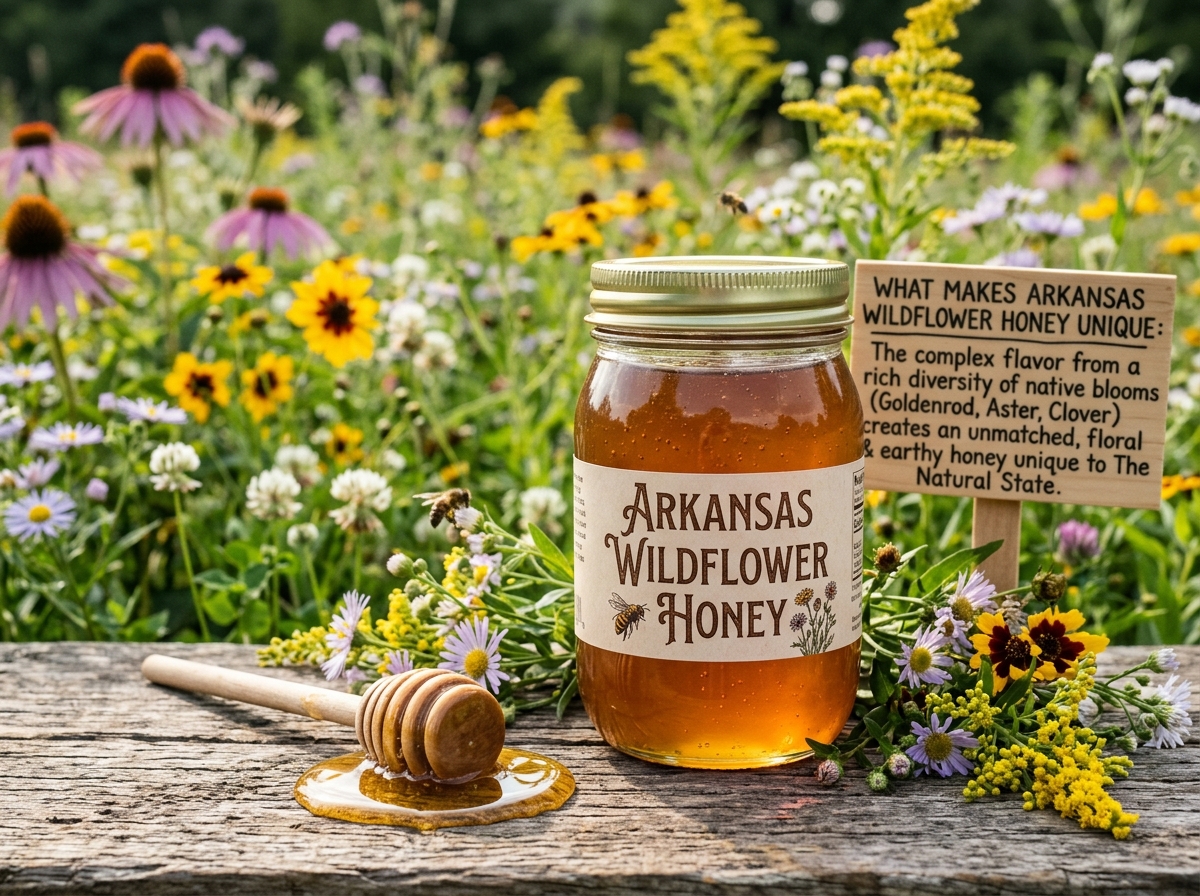
Most honey on grocery store shelves comes from a single flower source — clover, orange blossom, buckwheat. You know exactly what you’re getting before you even open the jar. Arkansas wildflower honey doesn’t work that way.
Open a jar from the Ozark Mountains or the Arkansas River Valley, and you’re holding something that no beekeeper fully controls. The flavor shifts with the season. The color changes from one batch to the next. Even the aroma tells a different story depending on which meadow the bees decided to visit that week.
That unpredictability isn’t a flaw — it’s the whole point.
Arkansas sits at a remarkable crossroads of ecosystems, where Ozark hardwood forests, Gulf Coastal Plain wetlands, and rolling river valleys meet. The botanical diversity that comes out of that mix feeds some of the most complex honey you’ll find anywhere in the American South. And once you understand why that is, you’ll never look at a jar of supermarket honey the same way again.
Why Arkansas Is Exceptional Bee Country
The Geography Does Most of the Work
Arkansas covers six distinct ecological regions, which is genuinely unusual for a mid-sized state. You have the Ozark Plateau in the northwest, the Ouachita Mountains cutting east to west through the center, the Arkansas River Valley nestled between them, and the lowland Delta stretching toward the Mississippi. Each of these regions supports different plant communities, which means different nectar sources for bees.
The Ozarks alone host over 2,600 native plant species. Many of these — wild bergamot, black-eyed Susan, purple coneflower, native clovers — are prime nectar producers. Bees working the Ozark highlands in late spring are drawing from a completely different palette than bees working the Delta bottomlands in early summer.
This geographic layering is exactly what makes Arkansas wildflower honey so variable and so interesting. A beekeeper in Fayetteville and a beekeeper in Pine Bluff are producing honey from the same state but practically from different worlds.
The Climate Extends the Bloom Season
Arkansas has a long growing season — roughly 200 to 250 frost-free days depending on elevation. That stretch of warm weather means nectar flows that would be impossible further north. Spring blooms arrive early, summer wildflowers push through the heat, and fall asters and goldenrod keep colonies productive well into October.
That extended season doesn’t just mean more honey. It means honey that captures multiple successive bloom cycles, often blending their flavors in ways that single-origin honeys simply can’t replicate.
What “Wildflower Honey” Actually Means
It’s Not a Single Source — That’s the Idea
Wildflower honey, technically called polyfloral honey, comes from bees visiting multiple different flowering plants rather than being managed to work a single crop. Beekeepers who produce monofloral honey — like tupelo honey in the Florida Panhandle — carefully time their hive placements and sometimes move bees to take advantage of a specific bloom. Wildflower production is the opposite of that. The bees roam, they choose, and the resulting honey reflects whatever was blooming in their foraging radius at that time.
For Arkansas wildflower honey, that radius typically spans two to three miles from the hive — and within that circle, a bee might visit dozens of different flowering species in a single day.
Why the Flavor Complexity Comes From This
Each flower’s nectar has its own sugar ratios, mineral content, enzymes, and aromatic compounds. When bees blend these sources in the hive, they’re essentially creating a flavor composition that no human could deliberately engineer. The resulting honey carries traces of everything — the slightly spicy warmth of wild bergamot, the gentle tartness of clover, the earthy depth of goldenrod, sometimes a faint fruitiness from blackberry canes along creek edges.
Tasting Arkansas wildflower honey slowly — like you’d sip a good wine — you’ll often notice the flavor shift as it moves across your palate. That’s not an accident. It’s chemistry.
The Native Nectar Sources That Shape the Flavor
Spring Contributors
The first major nectar flow in Arkansas typically begins in late March and runs through May. During this window, bees are working:
- Redbud (Cercis canadensis) — Arkansas’s state tree, producing nectar with a mild floral sweetness
- Tulip poplar (Liriodendron tulipifera) — one of the most significant nectar sources in the Ozarks, known for producing a darker, more robust honey
- Native clovers — various species provide clean, sweet nectar that forms a foundational background note
- Blackberry and dewberry — common along roadsides and forest edges, contributing a subtle fruity quality
Spring batches of Arkansas wildflower honey tend to be lighter in color and mildly sweet, with a clean floral character.
Summer Contributors
By June and July, the composition shifts. Bees are now pulling heavily from:
- Sourwood (Oxydendrum arboreum) — primarily an Ozark and Ouachita species, this tree produces nectar that honey judges consistently rate as exceptional; sourwood honey on its own is prized across Appalachia, and even trace amounts influence a wildflower batch
- Wild bergamot and bee balm — aromatic native mints that add a faintly herbal complexity
- Purple coneflower (Echinacea) — common in open meadows throughout the state
- Milkweed species — important ecologically for pollinators, also a good nectar source
Summer batches run darker, sometimes amber to deep gold, with a richer, more complex flavor profile.
Fall Contributors
Late season blooms keep Arkansas hives productive through September and October:
- Goldenrod (Solidago spp.) — produces abundantly, contributing a distinctly earthy, sometimes pollen-heavy character; goldenrod honey has an almost buttery quality
- Asters — multiple native species, lending a mild, slightly sharp flavor
- Smartweed and knotweed along waterways
Fall Arkansas wildflower honey is often the darkest of the year, with the most assertive flavor. It’s the batch that surprises people expecting something mild and sweet.
How Seasonal Batching Affects What You Buy
Here’s something worth understanding if you’re shopping for Arkansas wildflower honey: the jar labeled “wildflower honey” tells you very little without knowing when it was harvested.
A reputable Arkansas beekeeper will often sell spring, summer, and fall harvests separately — or blend them deliberately for a balanced year-round product. When you see a single batch labeled by season or harvest date, that’s a sign the beekeeper pays attention to these differences.
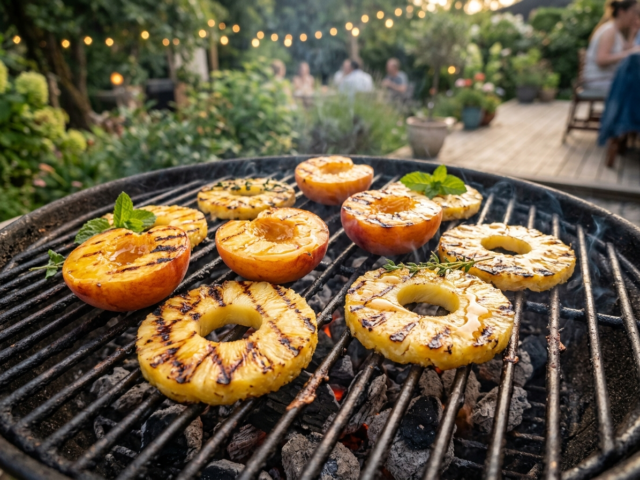
A spring batch will pair well with mild cheeses, yogurt, or drizzled over fruit. A summer batch handles bolder pairings — charcuterie, sharp cheddar, grilled meats. A fall batch, dark and assertive, is the one you want stirred into a strong tea or used in baking where its depth can hold its own.
Pro Tip: If you’re buying from a local Arkansas beekeeper at a farmers market, ask which bloom period the honey came from. That single question will tell you immediately whether they know their product.
Raw vs. Processed: Why It Matters Even More for Wildflower Honey
Most large-scale commercial honey gets heated and ultra-filtered before it hits store shelves. This extends shelf life, prevents crystallization, and creates a uniform, clear appearance. It also strips out most of the pollen, beeswax particles, enzymes, and volatile aromatic compounds that give wildflower honey its character.
For a single-source commercial honey, you’re mostly losing texture and some nutritional value. For wildflower honey, you’re losing a significant portion of what makes it wildflower honey. The very compounds that carry the floral complexity — those aromatic molecules from bergamot, sourwood, and goldenrod — are heat-sensitive and largely destroyed during processing.
Raw Arkansas wildflower honey, by contrast, is either unheated or minimally warmed (below 118°F / 47°C) just enough to allow straining. It keeps its pollen load, its natural enzymes, and — most importantly — its flavor integrity.
Raw honey also crystallizes faster. Don’t be alarmed when it does. Crystallization doesn’t mean the honey has gone bad; it means the glucose content is high enough to naturally solidify over time. You can learn more about the difference between creamed honey and raw honey to understand how that process actually works — because creamed honey is essentially crystallization done with intention and control.
The Ozark-Specific Advantage
Why Ozark Wildflower Honey Gets Its Own Reputation
Among honey enthusiasts, Ozark wildflower honey — specifically from the Arkansas Ozark Plateau — has developed a regional reputation somewhat like Appalachian sourwood honey or Pacific Northwest blackberry honey. It’s not officially designated or protected the way European honeys can be under PDO status, but among serious honey buyers and regional food writers, the distinction is real.
The reason is the Ozark forest itself. This highland plateau escaped glaciation during the last ice age, which means it retained an unusually diverse native plant community that’s been developing in relative isolation for thousands of years. That botanical age and diversity shows up in the nectar, and the nectar shows up in the honey.
Beekeepers who’ve worked hives in both the Ozarks and the Delta lowlands will often describe the Ozark honey as having a more complex, layered character — less straightforwardly sweet, more nuanced. The Delta honey tends to run lighter and milder, reflecting the different floral community there.
The Role of Forested Terrain
Open farmland honey — bees working soybean fields or commercial clover — tends to be simple. There’s nothing wrong with that, and it’s often very good. But forested terrain forces bees to work harder and range more widely, tapping into dozens of understory species that don’t exist in agricultural settings.
Arkansas’s mixed hardwood forests contain a remarkable understory: redbud, serviceberry, wild plum, native azaleas, and dozens of herbaceous species that bloom in the dappled light beneath the canopy. Bees working these forests are gathering nectar from plants that commercial beekeeping operations rarely encounter. That’s the flavor difference you taste.
What to Look For When Buying Arkansas Wildflower Honey
Not every jar labeled “Arkansas wildflower honey” represents what we’ve been describing. The label tells you the state of origin, but it doesn’t tell you whether the honey is raw, how it was processed, or whether the beekeeper is actually running hives in biodiverse terrain versus placing them near monoculture fields.
Here’s what separates genuinely distinct Arkansas wildflower honey from the generic stuff:
Color variation between batches is a good sign. If every jar from a given producer looks identical year after year, they’re either blending heavily or processing aggressively. Natural variation in color and consistency signals honest production.
Local farmers markets and small-batch producers are the most reliable source. Arkansas has a strong local honey culture, particularly in the Ozark region — towns like Eureka Springs, Fayetteville, Bentonville, and Mountain Home have regular markets where beekeepers sell directly.
Ask about the apiary location. A hive placed near Ozark National Forest or the Buffalo National River corridor is going to produce something quite different from hives near agricultural land in the Arkansas River Valley. Neither is better necessarily, but knowing where the bees are tells you something real about what’s in the jar.
If you enjoy wildflower honey on a sweeter, more spreadable note, it’s also worth knowing that creamed honey made from wildflower honey captures all the same flavor complexity in a texture that’s easier to spread on bread or biscuits — something a lot of people find preferable for everyday use.
FAQ
Q: Is Arkansas wildflower honey the same thing every time you buy it?
No, and that’s intentional. Because bees are pulling from dozens of different flowering plants across changing seasons, the flavor, color, and aroma naturally shift between harvests. A spring batch tends to be lighter and milder. A fall batch runs darker with more depth. This variability is what makes wildflower honey interesting, not a quality control problem. If you want absolute consistency, single-origin honeys are the better choice. If you want complexity, wildflower is it.
Q: Why does Arkansas wildflower honey crystallize so quickly?
All raw honey crystallizes eventually — it’s a natural process driven by the glucose-to-fructose ratio in the honey. Wildflower honeys that draw heavily from goldenrod, clover, and other high-glucose sources will crystallize faster than honeys like tupelo, which have a higher fructose content. Crystallization doesn’t affect quality at all. You can warm the jar gently in a bowl of warm water to re-liquefy it, or simply use it in its crystallized form, which spreads well and actually has a slightly mellower flavor.
Q: What makes Arkansas wildflower honey different from honey produced in neighboring states like Tennessee or Missouri?
The difference comes down to the specific combination of ecosystems Arkansas sits within. Tennessee and Missouri also have diverse landscapes, but Arkansas’s particular mix of Ozark highlands, Ouachita mountain terrain, and Gulf Coastal Plain lowlands creates a botanical combination found nowhere else. Specific nectar contributors like sourwood (more prominent in Ozark and Ouachita elevations), Delta wetland plants, and river valley wildflowers give Arkansas honey a flavor profile that reflects this unique overlap. It’s similar to how wine from neighboring appellations can taste distinctly different even though they share a grape variety — terrain and plant community matter.
Q: Can Arkansas wildflower honey be used the same way as regular honey?
Yes, entirely. It works in every application standard honey does — sweetening tea or coffee, drizzling over food, baking, marinades, and glazes. Where wildflower honey earns its place is in applications where you actually want to taste the honey. A thick drizzle over good biscuits, paired with a strong cheese, or stirred into plain yogurt — these let the flavor complexity show. In baking where honey is one of many ingredients, the nuance gets mostly lost. Use it where it can be the star.
The Jar Is Just the Beginning
Arkansas wildflower honey is the kind of food that rewards slowing down. It’s not complicated to enjoy — you don’t need a refined palate or any particular knowledge. But the more you pay attention to it, the more you notice.
The fact that no two batches are identical is the whole story. It’s honey that reflects a specific piece of land, a specific season, and the choices of thousands of bees over weeks of foraging. That’s not something any industrial process can replicate, and it’s not something you’ll find in a supermarket squeeze bottle.
If you haven’t tried it yet, start with a small-batch raw version from a local Arkansas producer. Taste it on its own first — just a small spoonful. Then decide how you want to use it. Chances are, you’ll be thinking about it long after the jar is empty.