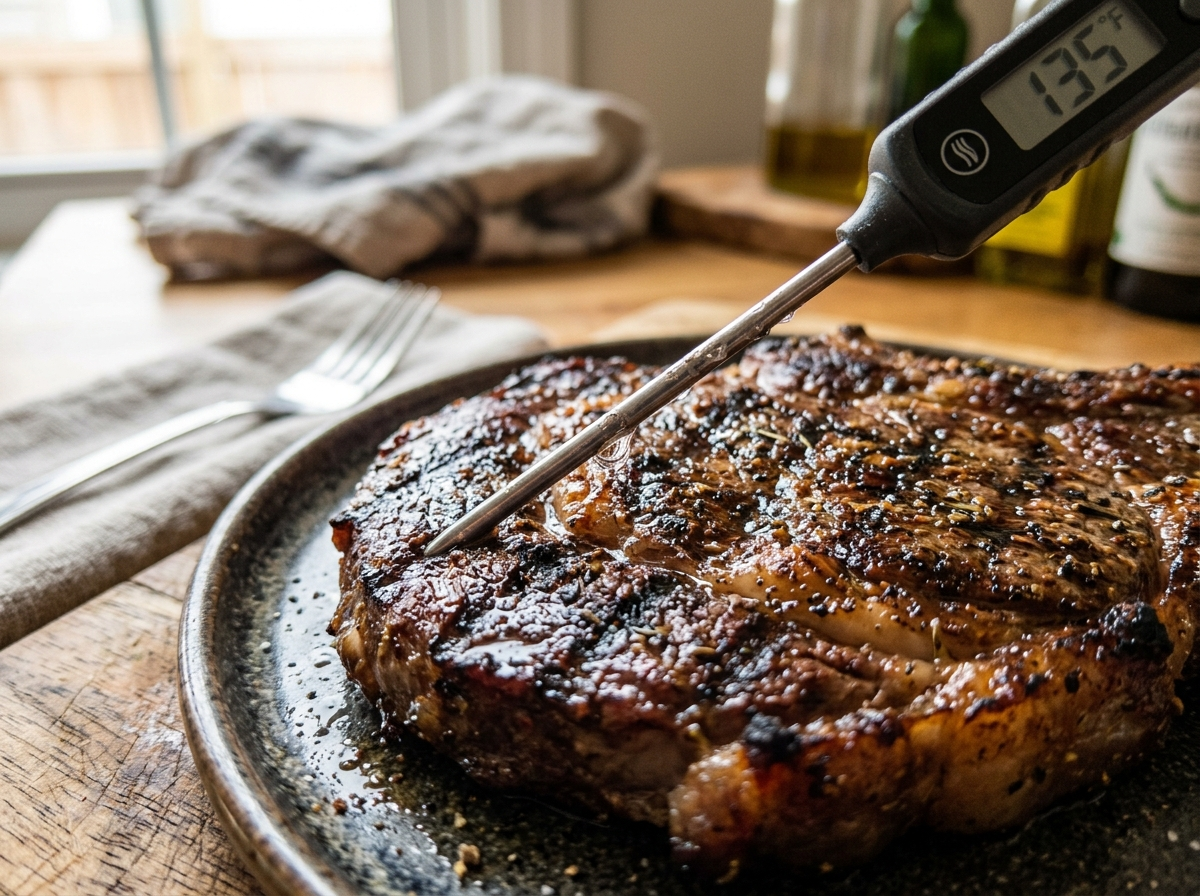
You’re standing over the grill, tongs in one hand, thermometer in the other. The steak looks perfect. But then that little voice creeps in — the one your uncle planted at every family cookout: “Don’t poke it! You’ll let all the juices out!” So you hesitate. You guess. You cut into it. And sure enough, it’s overcooked.
Sound familiar?
The idea that sticking a thermometer into meat will drain it dry is one of the most stubborn beliefs in home cooking. It gets passed down like a family recipe, except this one actually makes your food worse. Let’s clear this up once and for all so you can stop guessing and start cooking with confidence.
The Short Answer: No, a Thermometer Won’t Drain Your Meat
Here’s the one-sentence version you can tell your uncle at the next barbecue: poking meat with a thermometer probe causes a negligible amount of juice loss — so small that it has zero noticeable effect on how moist your food tastes.
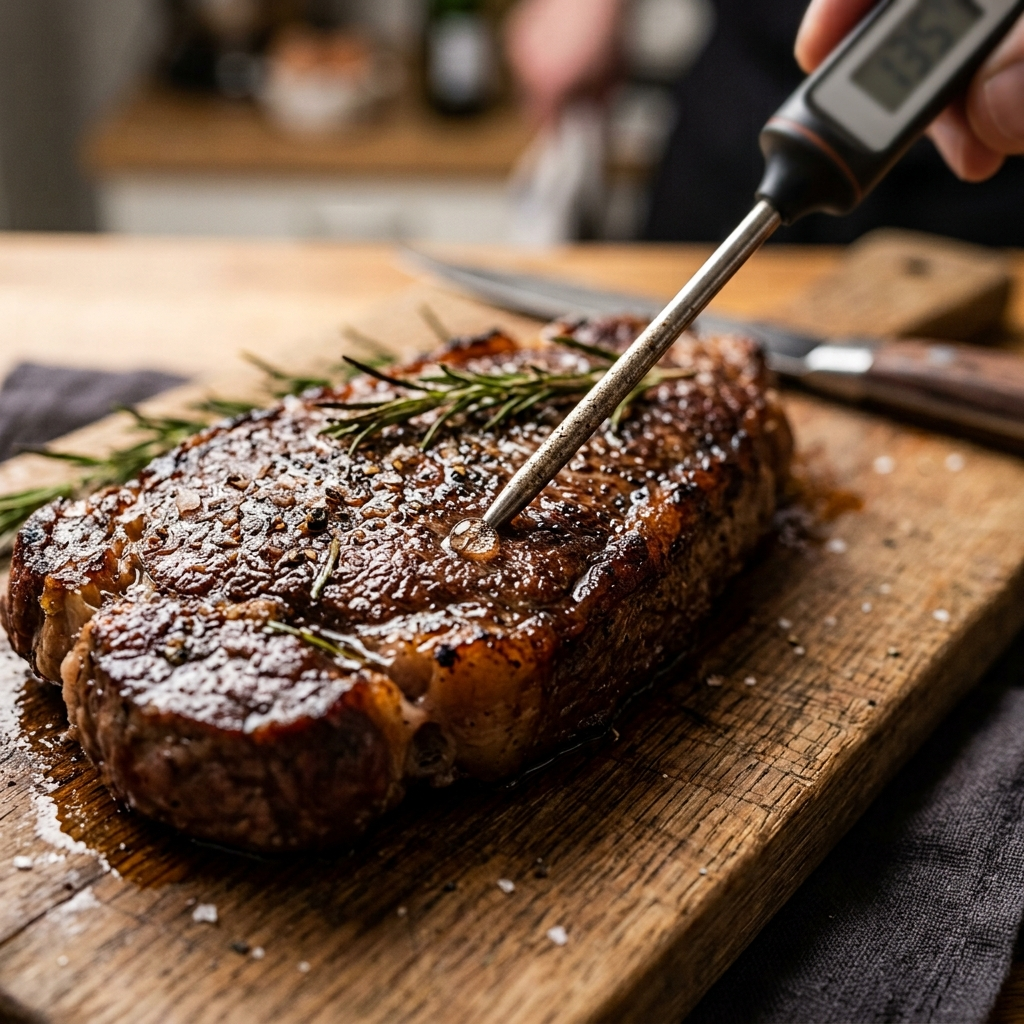
A standard instant-read thermometer probe is about 1-2 millimeters in diameter. That’s roughly the width of a thick sewing needle. When you slide it into a steak, chicken breast, or pork chop, the muscle fibers part around the thin metal shaft and mostly close back up when you pull it out. The tiny bead of moisture you might see on the surface afterward is a fraction of a teaspoon at most.
To put that in perspective, a single steak can lose 15-25% of its total moisture just from the heat of cooking. The amount that escapes through a thermometer hole is a rounding error by comparison. Food scientist and author J. Kenji López-Alt tested this extensively for his book The Food Lab and found that the juice loss from a thermometer probe was so minimal it couldn’t be measured on a standard kitchen scale.
So go ahead. Poke your meat. Check the temp. Your steak will thank you.
Why Do So Many People Believe This Myth?
If the science is this clear, why does the “don’t poke the meat” rule refuse to die? A big part of it comes down to mixing up two very different kitchen tools.
The Fork vs. Thermometer Confusion
Most people who warn against poking meat aren’t actually thinking about a thin thermometer probe. They’re thinking about a fork. And honestly, they have a point about the fork — just not for the reason they think.
Stabbing a steak repeatedly with a carving fork does create larger holes, and it can squeeze the meat in a way that pushes some moisture toward the surface. But even then, the moisture loss from fork-poking is tiny compared to the moisture lost from overcooking. The real problem with the fork isn’t the holes — it’s that using a fork usually means you’re not using a thermometer, which means you’re guessing at doneness, which means you’re probably overcooking the meat.
The thermometer myth piggybacks on the fork myth. Someone said “don’t poke it with a fork,” and over the years that morphed into “don’t poke it with anything.” But a thermometer probe and a fork tine are completely different tools doing completely different things. One is a thin, smooth needle. The other is a thick, sharp prong designed to grip and tear.
What Actually Happens Inside the Meat When You Insert a Probe
To understand why the juice loss is so small, it helps to know a little about what’s going on inside a piece of meat at the structural level.
Meat is made up of bundles of muscle fibers wrapped in connective tissue, and those fibers are packed with water. When you heat meat, the muscle fibers contract and squeeze that water out — kind of like wringing a wet towel. The hotter the meat gets, the tighter the fibers squeeze, and the more moisture gets pushed out. This is the primary mechanism behind moisture loss in cooking, and it has nothing to do with whether you poked a hole in the surface.
When you slide a thin thermometer probe into the meat, you’re parting those fibers, not cutting through them. Think of it like pushing a chopstick through a bundle of uncooked spaghetti. The strands move aside. They don’t snap. And when you remove the probe, the fibers relax back into place, especially if the meat is still warm and pliable.
The Tiny Bead of Moisture You See
You might notice a small drop of liquid on the surface where the probe went in. That’s real, and I won’t pretend it isn’t there. But here’s what I’ve noticed after years of checking temperatures on everything from weeknight chicken thighs to competition-style brisket: that little bead is almost always smaller than the moisture already pooling on the surface from normal cooking. The meat is already releasing moisture through evaporation and fiber contraction across its entire surface. The probe hole contributes a drop to an ocean.
If you want a deeper look at how heat physically changes the structure of meat and drives moisture out, I put together a full breakdown of how heat affects muscle fibers in meat that covers the science in more detail.
What Really Causes Dry Meat (Spoiler: It’s Not the Thermometer)
If the thermometer isn’t the villain, what is? Two things, almost every time.
Overcooking Is the Real Culprit
The single biggest reason meat turns out dry is that it spent too long on the heat. Remember that wringing-a-towel analogy? The longer and hotter you cook meat, the tighter those muscle fibers contract, and the more water they squeeze out. A chicken breast cooked to 150°F will be noticeably juicier than the same breast cooked to 175°F, and that difference has everything to do with internal temperature and nothing to do with how many times you checked it.
This is actually the great irony of the thermometer myth. People avoid the thermometer because they’re afraid of losing juices, so they guess at doneness, so they overcook the meat, so the meat dries out — and then they blame the one tool that would have prevented the whole problem.
A good instant-read thermometer lets you pull meat off the heat at exactly the right moment. For a medium-rare steak, that’s around 130-135°F. For chicken thighs, you’re looking at 175°F for the best texture. Without a thermometer, you’re playing a guessing game with a very expensive piece of protein.
Skipping the Rest
The second biggest moisture killer is cutting into meat too soon after cooking. When meat comes off the heat, the juices inside are still moving around, pushed toward the center by the contracting outer fibers. If you slice into it immediately, those juices flood out onto the cutting board. Let it rest for 5-10 minutes (longer for bigger cuts), and the fibers relax enough to reabsorb some of that liquid.
This is where carryover cooking comes into play, too. Your meat’s internal temperature will actually rise 5-10 degrees after you pull it off the heat, so you want to account for that when you’re checking temps. Pull a steak at 125°F if you want it to finish at 130-135°F during the rest. The thermometer is what lets you nail that timing.
If you want to understand exactly why that resting period makes such a dramatic difference in the final bite, check out this piece on why resting meat matters — it covers the science and the practical timing for different cuts.
How to Use a Meat Thermometer Without Worrying About Juice Loss
Now that we’ve settled the myth, let’s talk about getting the most out of your thermometer in practice. A few small habits will give you accurate readings every time.
Where to Insert the Probe
Aim for the thickest part of the meat, away from bone, fat, or gristle. Bone conducts heat differently than muscle, so a probe touching bone will give you a falsely high reading. Fat insulates, so a probe buried in a fat cap will read lower than the actual meat temperature. You want the tip of the probe sitting right in the center of the thickest muscle.
For thin cuts like chicken cutlets or skirt steak, insert the probe from the side rather than the top so the sensing area (usually the last half-inch of the tip) is fully embedded in the meat.
How Often Should You Check?
This is where the myth creates real harm. Some home cooks are so worried about juice loss that they only check the temperature once, usually too late. The truth is, checking two or three times during the cook is perfectly fine and actually recommended, especially when you’re learning how your grill or oven behaves.
Start checking earlier than you think you need to. If a recipe says a chicken breast takes 25 minutes, start probing at 18-20 minutes. You can always put it back on the heat, but you can’t undo overcooked meat. Each additional poke costs you a fraction of a drop of moisture. Each degree of overcooking costs you a noticeable amount of tenderness and flavor. The math is obvious.
If you want more strategies for judging doneness beyond just temperature, this guide on how to know when meat is done without cutting covers the touch test, visual cues, and timing methods you can use alongside your thermometer.
Why the Thermometer Matters More Than You Think (Food Safety)
Beyond taste and texture, there’s a safety angle that makes the thermometer non-negotiable. The USDA recommends specific minimum internal temperatures for different types of meat — 165°F for poultry, 160°F for ground beef, 145°F for whole cuts of pork and beef with a three-minute rest. These aren’t suggestions based on preference. They’re the temperatures at which harmful bacteria like Salmonella and E. coli are reliably killed.
You cannot determine whether a piece of chicken has reached 165°F by looking at it, touching it, or cutting into it to check if the juices run clear. The “clear juices” test is unreliable and has been debunked by food safety researchers multiple times. The only way to know is with a calibrated thermometer.
Food Safety Note: The internal temperature guidelines mentioned here are based on USDA recommendations for general home cooking. They are provided as general information and are not a substitute for professional food safety advice, especially if you are cooking for immunocompromised individuals, young children, pregnant women, or the elderly. Always follow current USDA food safety guidelines for the most up-to-date temperature recommendations.
This is especially critical if you’ve been relying on those little pop-up timers that come inserted in turkeys and roasts. Those devices are notoriously inaccurate and often don’t trigger until the meat is well past the safe temperature — meaning your bird is safe to eat but already dried out. I covered this problem in detail in my piece on why pop-up timers are bad if you want the full breakdown.
And if you’re curious about the broader temperature ranges where bacteria thrive, this overview of the food safety temperature danger zone explains why keeping meat out of the 40-140°F range matters just as much as hitting the right final temp.
Frequently Asked Questions
Does poking a steak with a fork ruin it?
Poking a steak once or twice with a fork won’t ruin it, but it’s not ideal. A fork creates a larger hole than a thermometer probe and can squeeze the meat slightly, pushing a small amount of moisture to the surface. The bigger problem is that if you’re using a fork to check doneness, you’re not getting an accurate temperature reading, which makes overcooking much more likely. Use tongs to flip and a thermometer to check.
How much juice do you actually lose from a meat thermometer?
The amount is so small it’s essentially unmeasurable in a home kitchen. Food science experiments, including those by J. Kenji López-Alt, have shown that the moisture lost through a standard thermometer probe hole is a tiny fraction of a teaspoon — far less than the moisture lost through normal evaporation and fiber contraction during cooking. You lose dramatically more juice by overcooking the meat by even five degrees than you do from inserting a probe.
Can you leave a meat thermometer in while cooking?
It depends on the type. Probe thermometers designed for oven or smoker use (the kind with a cable that runs to an external display) are built to stay in the meat during the entire cook. Standard instant-read thermometers are not designed for prolonged heat exposure and should only be inserted briefly to take a reading. Check your thermometer’s manual to be sure. Leaving an instant-read in a hot oven can damage the sensor and give you inaccurate readings.
The next time someone at a cookout tells you not to poke the meat, you’ll know exactly what to say. A thin thermometer probe doesn’t drain juices — overcooking does. And the only reliable way to avoid overcooking is to check the internal temperature early and often.
Your thermometer is the single most useful tool on your grill or in your kitchen. Use it without guilt. Check your steaks, your chicken, your pork, your burgers. Pull them at the right temp, let them rest, and watch how much juicier everything turns out. The proof is in the first bite.
Grab your thermometer, fire up the grill, and cook with confidence. Your meat — and your guests — will notice the difference.