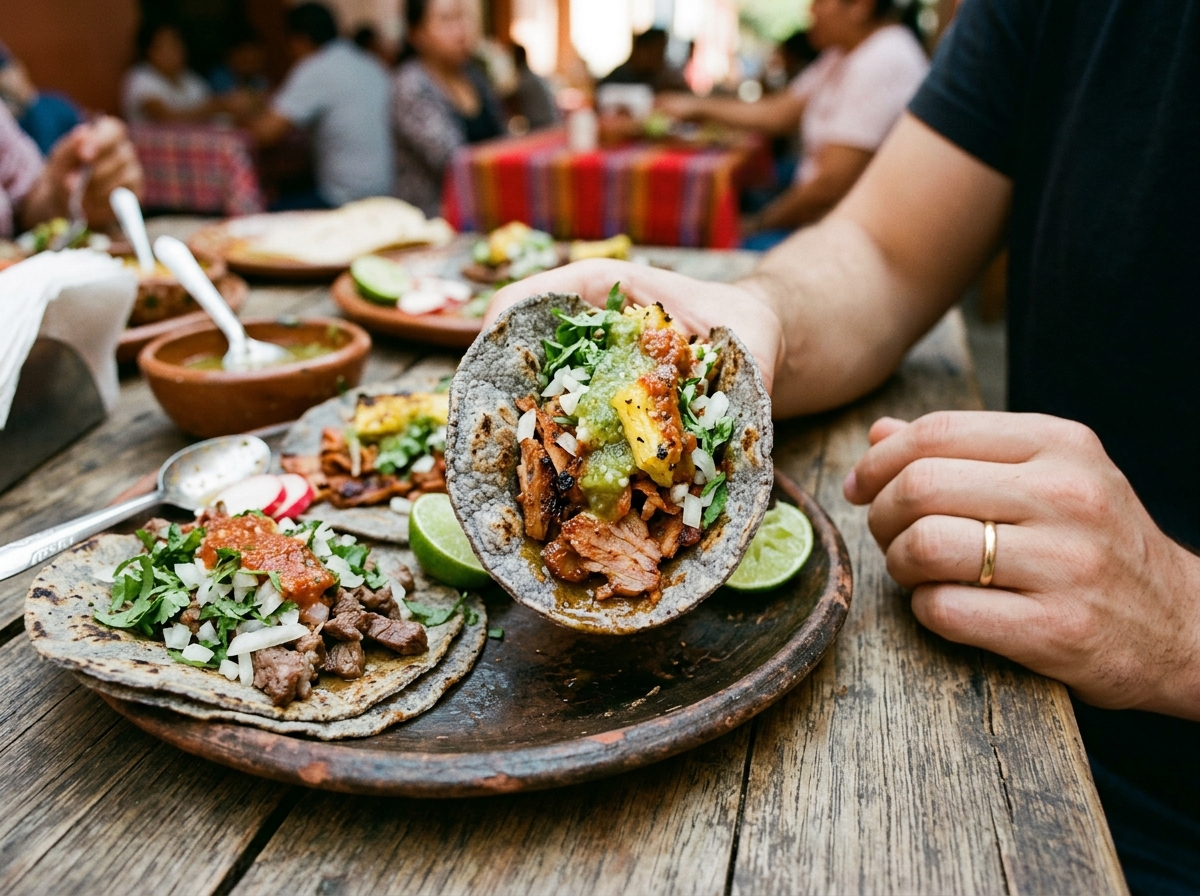
Most people’s first taco experience came wrapped in a hard yellow shell with shredded cheese, ground beef, and iceberg lettuce. That version isn’t bad — but it’s about as Mexican as a fortune cookie is Chinese.
Real Mexican tacos look different, taste different, and feel different. They’re smaller, simpler, and somehow more satisfying. Two warm corn tortillas, a handful of slow-cooked meat, a squeeze of lime, fresh cilantro, and diced onion. That’s it. No sour cream. No cheddar. No crunchy shells.
If you’ve ever stood at a street taco cart in Mexico City and eaten three tacos in five minutes flat, you know exactly what we’re talking about. And if you haven’t — this is the next best thing.
What Actually Makes a Taco “Authentic”
The word “authentic” gets thrown around a lot in food writing, often to sound fancy. But with Mexican tacos, it actually means something specific.
Authentic Mexican tacos come from regional traditions — recipes and techniques passed down through generations, tied to specific states, cities, and even neighborhoods. A taco al pastor from Mexico City is not the same animal as a fish taco from Baja California. Both are authentic. Both are Mexican. But they grew up in completely different kitchens.
So when people ask “what makes a taco authentic,” the real answer is: it respects its origin. The ingredients are simple and local, the tortilla is handmade or freshly pressed, the meat is cooked with care, and the toppings don’t overpower — they complement.
What it’s not is a vehicle for every ingredient in your fridge.
Quick Fact: UNESCO recognized traditional Mexican cuisine as an Intangible Cultural Heritage of Humanity in 2010 — one of only a handful of food cultures to earn that distinction. Tacos are central to that recognition.
The Tortilla Is Not an Afterthought
Here’s where most Americanized versions get it completely wrong. The tortilla isn’t just a wrapper — it’s half the meal.
In Mexico, street tacos almost always use corn tortillas, not flour. Corn tortillas have been a part of Mexican food culture for over 10,000 years, tracing back to the ancient civilizations of Mesoamerica. They’re denser, earthier, and hold up better to juicy, fatty fillings.
You’ll notice that authentic taco stands usually serve their tacos with two tortillas stacked together. This isn’t an accident or overindulgence — there’s a real reason behind it. A single corn tortilla can tear easily under the weight of wet, heavy fillings. Two tortillas provide structural support, and you can eat the second one on its own once it’s soaked up the meat juices. If you want to go deeper on this, here’s why Mexican tacos traditionally come with two tortillas.
Flour tortillas aren’t wrong, exactly — they’re popular in northern Mexico, especially in states like Sonora and Chihuahua. But if you’re eating a taco al pastor, carnitas, or barbacoa from a street cart in central or southern Mexico, corn is what you’re getting. The corn vs flour tortilla debate is worth understanding if you want to make the right call when cooking at home.
Pro Tip: If you’re making tacos at home, warm your corn tortillas directly on a gas flame or a dry cast iron pan. Ten to fifteen seconds per side. That slight char changes everything.
The Meat: Where the Real Flavor Lives
Mexican taco meat is slow, intentional, and deeply seasoned. It’s not a burger patty cut into strips. It’s not rotisserie chicken pulled from a grocery store bag. Each cut has a purpose, a cooking method, and a backstory.
Here are the most iconic ones:
Tacos al Pastor — This is arguably Mexico’s most famous street taco. Pork marinated in dried chiles, achiote, and pineapple, cooked on a vertical spit (trompo) that looks almost exactly like a Middle Eastern shawarma — because it is. Lebanese immigrants brought the vertical spit concept to Mexico in the early 20th century, and Mexican cooks transformed it into something entirely their own. You can read the full story of tacos al pastor and what makes them so special.
Carnitas — Pork shoulder slow-cooked (confit-style) in its own fat until it’s impossibly tender, then crisped up at the end. It’s from Michoacán, and the best versions have a mix of textures — some soft, some slightly crispy. The fat that renders out during cooking is what gives carnitas its richness.
Carne Asada — Grilled beef, usually skirt steak or flank steak, marinated in citrus and spices. It’s the taco of northern Mexico and has a huge following in California and Texas. The key is the char from a very hot grill and a good rest before slicing. Check out this carne asada tacos recipe if you want to make it at home properly.
Barbacoa — Traditionally, this is beef cheeks or lamb wrapped in maguey leaves and slow-cooked underground for hours. The result is fall-apart tender meat with a smoky, earthy flavor that you simply can’t fake with a slow cooker (though many try). Weekend mornings in Mexico are barbacoa mornings.
Birria — Originally from Jalisco and made with goat, though beef birria has become massively popular both in Mexico and across the U.S. The meat is braised in a complex chile broth until it shreds effortlessly, and the consommé (broth) is served alongside for dipping. Birria tacos are often fried briefly on the griddle so the tortilla gets a little crispy — that version is called a quesabirria.
If you want a full breakdown of Mexican taco meat types and what goes best where, that’s a rabbit hole worth going down.
Toppings: Less Is More (And That’s the Point)
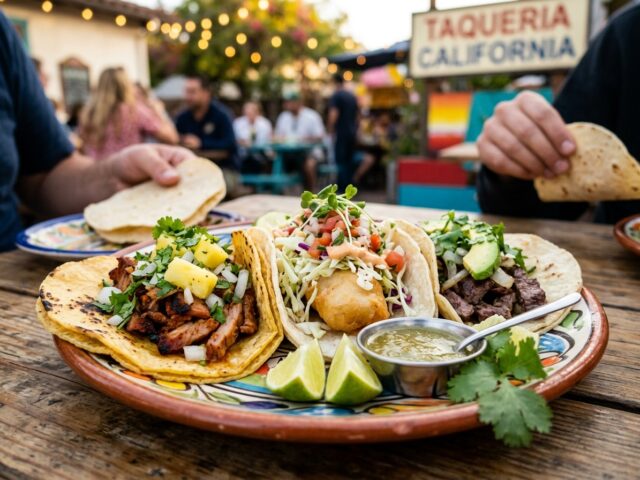
Walk up to any legit taco stand in Mexico and look at the topping setup. You’ll typically see a small pile of chopped white onion, a bunch of fresh cilantro, lime wedges, salsa verde, and salsa roja. Sometimes sliced radishes or cucumber. Maybe avocado.
That’s it.
No shredded cheese. No sour cream. No pico de gallo in a big bowl. No jalapeño slices from a jar.
The toppings on an authentic taco exist to brighten the meat, not bury it. A squeeze of lime cuts through fat. Onion adds crunch and sharpness. Cilantro gives freshness. Salsa adds heat and depth. Each element has a job.
The salsa, in particular, is serious business. Mexican street taco salsas are not the jarred tomato stuff. They’re blended, charred, roasted — sometimes made with tomatillos, sometimes with dried chiles, sometimes with both. The best taco sauces are the ones that have actual complexity behind them, not just heat.
If you love avocado on your tacos — and honestly, who doesn’t — here’s how avocado fits into the authentic taco experience. Guacamole or sliced avocado is used in Mexico, just not on every taco the way American versions tend to pile it on.
Did You Know? The cilantro-onion combination on street tacos isn’t random. It’s been the standard garnish for hundreds of years because these two ingredients are cheap, flavorful, and grow abundantly across Mexico.
Regional Variations That Deserve More Attention
Mexico is a big, diverse country with 31 states — and each one has its own taco identity. Lumping them all together under “Mexican tacos” is like saying all Italian food is the same.
Baja California gave the world the fish taco. Crispy battered fish (often cod or mahi-mahi), shredded cabbage, crema, and a squeeze of lime in a soft corn tortilla. Born in the fishing towns of Ensenada and La Paz, it’s one of the most copied tacos outside Mexico.
Oaxaca is home to tlayudas, but also to tasajo tacos — thinly sliced dried beef with a distinctive, almost funky depth of flavor from the curing process.
Mexico City is where al pastor rules, but also where you’ll find tacos de canasta — basket tacos that are steamed inside a cloth-covered basket and sold by bicycle vendors in the early morning. They’re soft, oily at the edges, and filled with potato, chicharrón, or bean.
Yucatán has cochinita pibil — achiote-marinated pork slow-roasted in banana leaves. It’s tangy, deeply red-orange in color, and topped with pickled red onion. Nothing else quite tastes like it.
Understanding the types of Mexican tacos by region gives you a completely different picture than the one most people grow up with.
How to Spot an Authentic Mexican Taco (Wherever You Are)
You don’t have to fly to Mexico City to find real tacos — though it helps. Here’s what to look for when you’re trying to judge whether a taco spot is doing things right:
The tortilla matters. If it’s fresh, warm, and slightly charred, that’s a good sign. If it came pre-folded and cold, be skeptical.
The meat is the focus. A good taco doesn’t distract you with fifteen toppings. If you have to dig through layers to find the meat, something’s off.
The salsa is house-made. Real taco places make their salsa fresh, often daily. Ask. If it comes from a jar, it shows.
The size is small. Street tacos in Mexico are palm-sized, meant to be eaten in three or four bites. If you’re getting a massive flour-tortilla wrap, that’s Tex-Mex (delicious in its own right, but a different thing entirely).
The crowd tells you something. If the locals are eating there, that’s usually the most reliable review you’re going to get.
The History Behind the Taco (Briefly)
The word “taco” has debated origins, but the food itself predates the Spanish arrival in Mexico. Indigenous people were already eating corn tortillas folded around various fillings. The word likely comes from the silver mines of 18th century Mexico, where “taco” referred to small explosive charges — a metaphor for the little parcels of food that workers ate.
The history of tacos is actually fascinating because it shows how a street food born out of necessity became one of the most beloved dishes on the planet. And the evolution of taco fillings over centuries tells you a lot about how Mexican culture absorbed and transformed outside influences without losing its core identity.
FAQ
What is the difference between authentic Mexican tacos and Tex-Mex tacos?
Authentic Mexican tacos use small corn tortillas, simple toppings like cilantro and onion, and slow-cooked meats. Tex-Mex tacos — which developed along the Texas-Mexico border — use larger flour tortillas or hard shells, shredded cheese, sour cream, and often ground beef. Neither is wrong, but they’re genuinely different foods with different origins.
Why do authentic Mexican tacos use two tortillas?
It’s mostly structural. A single corn tortilla can tear under juicy fillings. Two tortillas give you a more stable base, and the inner one soaks up the meat juices while the outer one holds its shape. It’s practical, not wasteful.
What meat is most commonly used in authentic Mexican street tacos?
Al pastor, carnitas, carne asada, and barbacoa are the most common. The choice often depends on the region — al pastor is king in Mexico City, carne asada dominates in the north, and cochinita pibil is the specialty of the Yucatán Peninsula.
Are corn tortillas always used in authentic Mexican tacos?
Mostly yes, especially in central and southern Mexico. Northern states like Sonora use flour tortillas more commonly because wheat grows well there. So while corn is the default for most street tacos, flour tortillas have their own authentic regional tradition.
Can you make authentic Mexican tacos at home?
Absolutely. The key is sourcing good quality masa (for the tortillas), using the right cut of meat, and keeping the toppings simple. A good homemade salsa verde and fresh lime are what take a home taco from “fine” to actually memorable.
The next time you’re standing in front of a taco menu — whether in Los Angeles, Mexico City, or your own kitchen — you’ll read it differently now. You’ll notice whether the tortilla is corn or flour, whether the meat has a proper name and a tradition behind it, and whether the toppings are there to support the filling or just fill up the plate.
Real Mexican tacos aren’t complicated. That’s the whole point. They’re proof that when every ingredient earns its place, you don’t need much to make something genuinely great.