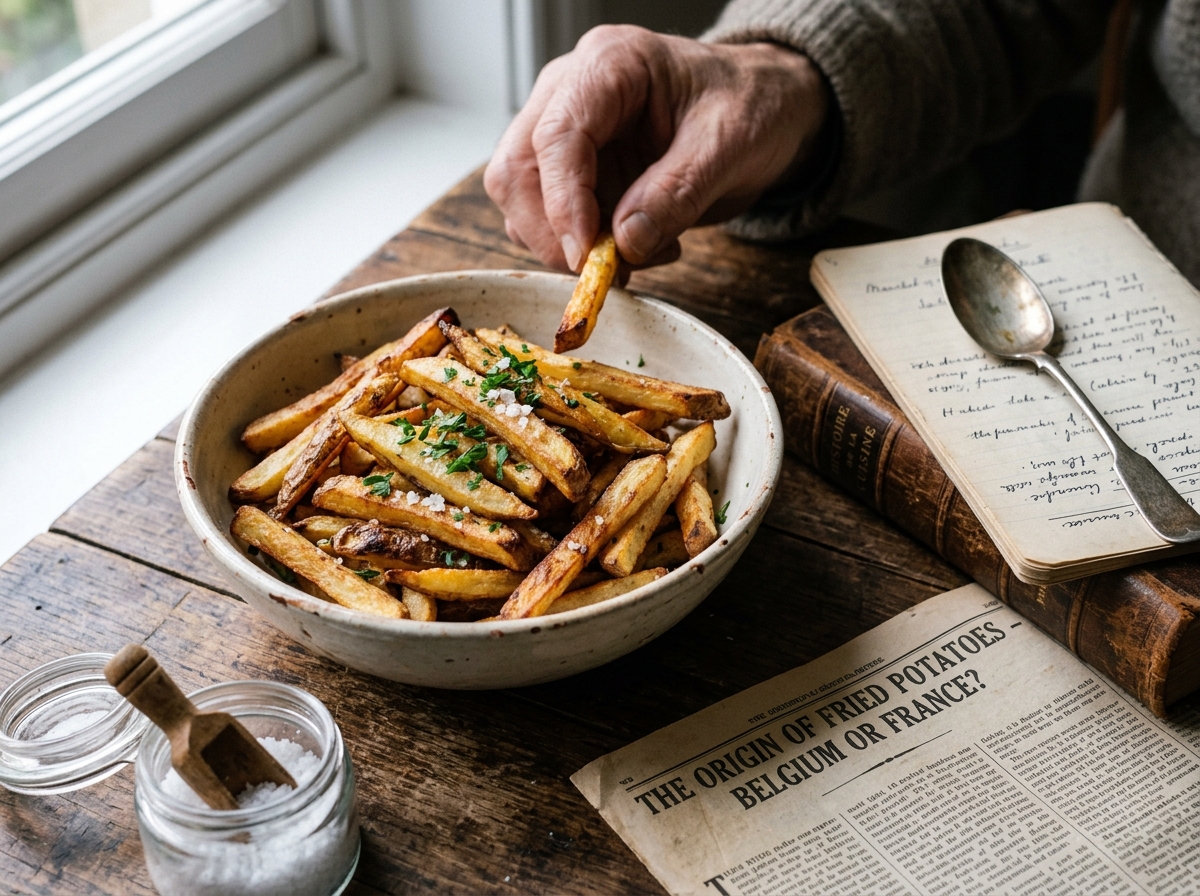
Americans eat roughly 4.5 billion pounds of french fries every single year. That’s nearly 30 pounds per person — enough golden, crispy sticks to circle the earth several times over. But here’s what’s funny: most people who munch on fries daily have no idea where they actually came from. Was it France? Belgium? Or somewhere else entirely?
The story of homemade french fries is way more interesting — and way more debated — than you’d expect. It involves war, poverty, street vendors, presidents, and a centuries-old argument between two European nations that still hasn’t been settled. And the homemade version? That tradition goes back much further than any fast-food chain.
Let’s walk through the real history behind your favorite crispy snack, and see how making french fries at home connects you to a tradition that’s hundreds of years old.
The Great Debate: France vs. Belgium
If you’ve ever assumed french fries are French — well, you’re not alone. The name kind of gives that impression, right? But the actual origin is one of the most hotly contested food debates in culinary history. Both France and Belgium claim to have invented fries, and both have pretty convincing stories.
The Belgian Claim
Belgian historians often point to a manuscript from 1781 that describes how villagers in the Meuse Valley (near the city of Namur) had a long tradition of frying small fish caught from the river. During harsh winters, when the river froze over and fishing became impossible, these villagers sliced potatoes into long, thin strips — roughly the shape of small fish — and fried them as a substitute.
This story has deep roots in Belgian culture. Jo Gérard, a Belgian journalist and historian, popularized this narrative in the 1980s, claiming the tradition dated as far back as 1680. While some food historians question whether potatoes were widely available in that region so early, the story remains central to Belgium’s national identity. Belgium even submitted its frites culture to UNESCO’s list of intangible cultural heritage in 2017.
Walk through any Belgian city today, and you’ll find “frituren” or “fritkots” — small fry stands — on almost every corner. These aren’t fancy restaurants. They’re street stalls where locals line up for thick-cut fries served in paper cones with mayonnaise. It’s street food in its purest form, and Belgians take it very seriously.
The French Claim
France has its own version of events. Parisian street vendors were selling fried potatoes — “pommes frites” — on the Pont Neuf bridge as early as the 1780s, right before the French Revolution. These vendors would slice potatoes thin and fry them in large vats of oil, selling them to passersby as cheap, filling street food.
The French argument gets a boost from the work of Antoine-Augustin Parmentier, a pharmacist and nutritionist who championed the potato in France during the late 18th century. Potatoes had been viewed with suspicion across much of Europe for a long time — people thought they caused leprosy, among other wild beliefs. Parmentier worked hard to change public perception, even convincing King Louis XVI to wear a potato flower in his buttonhole as a fashion statement. Once French people started accepting potatoes, frying them was a natural next step.
So who’s right? Honestly, both countries probably developed fried potatoes somewhat independently. The potato was spreading across Europe during the same period, and frying food in oil or fat was already a common cooking method. But the name “french fries” — that has its own separate story.
How Did They Become “French” Fries?
Here’s where things get interesting. The word “french” in french fries probably has nothing to do with France at all.
One widely accepted theory points to American soldiers during World War I. When U.S. troops were stationed in southern Belgium, they encountered those beloved Belgian frites. Since the dominant language in that part of Belgium was French, the soldiers naturally called them “French fries.” They brought the name — and the craving — back home to America.
There’s another theory too. The word “french” might refer to the old culinary term “to french,” which means to cut food into thin strips. So “french fries” could simply mean “frenched fried potatoes” — potatoes that have been cut into strips and then fried. This explanation is less dramatic, but it makes a lot of linguistic sense.
Either way, by the mid-20th century, “french fries” had become the standard American term, while the British stuck with “chips” and the French continued calling them “pommes frites.”
Did you know? In 2003, when France opposed the U.S.-led invasion of Iraq, some American politicians briefly renamed french fries as “freedom fries” in congressional cafeterias. The name didn’t stick, but it showed just how closely the word “French” was tied to fries in American culture — even though the connection to France was always shaky.
The Potato’s Long Road to Your Kitchen
You can’t talk about the history of homemade french fries without talking about the potato itself. Because for most of European history, the potato didn’t even exist on the continent.
Potatoes are native to South America — specifically the Andes region of modern-day Peru and Bolivia. The Inca people had been cultivating and eating potatoes for thousands of years before Spanish conquistadors arrived in the 16th century. When the Spanish brought potatoes back to Europe around the 1570s, the reaction was… not great.
Europeans didn’t trust this weird underground vegetable. It looked lumpy and strange. It grew in the dirt. Some people genuinely believed it was poisonous or linked to diseases. In parts of France, potatoes were actually banned for human consumption between 1748 and 1772 because authorities considered them dangerous.
It took advocates like Parmentier in France and Frederick the Great in Prussia to slowly convince people that potatoes were safe, nutritious, and — most importantly — cheap to grow. By the late 1700s, potatoes had become a staple crop across much of Europe. And once people had plenty of potatoes, they started experimenting with how to cook them.
Boiling was common. Roasting too. But frying? Frying turned the humble potato into something special. That crispy exterior, that fluffy interior — it was a transformation. And it didn’t require a professional kitchen. Anyone with a pot, some oil or animal fat, and a knife could make fried potatoes at home.
That’s really where the tradition of homemade french fries begins — not in restaurants or royal courts, but in ordinary kitchens where families were looking for a tasty, affordable way to feed themselves.
Thomas Jefferson and the American Connection
The story of french fries in America often circles back to one name: Thomas Jefferson.
Jefferson served as the U.S. Minister to France from 1784 to 1789 — right in the middle of the Parisian potato craze. He lived in Paris, ate French food regularly, and developed a real appreciation for French cuisine. His personal notes include a recipe for “potatoes, fried in the French manner” — potatoes cut into thin rounds and fried until crispy.
When Jefferson returned to America and eventually became president, he reportedly served these fried potatoes at White House dinners. A note from an 1802 White House dinner describes “potatoes served in the French manner,” which many historians interpret as an early form of french fries in America.
Now, Jefferson didn’t single-handedly introduce fried potatoes to America. Potatoes were already being grown and eaten in the colonies. But he likely helped popularize the French style of frying them — thin-cut, crispy, and served as a side dish rather than just a basic boiled staple.
It’s a fun detail, right? The same guy who wrote the Declaration of Independence might also be responsible for bringing french fries to American dinner tables. Not a bad legacy.
Street Food Origins: Where Homemade Met the Public
For most of their history, french fries were either homemade or sold as street food. The concept of getting fries from a restaurant — or especially a drive-through — is relatively modern.
In 19th-century Belgium and France, fried potatoes were classic street food. Vendors set up carts and stalls near markets, bridges, and public squares. They’d fry potatoes in large pots of beef tallow or lard, scoop them into paper cones, and sell them for a few coins. Workers, students, families — everyone ate them.
This was genuinely democratic food. You didn’t need money for a fancy meal. You didn’t need a reservation. You just walked up, paid a tiny amount, and got a hot, satisfying snack. And the technique was simple enough that people replicated it at home without any trouble.
In America, fried potatoes followed a similar path. By the late 1800s, they were a common household side dish and a popular item at fairs, carnivals, and boardwalks. Home cooks would use cast-iron pans or Dutch ovens filled with lard or shortening. The process was straightforward — peel, cut, fry, salt, eat.
Pro Tip: If you’re making homemade french fries today, the technique hasn’t changed much from those 19th-century kitchens. The real secret is still about choosing the right potato (high-starch varieties like Russets work best) and getting your oil temperature just right. Too cool, and the fries absorb grease. Too hot, and they burn before cooking through.
The Rise of Fast Food Changed Everything
For decades, homemade french fries were the norm. Then the 20th century happened.
The fast-food industry transformed fries from a homemade side dish into a mass-produced global commodity. And one man played an outsized role in that transformation: J.R. Simplot.
In the 1940s, Simplot — an Idaho businessman — developed a process for flash-freezing french fries. This was a big deal. Before frozen fries, restaurants had to peel, cut, and fry fresh potatoes every day. Simplot’s frozen fries could be stored for months and cooked in minutes with consistent results.
In 1967, the McDonald’s corporation struck a deal with Simplot to supply their restaurants with frozen fries. Before that, McDonald’s had been using fresh potatoes — the founder, Ray Kroc, was initially resistant to the switch. But the economics were hard to argue with. Frozen fries were cheaper, faster, and more uniform.
That deal changed the food industry. By the 1970s and 1980s, frozen fries dominated not just restaurants but home kitchens too. Why spend 30 minutes peeling and cutting potatoes when you could dump a bag of frozen fries onto a baking sheet?
The consequence? A whole generation grew up thinking french fries came from a bag in the freezer. The art of making them from scratch — something families had done for centuries — started fading.
Why Homemade French Fries Are Making a Comeback
Something shifted in the last 10–15 years. People started caring more about what’s in their food. The farm-to-table movement, food blogs, cooking shows, and social media all played a part. And homemade french fries became cool again.
There are good reasons for this. Commercial frozen fries often contain more than just potatoes. Check the ingredients list on a bag sometime — you might find dextrose, sodium acid pyrophosphate, dimethylpolysiloxane, and various preservatives. That’s a long way from the simple potato-oil-salt combination of traditional homemade fries.
Making fries at home puts you in control. You pick the potato variety. You choose the type of oil — peanut oil for high heat, sunflower for a lighter taste, or even beef tallow if you want that old-school McDonald’s flavor (yes, they used beef tallow until 1990). You decide how thick or thin to cut them. You season them however you want.
The rise of home cooking tools has helped too. Air fryers, Dutch ovens, deep-fry thermometers, and mandoline slicers make the process easier than ever. You don’t need professional equipment to get golden, crispy french fries at home.
And honestly? There’s something satisfying about it. Taking a whole potato and turning it into a pile of hot, salty, crispy fries — it connects you to a tradition that goes back centuries. Belgian villagers frying potato strips by the fireplace. Parisian street vendors on the Pont Neuf. Thomas Jefferson’s White House kitchen. Your kitchen is part of that same story.
The Double-Fry Method: A Historical Technique
If you’ve ever tried making fries at home and ended up with soggy, limp results, you’re not alone. There’s a reason restaurant fries taste better, and it has to do with a technique that’s been used since at least the 19th century: the double-fry method.
The idea is simple. You fry the potatoes twice — once at a lower temperature (around 300–325°F) to cook the inside, and then again at a higher temperature (375°F) to crisp the outside. That first fry softens the potato and starts the dehydration process. The second fry creates that signature crunch.
Belgian fritkots have used this method for generations. Many French chefs consider it essential. Even Heston Blumenthal, the famous British chef, developed a triple-cooked chip method that takes the concept even further — boiling, frying once, freezing, and frying again.
If you’re frying at home without a deep fryer, a heavy-bottomed pot or Dutch oven works perfectly well. The key is patience. Rushing the process by cranking up the heat is exactly how you end up with fries that are burnt on the outside and raw in the middle.
Quick Fact: The Maillard reaction — the chemical process that creates browning and flavor — only kicks in at temperatures above 280°F. That’s why your second fry needs to be hot enough to trigger it. Without it, fries look pale and taste flat.
French Fries Around the World
One of the most fascinating things about french fries is how every culture has made them their own. The basic concept — fried potato strips — is universal, but the toppings, seasonings, and serving styles vary wildly.
In Belgium, the classic is frites with mayonnaise. Not ketchup. Belgians will give you a look if you ask for ketchup with your fries. They also serve them with dozens of other sauces — andalouse, samurai, joppiesaus — but mayo is the default.
In Canada, poutine reigns supreme. Fries topped with fresh cheese curds and brown gravy. It started in rural Quebec in the 1950s and has since become a national dish.
In the Netherlands, you’ll find “patat oorlog” (war fries) — fries smothered in peanut satay sauce, mayonnaise, and diced onions. It sounds chaotic, but it works.
In the UK, chips are thicker-cut and often served with fish and malt vinegar. The classic fish and chips shops — “chippies” — have been a British institution since the 1860s.
In Japan, you can find fries seasoned with seaweed, soy sauce, or even consommé powder. McDonald’s Japan regularly releases limited-edition fry flavors.
And right here in the U.S., regional variations are everywhere. Cajun fries in Louisiana. Chili cheese fries across the Southwest. Boardwalk fries on the Jersey Shore, served fresh-cut and doused in vinegar. If you enjoy exploring how food traditions overlap across cultures, you might also like reading about the evolution of taco fillings — another story of a simple dish that traveled the world and changed along the way.
The Science Behind Why We Love Them
There’s an actual scientific explanation for why french fries are so universally loved, and it goes beyond just “they taste good.”
French fries hit multiple pleasure triggers in your brain simultaneously. The crunch activates sensory neurons that humans associate with freshness. The salt triggers dopamine release. The combination of fat and starch together is something our brains are hardwired to seek out — it signals calorie-dense food, which for most of human history meant survival.
A 2018 study published in Cell Metabolism found that foods combining fat and carbohydrates together activate brain reward circuits more powerfully than foods containing either one alone. French fries are basically the poster child for that combination.
The temperature contrast plays a role too. Hot food in general feels more satisfying, and the contrast between a crunchy, hot exterior and a soft, steaming interior creates what food scientists call “dynamic contrast” — a textural experience that keeps you reaching for one more.
This isn’t just modern science catching up, either. People have intuitively understood this appeal for centuries. That’s why fried potatoes caught on so quickly across every culture they reached. You don’t need a food science degree to know that a hot, crispy, salty fry tastes really, really good.
What’s Changed — and What Hasn’t
The way we make homemade french fries in 2025 would look both familiar and foreign to a 19th-century cook.
The familiar part: you still start with a whole potato, a sharp knife, and something hot to fry it in. The core technique hasn’t changed in 200+ years.
What has changed is the tools and knowledge available. We now understand why soaking cut potatoes in cold water before frying improves crispness (it removes surface starch). We know which potato varieties have the right starch-to-moisture ratio. We have thermometers that let us hit exact oil temperatures. We have air fryers that can produce crispy results with a fraction of the oil.
The oil itself has changed too. Early fries were cooked in animal fat — beef tallow, lard, duck fat. These fats produce incredible flavor, and some high-end restaurants and home cooks are returning to them. But most modern kitchens use vegetable oils like peanut, canola, or sunflower. Each oil brings a different flavor profile and smoke point, which is why choosing the best oil for homemade fries matters more than most people realize.
Even serving styles have evolved. French fries used to be a side dish — something that accompanied a main course. Now they’re often the main event. Loaded fries, truffle fries, garlic parmesan fries, sweet potato fries — the humble fried potato has become a canvas for creativity. It’s the same kind of transformation you see with taco toppings, where a simple base becomes infinitely customizable.
FAQ
Who actually invented french fries — France or Belgium?
Both countries have legitimate claims, and historians haven’t reached a definitive answer. Belgium points to 17th-century villagers in the Meuse Valley who fried potato strips as a substitute for small fried fish. France points to Parisian street vendors selling fried potatoes on the Pont Neuf bridge in the 1780s. The most likely answer is that both cultures developed fried potatoes somewhat independently as the potato spread across Europe in the late 1700s.
Why are they called “french” fries if they might not be from France?
The most popular theory involves American soldiers during World War I. When stationed in French-speaking southern Belgium, they tasted Belgian frites and called them “French fries” because the locals spoke French. Another explanation is that “french” refers to the culinary term “to french,” meaning to cut into thin strips. So “french fries” may simply mean “frenched (cut) fried potatoes.”
What’s the best potato for homemade french fries?
High-starch potatoes like Russet Burbanks are generally considered the best choice for homemade fries. Their high starch and low moisture content creates a fluffy interior and crispy exterior when fried. Yukon Golds work too if you prefer a creamier texture, but waxy potatoes like Red Bliss tend to produce a denser, less crispy result.
Did Thomas Jefferson really bring french fries to America?
Jefferson didn’t invent french fries or formally introduce them to the country, but his personal papers include a recipe for “potatoes fried in the French manner,” and he reportedly served them at White House dinners around 1802. He likely helped popularize the French style of preparing fried potatoes among American elites after spending five years in Paris.
Why do restaurant fries taste better than homemade ones?
Restaurants almost always use the double-fry method — frying at a lower temperature first, then at a higher temperature for crispness. They also use high-quality frying oils with high smoke points, often maintained at precise temperatures with commercial equipment. At home, you can achieve similar results by soaking cut potatoes in cold water, drying them thoroughly, and frying twice with a rest period between fries.
Your Kitchen, Their History
Every time you peel a potato, heat up a pot of oil, and drop in a batch of hand-cut fries, you’re participating in something much bigger than just making a snack. You’re connecting to Belgian villagers improvising during frozen winters. To Parisian street vendors feeding revolutionary crowds. To Thomas Jefferson experimenting with French recipes in an American kitchen. To your own grandparents who probably made fries in a cast-iron skillet without thinking twice about it.
The fast-food industry tried to convince us that french fries belong in a drive-through window. But their real home has always been your kitchen — where a few simple ingredients and a little patience produce something no frozen bag can match.
So the next time you’re standing over a pot of hot oil, watching those potato strips turn golden and listening to that satisfying sizzle, know this: you’re keeping a tradition alive that stretches back centuries. And that first bite — hot, crispy, perfectly salted — is proof that some things really don’t need to be improved. They just need to be made with care.