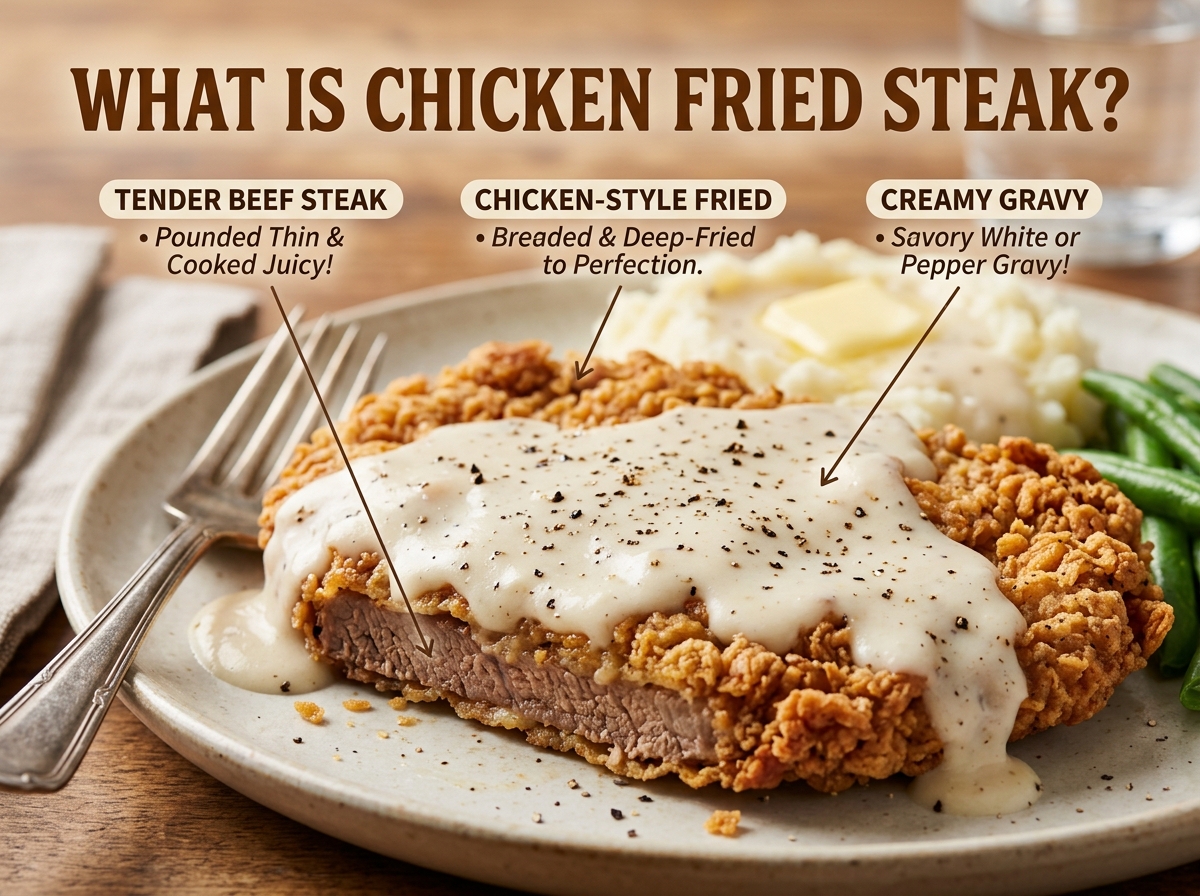
There’s no chicken in chicken fried steak. That trips up almost everyone who hears the name for the first time. It’s a beef steak — usually a tough, cheap cut — that’s been tenderized, breaded, and fried the same way you’d fry a piece of chicken. That’s it. That’s where the name comes from. And yet this simple dish has become one of the most beloved comfort foods across the American South and beyond.
If you’ve ever stared at a diner menu wondering what exactly you’d be ordering, or if you’ve tried it once and now you want to make it at home, you’re in the right place. Let’s break down everything about chicken fried steak — its history, what makes it different from country fried steak, how to cook it properly, and why it has earned a permanent spot on Southern tables for over a century.
The Name Makes No Sense — Until It Does
Yeah, let’s address the elephant in the room. Why call something “chicken fried” when there’s zero chicken involved?
The answer is all about technique, not ingredients. Think about how you’d prepare fried chicken: you take the meat, dredge it in seasoned flour (sometimes with an egg wash), and fry it in hot oil until it’s golden and crispy. Chicken fried steak follows the exact same process. You’re taking a piece of beef and preparing it using the fried chicken method.
Some food historians also point out that the dish likely got its name because early versions were meant to make a cheap, tough steak taste as good as fried chicken — which was considered a treat. So the cooking method gave the dish its name, and the name stuck.
Quick fact: The term “chicken fried steak” appears in print as early as the 1930s, though versions of the dish existed long before that.
A Brief History of Chicken Fried Steak
Every great comfort food has an origin story, and chicken fried steak has a few competing ones. The truth is probably a mix of all of them.
German and Austrian Roots
The most widely accepted theory traces chicken fried steak back to German and Austrian immigrants who settled in Texas during the mid-1800s. These immigrants brought with them the tradition of Wiener Schnitzel — a thin, breaded, and pan-fried veal cutlet that’s a staple in Austrian cuisine. When they arrived in Texas, veal wasn’t easy to come by, but beef was everywhere. So they adapted the recipe, swapping veal for a cheap cut of beef steak.
Over time, the dish evolved. The breading got thicker. The pan-frying shifted toward deep-frying. And instead of a squeeze of lemon (like you’d get with schnitzel), Texans smothered it in cream gravy. That’s basically where chicken fried steak was born.
The Texas Connection
Texas claims chicken fried steak as its own, and the claim is pretty strong. The town of Lamesa, Texas, has long been cited as one of the earliest homes of the dish. Jimmy Don Perkins, a cook in Lamesa, is sometimes credited with popularizing it in the early 20th century, though the exact details are debated.
What’s not debated is this: by the 1940s and 1950s, chicken fried steak was a staple in Texas diners, truck stops, and home kitchens. From there, it spread across the South and eventually became a fixture of American comfort food.
Did you know? The Texas Legislature unofficially recognizes chicken fried steak as a state culinary treasure. It even celebrated its own day — October 26 — as National Chicken Fried Steak Day.
The Southern Spread
As Texans moved around and Southern cuisine gained broader popularity, chicken fried steak traveled with them. By the mid-20th century, you could find it on menus across Oklahoma, Arkansas, Louisiana, and eventually across the entire country. It became synonymous with diner culture — the kind of meal you’d order alongside mashed potatoes, green beans, and a tall glass of sweet tea.
The dish also shows up in some Southern comfort foods for football watch party menus, which makes perfect sense. It’s hearty, satisfying, and feeds a crowd without breaking the bank.
Chicken Fried Steak vs. Country Fried Steak — What’s the Difference?
This is the question that sparks actual debates at dinner tables. Are they the same thing? Not quite, though the line between them is blurry and depends heavily on where you are.
Chicken Fried Steak
The classic version uses a flour-based breading (sometimes double-dredged with an egg wash in between for extra crunch). It’s fried until the crust is crispy and golden. The hallmark topping is white cream gravy — made from pan drippings, flour, milk, and black pepper. The gravy is poured right over the top of the crispy steak.
The focus here is on that crunchy exterior. It should shatter a little when you cut into it.
Country Fried Steak
Country fried steak is often the same cut of beef, prepared similarly, but it’s typically served with brown gravy instead of white cream gravy. Some versions skip the egg wash entirely, resulting in a thinner, less crunchy coating. The overall vibe is a bit more like a smothered steak — the gravy soaks into the crust, making it softer.
Here’s a rough breakdown of the key differences:
- Breading: Chicken fried tends to be thicker and crunchier; country fried is often thinner.
- Gravy: Chicken fried gets white cream gravy; country fried gets brown gravy.
- Texture: Chicken fried keeps its crunch; country fried is often softer from the gravy.
That said, plenty of restaurants use the terms interchangeably. If you’re particular about it, just ask what kind of gravy comes with it. That’ll tell you which version you’re getting.
What Cut of Beef Works Best?
You don’t need an expensive steak for this dish. In fact, using a premium cut would kind of miss the point. Chicken fried steak was born as a way to make tough, affordable beef taste incredible.
Cube Steak — The Classic Choice
Cube steak is the most traditional option. It’s usually cut from the top round or top sirloin, then run through a mechanical tenderizer that leaves a distinctive pattern of small indentations on the surface (that’s why it’s called “cube” steak). This process breaks down the tough muscle fibers and makes the meat tender enough to cook quickly.
You can find cube steak at virtually any grocery store, and it’s usually one of the cheapest cuts in the meat case.
Round Steak
If you can’t find cube steak, a piece of top round or bottom round works well. You’ll just need to tenderize it yourself. Place the steak between two sheets of plastic wrap and pound it with a meat mallet until it’s about ¼ inch thick. This does the same job as the mechanical tenderizer — it breaks down the tough connective tissue and makes the meat easy to chew.
A Note on Thickness
No matter which cut you choose, thickness matters. You want your steak thin — around ¼ to ½ inch. Too thick and the outside will burn before the inside cooks through. Too thin and it’ll dry out. That ¼ to ½ inch range gives you the perfect balance: a crispy crust with juicy, tender beef inside.
How to Make Chicken Fried Steak at Home
Making chicken fried steak at home isn’t complicated, but there are a few details that separate a good version from a great one. Let’s walk through the process step by step.
What You’ll Need
For the steak:
- 4 cube steaks (about 4–6 ounces each)
- 2 cups all-purpose flour
- 1 teaspoon garlic powder
- 1 teaspoon onion powder
- 1 teaspoon paprika
- Salt and black pepper to taste
- 2 eggs
- ½ cup buttermilk
- Vegetable oil or shortening for frying
For the cream gravy:
- 3 tablespoons pan drippings (from frying the steaks)
- ¼ cup all-purpose flour
- 2½ cups whole milk
- Salt and lots of black pepper
Step 1: Season and Prep the Steaks
Pat your cube steaks dry with paper towels. Season both sides generously with salt and pepper. Dry meat = better browning. Wet meat = soggy crust. Simple as that.
Step 2: Set Up Your Dredging Station
Mix the flour, garlic powder, onion powder, paprika, salt, and pepper in a shallow dish. In a separate bowl, whisk together the eggs and buttermilk. The buttermilk adds tang and helps the flour coating stick better.
Here’s the order: flour mixture → egg wash → flour mixture again. That double dredge is what gives you the thick, crunchy crust that makes chicken fried steak special. Press the flour firmly into the meat each time. Don’t just dip it — really pack it on.
Pro tip: After breading, let the steaks rest on a wire rack for 10–15 minutes before frying. This helps the coating set and prevents it from falling off in the oil.
Step 3: Fry the Steaks
Pour about ½ inch of vegetable oil into a large cast iron skillet or heavy-bottomed pan. Heat it to 350°F (175°C). If you don’t have a thermometer, drop a small pinch of flour into the oil — if it sizzles immediately, you’re ready.
Carefully place the steaks in the hot oil. Don’t crowd the pan — fry one or two at a time. Cook for about 3–4 minutes per side until the crust is deep golden brown. The internal temperature of the beef should reach at least 145°F (63°C).
Transfer the fried steaks to a wire rack set over a sheet pan. Don’t put them on paper towels — that traps steam and makes the bottom soggy.
If you’re interested in getting your frying technique right across different dishes, there’s a helpful piece on how to fry at home without deep frying that covers oil temperature control and pan-frying basics really well.
Step 4: Make the Cream Gravy
This is where the magic happens. Don’t skip the gravy. A chicken fried steak without cream gravy is like a taco without salsa — technically still food, but missing its soul.
Pour out most of the oil from the skillet, leaving about 3 tablespoons of the drippings and any browned bits stuck to the bottom. Those browned bits are flavor gold.
Set the skillet over medium heat. Sprinkle in the flour and whisk constantly for about 1–2 minutes. You’re making a roux — it should turn a light golden color and smell nutty.
Slowly pour in the milk, whisking the entire time to prevent lumps. Keep whisking as the gravy comes to a gentle simmer. It’ll thicken up within 3–5 minutes. Season generously with salt and a lot of black pepper. Southern cream gravy should be peppery. That’s non-negotiable.
If the gravy gets too thick, add a splash more milk. Too thin? Let it simmer another minute or two. You want it to coat the back of a spoon — thick enough to cling to the steak but still pourable.
Step 5: Serve It Up
Place the fried steaks on plates and pour that gorgeous, peppery cream gravy right over the top. Traditional sides include mashed potatoes (also smothered in gravy, obviously), green beans, coleslaw, or biscuits.
The Secrets That Make All the Difference
You can follow a recipe to the letter and still end up with mediocre chicken fried steak. Here are the details that separate home-cook versions from the ones you remember from your favorite diner.
Buttermilk Is Non-Negotiable
Regular milk or plain eggs will work in a pinch, but buttermilk changes the texture of the crust. Its acidity tenderizes the surface of the meat slightly and helps the flour coating adhere like it’s glued on. The result is a crust that stays put instead of sliding off the steak.
Don’t Skip the Rest Period
After breading, give those steaks 10–15 minutes on a wire rack before they hit the oil. I know it’s tempting to fry immediately, but patience pays off. The resting time lets the coating hydrate and bond with the meat. Skip this step and you’ll watch your beautiful breading float away in the oil.
Cast Iron Is Your Best Friend
A cast iron skillet holds heat better than any other pan. That means when you drop a cold steak into hot oil, the temperature doesn’t plummet. Consistent oil temperature = even browning = perfect crust. If you don’t have cast iron, use the heaviest pan you own.
Temperature Control Is Everything
If the oil is too hot, the crust burns before the beef cooks. If it’s too cool, the steak absorbs oil and turns greasy. Keep your oil at 345–360°F throughout the frying process. Adjusting the burner as you cook is totally normal — just stay in that range.
This same principle applies to almost everything you fry. If you’ve ever wondered about choosing the best oil for homemade French fries, the temperature control advice there applies equally here.
Where Chicken Fried Steak Fits in American Food Culture
Chicken fried steak isn’t just a recipe. It’s a cultural marker. It tells you something about where you are, who’s cooking, and what values are on the table — literally and figuratively.
A Working-Class Staple
This was always a working-class dish. Ranch hands, farmers, truck drivers, factory workers — these were the people who made chicken fried steak famous. It took cheap ingredients and turned them into something deeply satisfying. A single plate could fuel a full day of hard work. That practicality is woven into the dish’s identity.
Diner Culture and Nostalgia
Walk into almost any diner, family restaurant, or truck stop across the Southern United States and you’ll find chicken fried steak on the menu. It’s as much a part of the American diner as a cup of coffee and a jukebox. For many people, it’s tied to memories — Sunday dinners at grandma’s house, late-night meals after football games, road trips through small Texas towns.
Modern Variations
Chefs have been riffing on chicken fried steak for years. You’ll find versions made with elk, bison, pork chops, and even portobello mushrooms. Some restaurants serve it on biscuits like a sandwich. Others drizzle it with hot honey for a sweet-heat twist that sounds wrong but works beautifully.
The dish has also found its way into fusion menus. You might see it served with kimchi slaw, chipotle gravy, or alongside carne asada in Tex-Mex-inspired plates. The core technique stays the same — bread it, fry it, smother it — but the flavors around it keep evolving.
Common Mistakes (and How to Avoid Them)
Even experienced cooks mess up chicken fried steak from time to time. Here are the pitfalls to watch out for.
Using too little oil. You need enough oil to come halfway up the side of the steak. If the oil is too shallow, you won’t get even browning and the bottom crust will be much thicker than the top.
Crowding the pan. Putting too many steaks in at once drops the oil temperature dramatically. Fry one or two at a time, max. Yes, it takes longer. Yes, it’s worth it.
Making the gravy too early. If you make the gravy while the steaks are cooling on the counter, everything gets cold. Fry all your steaks first, keep them warm in a 200°F oven on a wire rack, then make your gravy. Serve immediately.
Forgetting to season the flour. Plain flour coating tastes like… plain flour. Season your dredging mixture well. Taste a pinch of the seasoned flour — if it tastes bland to you, it’ll taste bland on the steak too.
Thin, watery gravy. If your gravy is more like milk soup, you didn’t cook the roux long enough or didn’t use enough flour. A good cream gravy should be thick enough to hold its shape on a spoon for a second before slowly dripping off.
Nutritional Reality Check
Let’s be real — chicken fried steak is not health food. Nobody eats it because they’re counting calories. But if you’re curious about what you’re getting, here’s a rough idea.
A typical serving (one steak with gravy) runs around 500–700 calories, depending on the size of the steak and how generous you are with the gravy. You’re looking at roughly 25–35 grams of fat, 30–40 grams of protein, and 30–40 grams of carbohydrates from the breading and gravy.
Is it an everyday meal? Probably not if you’re watching your intake. But as an occasional indulgence? Absolutely worth it.
A few small tweaks can lighten it up without ruining the experience. Use a thinner breading (skip the double dredge). Make the gravy with 2% milk instead of whole. Serve it with roasted vegetables instead of mashed potatoes. You’ll still get the essence of the dish with a slightly smaller nutritional footprint.
FAQ
Does chicken fried steak contain any chicken?
No. Despite the confusing name, chicken fried steak is made entirely with beef. The “chicken fried” part refers to the cooking method — it’s prepared the same way you’d make fried chicken, with a seasoned flour coating and pan-frying or deep-frying in hot oil.
What’s the best oil for frying chicken fried steak?
Vegetable oil, canola oil, or peanut oil all work great because they have high smoke points and neutral flavors. Shortening (like Crisco) is another classic choice that many old-school Southern cooks swear by. Avoid olive oil — its smoke point is too low for this kind of frying.
Can I make chicken fried steak ahead of time?
You can bread the steaks ahead of time and refrigerate them for up to a few hours before frying. But once they’re fried, they’re best served immediately. Reheating makes the crust lose its crunch. If you must reheat, use an oven at 375°F on a wire rack for about 10 minutes — never microwave it.
What sides go best with chicken fried steak?
Classic sides include mashed potatoes with cream gravy, buttered corn, green beans, coleslaw, biscuits, and mac and cheese. For a slightly lighter meal, a simple green salad or roasted vegetables work well alongside it. If you’re hosting a gathering, chicken fried steak pairs nicely with other Southern comfort foods on a buffet spread.
Is chicken fried steak the same as schnitzel?
They’re cousins, not twins. Both involve breading and frying a thin piece of meat. But traditional Wiener Schnitzel uses veal, has a thinner and lighter breading, and is served with lemon rather than gravy. Chicken fried steak uses beef, has a thicker crust, and is almost always topped with cream gravy. The German and Austrian immigrants who settled in Texas likely adapted their schnitzel recipe into what became chicken fried steak.
Your Next Move
Chicken fried steak is one of those rare dishes that’s greater than the sum of its parts. A cheap cut of beef. Some flour. An egg. Hot oil. Milk and pepper. None of these ingredients are exciting on their own. But put them together with the right technique and a little patience, and you get a plate of food that makes people close their eyes and sigh.
If you’ve never made it at home, this weekend is a good time to start. Grab some cube steaks, heat up your cast iron, and give it a shot. The first time might not be perfect — maybe the crust falls off or the gravy is a little lumpy. That’s fine. The second time will be better. And by the third time, you’ll have people asking you to make it every weekend.
That’s the beauty of comfort food. It doesn’t need to be fancy. It just needs to be made with care, served hot, and shared with people you enjoy being around.