A scorned girlfriend, a plate of revenge chicken, and a spice paste so fiery it was meant as punishment — that’s the origin story of one of America’s most beloved dishes. Nashville hot chicken didn’t start in some fancy test kitchen or a celebrity chef’s restaurant. It started with heartbreak and cayenne pepper, sometime in the 1930s, in a small kitchen in Nashville, Tennessee.
Today, you’ll find Nashville hot chicken on menus from food trucks in Portland to fine-dining restaurants in New York. Fast food chains like KFC, Popeyes, and Shake Shack all have their own versions. But here’s the thing — most of them get it wrong. Real Nashville hot chicken isn’t just “spicy fried chicken.” It’s a very specific preparation with a very specific technique, and once you understand what makes it different, you’ll never confuse it with a regular spicy chicken sandwich again.
Whether you want to understand the history, learn to make it at home, or just figure out why everyone’s so obsessed, this piece covers it all.
The Real Origin Story — It Started as Revenge
You can’t talk about Nashville hot chicken without talking about Thornton Prince III. The story goes like this: Thornton was a well-known ladies’ man in 1930s Nashville. One night, after he came home from what was presumably a late-night outing with someone who wasn’t his girlfriend, she decided to teach him a lesson.
The next morning, she made him fried chicken. But she loaded it with the hottest spices she could find — cayenne pepper, mustard powder, and whatever else she had in the pantry. The goal? Make it so unbearably hot that it would ruin his meal.
It backfired. Thornton loved it.
He loved it so much, in fact, that he started perfecting the recipe and eventually opened a restaurant called BBQ Chicken Shack, which later became Prince’s Hot Chicken Shack. That restaurant still operates today, now run by André Prince Jeffries, a great-niece of the original Thornton Prince. It’s been serving Nashville hot chicken for nearly 80 years, and it’s still considered the gold standard.
Quick Fact: Prince’s Hot Chicken Shack has been at multiple locations in Nashville since the 1940s. It’s currently on Dickerson Pike, and lines regularly stretch out the door — especially on weekends.
Is the revenge story 100% verified? Not really. It’s more legend than documented history. But André Prince Jeffries herself has told this story in countless interviews, and whether every detail is perfectly accurate, the spirit of it captures something true: Nashville hot chicken was born out of emotion, not calculation.
What Actually Makes Nashville Hot Chicken Different?
This is the question most people get wrong. A lot of folks think you can just toss some cayenne on fried chicken and call it “Nashville hot.” You can’t. The difference is in the technique, and specifically in one critical step that most imitators skip or modify.
The Spice Paste (Not a Dry Rub)
The defining feature of authentic Nashville hot chicken is the spice paste that gets brushed onto the chicken after it comes out of the fryer. This paste is made by mixing cayenne pepper, brown sugar, paprika, garlic powder, and other spices into some of the hot frying oil from the very pan the chicken was cooked in.
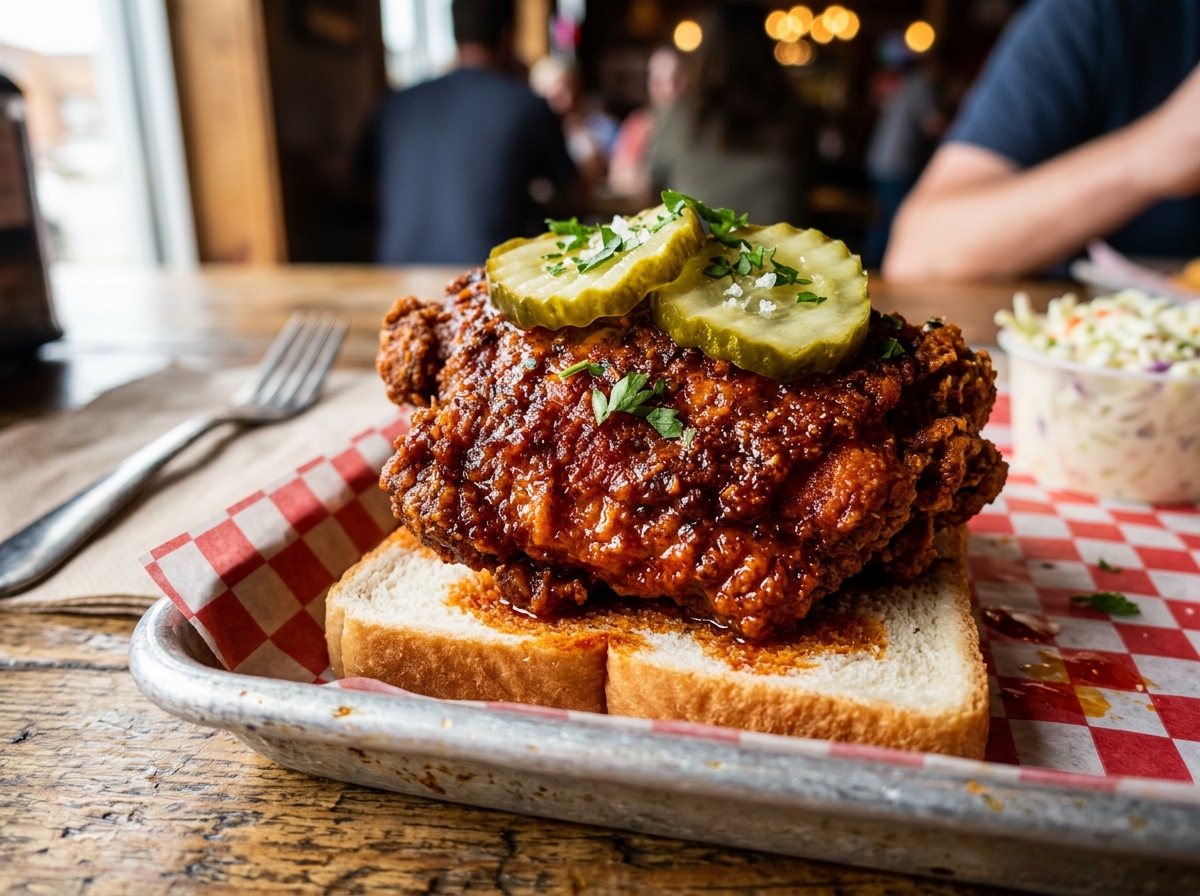
Read that again — they use the hot frying oil as the base of the spice paste. That’s what gives Nashville hot chicken its distinctive look: a dark, reddish-brown, almost lacquered coating that’s slightly oily and intensely flavorful. It’s not a sauce. It’s not a glaze. It’s a spice-infused oil paste.
This technique does two things simultaneously. It delivers the heat directly to every surface of the chicken, and it also creates that signature sheen. When you see a piece of Nashville hot chicken glistening under the lights, that’s the frying oil and cayenne doing their work.
The Brine and Buttermilk Soak
Before anything gets fried, the chicken is typically soaked in a seasoned buttermilk brine for at least several hours — often overnight. This step tenderizes the meat and adds a layer of flavor that goes deeper than just the surface. Some places add hot sauce directly into the buttermilk, so the heat starts from the inside out.
If you’ve ever made chicken tacos for catering or any other dish that benefits from a good marinade, you already know how much difference a proper soak makes. Same principle here, just different flavors.
The Breading
The breading is usually simple — seasoned flour, sometimes with a bit of cornstarch for extra crunch. No panko, no breadcrumbs, no elaborate multi-step coating. Just well-seasoned flour, pressed firmly into the buttermilk-soaked chicken. Some cooks do a double-dip (flour, back into buttermilk, flour again), but the coating stays relatively thin compared to something like chicken fried steak.
Speaking of which, if you’re curious about another Southern fried classic, take a look at what chicken fried steak actually is — the breading philosophy is surprisingly similar, though the execution differs quite a bit.
The Serving
Traditional Nashville hot chicken is always served on top of white bread slices with dill pickle chips on the side. This isn’t just presentation — the bread soaks up the spicy oil that drips off the chicken, and you eat that bread. It’s practically a bonus course. The pickles provide a sharp, vinegary contrast to the heat, giving your palate a brief reset between bites.
You won’t find Nashville hot chicken traditionally served on a brioche bun with coleslaw and fancy aioli. Those are modern adaptations. The original is bone-in chicken pieces, on white bread, with pickles. That’s it. And it works perfectly.
Heat Levels: How Hot Are We Really Talking?
Most Nashville hot chicken restaurants offer a range of heat levels, and this is where things get interesting — and sometimes dangerous.
At Prince’s Hot Chicken Shack, the scale typically goes something like this: Plain, Mild, Medium, Hot, and Extra Hot. But don’t let the word “mild” fool you. “Mild” at Prince’s would be considered fairly spicy at most regular restaurants. Their “hot” is genuinely painful for people who aren’t used to serious capsaicin. And “extra hot”? That’s reserved for people who either have an astonishing tolerance for spice or enjoy suffering.
Other popular Nashville spots like Hattie B’s, Bolton’s Spicy Chicken & Fish, and 400 Degrees have their own scales, and the top levels at each place can vary wildly. Some use ghost peppers or Carolina Reapers at their highest tiers.
Pro Tip: If you’re trying Nashville hot chicken for the first time — at a real Nashville restaurant, not a fast food chain — start at medium. Seriously. Your ego might want you to go higher, but your body will thank you for showing some restraint. You can always order hotter next time. You can’t un-eat something that’s making you question your life choices.
The heat in Nashville hot chicken isn’t just about the Scoville units of the cayenne pepper. Because the spice is carried in hot oil, it coats your lips, your tongue, and your throat in a way that dry spice doesn’t. The fat in the oil actually helps the capsaicin molecules bond to your pain receptors more effectively. So even a “medium” Nashville hot chicken can feel more intense than sprinkling the same amount of cayenne on a piece of grilled chicken.
Making Nashville Hot Chicken at Home
This is where most people land when they search for Nashville hot chicken — they want to make it themselves. And the good news is, you absolutely can. The technique isn’t complicated. It just requires attention to a few details.
What You’ll Need
For the brine:
Buttermilk (about 2 cups), hot sauce (a few tablespoons of something like Louisiana-style or Crystal), salt, garlic powder, and a pinch of paprika.
For the chicken:
Bone-in, skin-on chicken pieces work best. Thighs and drumsticks are traditional, though breast pieces are common too. You’ll need about 3–4 pounds for a solid batch.
For the breading:
All-purpose flour (about 2 cups), salt, black pepper, a little garlic powder, and a half teaspoon of cayenne in the flour itself.
For the hot paste (the key part):
Cayenne pepper (3–4 tablespoons for “hot” level — adjust based on your tolerance), brown sugar (1 tablespoon), paprika (1 teaspoon), garlic powder (1 teaspoon), and about 1/3 cup of the hot frying oil you just cooked the chicken in.
For serving:
White bread slices and dill pickle chips.
The Process
Step 1 — Brine the chicken. Combine your buttermilk, hot sauce, salt, and garlic powder in a large bowl. Submerge the chicken pieces, cover, and refrigerate for at least 4 hours. Overnight is better. This step is non-negotiable if you want properly tender, flavorful chicken.
Step 2 — Set up your frying station. Pull the chicken from the brine and let excess buttermilk drip off. Season your flour mixture in a shallow dish. Press each piece firmly into the flour, making sure every surface is well-coated. Let the breaded pieces rest on a wire rack for about 10–15 minutes before frying — this helps the coating set and prevents it from falling off in the oil.
Step 3 — Fry the chicken. Heat your frying oil (peanut oil is traditional, but vegetable or canola work fine) to 325°F (163°C). Yes, 325°F — not 350°F or 375°F like most fried chicken recipes call for. The lower temperature allows the chicken to cook through without burning the exterior, which is important because you’re going to be applying a dark spice paste afterward. Fry for about 15–18 minutes for thighs and drumsticks, flipping once halfway through. Internal temperature should hit 165°F (74°C).
Getting the oil temperature right matters a lot here. If you’re interested in the science behind frying temperatures, you might find our guide on how to fry at home without deep frying helpful — it covers oil management basics that apply to this recipe too.
Step 4 — Make the paste. While the chicken is frying (or right after it comes out), combine your cayenne, brown sugar, paprika, and garlic powder in a heat-safe bowl. Carefully ladle about 1/3 cup of the hot frying oil into the spice mixture and stir until it forms a paste. It should be loose enough to brush on, but thick enough to cling.
Step 5 — Apply the paste. Using a basting brush, coat each piece of fried chicken generously with the spice paste. Don’t be shy. Get it into every crevice and fold of the crust.
Step 6 — Serve immediately. Place the chicken on white bread slices and add pickle chips on the side. Eat it while it’s hot. Nashville hot chicken doesn’t really do “leftovers” well — the crust softens, and the paste loses its punch.
⚠️ Warning: The hot oil and spice paste combination can cause serious skin irritation. Don’t touch your face — especially your eyes — while handling it. Wash your hands thoroughly after. Some people wear disposable gloves when applying the paste, which isn’t a bad idea.
Why Did Nashville Hot Chicken Blow Up Nationwide?
For decades, Nashville hot chicken was a local thing. You had to go to Nashville to eat it. Prince’s, Bolton’s, and a handful of other spots had been serving it since the mid-20th century, but it wasn’t on the national radar.
That started to change in the early 2010s. A few factors converged.
The food media boom — blogs, Instagram, YouTube — made visually striking food go viral, and few dishes photograph as dramatically as Nashville hot chicken. That dark, glistening coating against white bread and bright green pickles? It’s practically designed for a camera.
Nashville itself was growing as a tourist destination. As more people visited for music and nightlife, they discovered the food scene. Hot chicken spots became must-visit stops, and visitors brought the obsession home with them.
Then the restaurant industry caught on. Chefs in cities like Los Angeles, New York, and Chicago started putting Nashville hot chicken on their menus. Spicy chicken sandwiches inspired by the Nashville style popped up everywhere. And in 2016, KFC launched a “Nashville Hot” product line nationally, which — love it or hate it — introduced the concept to millions of people who’d never heard of it.
The 2019–2020 “chicken sandwich wars” between Popeyes, Chick-fil-A, and others further cemented spicy fried chicken as a cultural moment. Nashville hot chicken was riding that wave hard.
Did you know? The city of Nashville officially established the Music City Hot Chicken Festival in 2007, held annually at East Park. It draws thousands of visitors and features competitions among local hot chicken restaurants. The event helped formalize Nashville hot chicken as a recognized regional cuisine, not just a niche local specialty.
Nashville Hot Chicken Tenders — The Approachable Version
Not everyone wants to deal with bone-in chicken, and that’s fine. Nashville hot chicken tenders have become enormously popular, especially for home cooks and restaurants looking for a more manageable format.
The technique is identical — buttermilk brine, seasoned flour coating, frying, and the hot oil spice paste. You just use chicken tenderloins instead of bone-in pieces. The cooking time drops to about 6–8 minutes in the fryer since tenders are thinner.
Tenders also work great as the protein in sandwiches, wraps, and even tacos. If you’ve ever explored the evolution of taco fillings, you know that fried chicken — especially spicy fried chicken — has become a legitimate taco filling in the fusion world. A Nashville hot chicken tender on a corn tortilla with pickled onions and a drizzle of ranch? That’s a legitimate meal.
For a deeper look at making tenders specifically, check out our detailed guide on Nashville hot chicken tenders.
What to Drink and Eat Alongside Nashville Hot Chicken
You’re going to need something to drink with this. And no, water isn’t the best option — it actually spreads the capsaicin around your mouth rather than neutralizing it.
Milk-based drinks are your best friend. The casein protein in milk binds to capsaicin and washes it away. A tall glass of cold whole milk, a milkshake, or even a sweet iced tea will do more for you than water ever could.
Beer is the classic pairing. Something light and cold — a lager, a pilsner, or a wheat beer — works best. You don’t want a hoppy IPA; the bitterness can amplify the burn rather than soothing it.
As for sides, Nashville hot chicken traditionally comes with classic Southern accompaniments: coleslaw (the cool, creamy kind), mac and cheese, baked beans, or potato salad. The coleslaw is particularly smart because the creaminess acts as a buffer against the heat, similar to how dairy drinks help.
If you’re building a full spread — say for a game day or a party — Nashville hot chicken sits beautifully alongside other Southern comfort foods. Think of it as the star of a Southern-style buffet.
And if you’re making fries to go alongside? Getting the oil right makes all the difference. Our piece on choosing the best oil for homemade french fries can help you there — because you might already have the fryer going anyway.
The Difference Between Authentic and Chain Restaurant Versions
Let’s be straight about this. The Nashville hot chicken you get from a fast food chain and the Nashville hot chicken you get from Prince’s or Hattie B’s are barely the same dish.
Chain restaurant versions typically use a pre-made spice blend applied as a dry seasoning or a flavored sauce. The chicken is often pressure-fried (which is standard for fast food chicken) and then dusted or coated. There’s no hot oil spice paste. There’s no overnight buttermilk brine. The heat level is designed for mass-market tolerance, which means it’s toned way down.
That’s not necessarily a criticism — chains have to serve millions of people with consistent results. But calling it “Nashville hot chicken” is a stretch. It’s more like “Nashville-inspired spicy chicken.”
Authentic Nashville hot chicken, on the other hand, is an experience. It’s messy. The oil drips down your wrists. The heat builds with every bite. Your lips tingle for an hour afterward. The bread at the bottom is soggy with cayenne-infused oil, and you eat it anyway because it’s somehow the best part.
If you’ve never had the real thing, make it a point to try it — either by visiting Nashville or by making it at home using the proper technique.
A Few Things People Often Get Wrong
“Any cayenne-heavy fried chicken is Nashville hot chicken.”
Not quite. The cayenne is important, yes, but the technique of mixing spices into hot frying oil to create a paste is what defines the dish. Without that step, you just have spicy fried chicken — which can be great, but it’s a different thing.
“Boneless chicken wings can be Nashville hot.”
Technically you can apply the technique to any cut, but traditionalists would push back on this. The bone-in format matters because it affects how the chicken cooks, how the crust forms, and how the paste adheres. Bone-in pieces also stay juicier because the bones insulate the meat during frying.
“You need special peppers or exotic spices.”
You really don’t. Classic Nashville hot chicken uses regular cayenne pepper as the primary heat source. Some modern versions add ghost pepper or habanero powder, but the original recipes relied on cayenne and got their intensity from the sheer quantity used, not from specialty peppers. Brown sugar, paprika, garlic powder — these are pantry staples, not rare ingredients.
FAQ
What’s the best oil for frying Nashville hot chicken?
Peanut oil is the traditional choice because it has a high smoke point (about 450°F) and a neutral flavor that doesn’t compete with the spices. Vegetable oil and canola oil are good alternatives. Avoid olive oil — its smoke point is too low for deep frying, and the flavor doesn’t work with this dish.
How spicy is Nashville hot chicken really?
That depends entirely on how much cayenne goes into the paste. A “medium” at a Nashville restaurant like Prince’s would register as “very spicy” for most casual diners. The highest levels use so much cayenne that the chicken appears almost black-red, and the heat is genuinely punishing. Start mild or medium your first time.
Can you make Nashville hot chicken in an air fryer?
You can make a version of it, but it won’t be quite the same. The air fryer won’t produce enough hot oil for the traditional spice paste, so you’d need to make the paste separately using heated oil from the stovetop. The texture of the crust will also be different — less craggy and crunchy than deep-fried. It works as a lighter alternative, but purists won’t consider it authentic.
What’s the difference between Nashville hot chicken and Buffalo chicken?
They’re completely different preparations. Buffalo chicken (typically wings) is fried plain and then tossed in a sauce made from hot sauce and butter. Nashville hot chicken is coated with a cayenne-and-oil paste after frying. The flavor profiles, textures, and heat delivery are all distinct. Buffalo is tangy and buttery; Nashville hot is smoky, sweet-spicy, and oily.
How long can you store leftover Nashville hot chicken?
You can refrigerate it for up to 3 days in an airtight container. To reheat, use an oven at 375°F for about 10–12 minutes to re-crisp the coating. Microwaving works in a pinch but will make the crust soggy. Honestly, though, Nashville hot chicken is best eaten fresh — the texture degrades noticeably after sitting.
Your Next Move
Nashville hot chicken is one of those dishes that sounds simple on paper but rewards you for doing it right. The overnight brine, the proper frying temperature, and that hot oil spice paste — these details are what separate a truly great Nashville hot chicken experience from just another piece of spicy fried chicken.
If you’ve been eating chain restaurant versions and thinking “this is fine, but what’s the big deal?” — you haven’t had the real thing yet. Make it at home this weekend. Follow the technique. Use the hot frying oil in the paste. Serve it on white bread with pickles. And start at medium heat.
Once you take that first bite — the crunch, the warmth spreading across your tongue, the slight sweetness from the brown sugar cutting through the cayenne — you’ll understand exactly why a dish born from a revenge prank became one of America’s most iconic foods.