Here’s something most people don’t realize — about 7 out of 10 homemade mozzarella sticks either burst open in the fryer, leak cheese everywhere, or come out with a soggy, pale coating. And the frustrating part? The fix isn’t complicated. It’s almost always about temperature accuracy and timing. A few degrees off, a few seconds too long, and you’ve got a greasy mess instead of that golden, crispy shell with perfectly melted cheese inside.
If you’ve ever pulled mozzarella sticks out of the oil only to find empty shells or a pool of cheese at the bottom of your pot, you’re not alone. Deep frying mozzarella sticks is one of those things that looks deceptively simple. Coat, freeze, fry. Done, right? Not quite. The difference between restaurant-quality mozzarella sticks and a kitchen disaster comes down to precision — the right oil temperature, the right frying duration, and a few prep steps most recipes skip over too quickly.
Let’s break all of that down so your next batch turns out exactly the way you want.
Why Temperature Accuracy Matters More Than You Think
You might assume that deep frying is just “throw it in hot oil and wait.” But mozzarella sticks are uniquely unforgiving. Unlike french fries or chicken tenders, you’re dealing with cheese — a filling that melts fast and doesn’t wait around for your breading to catch up.
The whole goal here is a race against time. You need the outer coating to turn golden and crispy before the cheese inside fully melts and finds a way to escape. If your oil is too cool, the breading absorbs oil, stays soft, and the cheese has too much time to heat through and burst out. If your oil is too hot, the outside burns while the inside stays cold and rubbery.
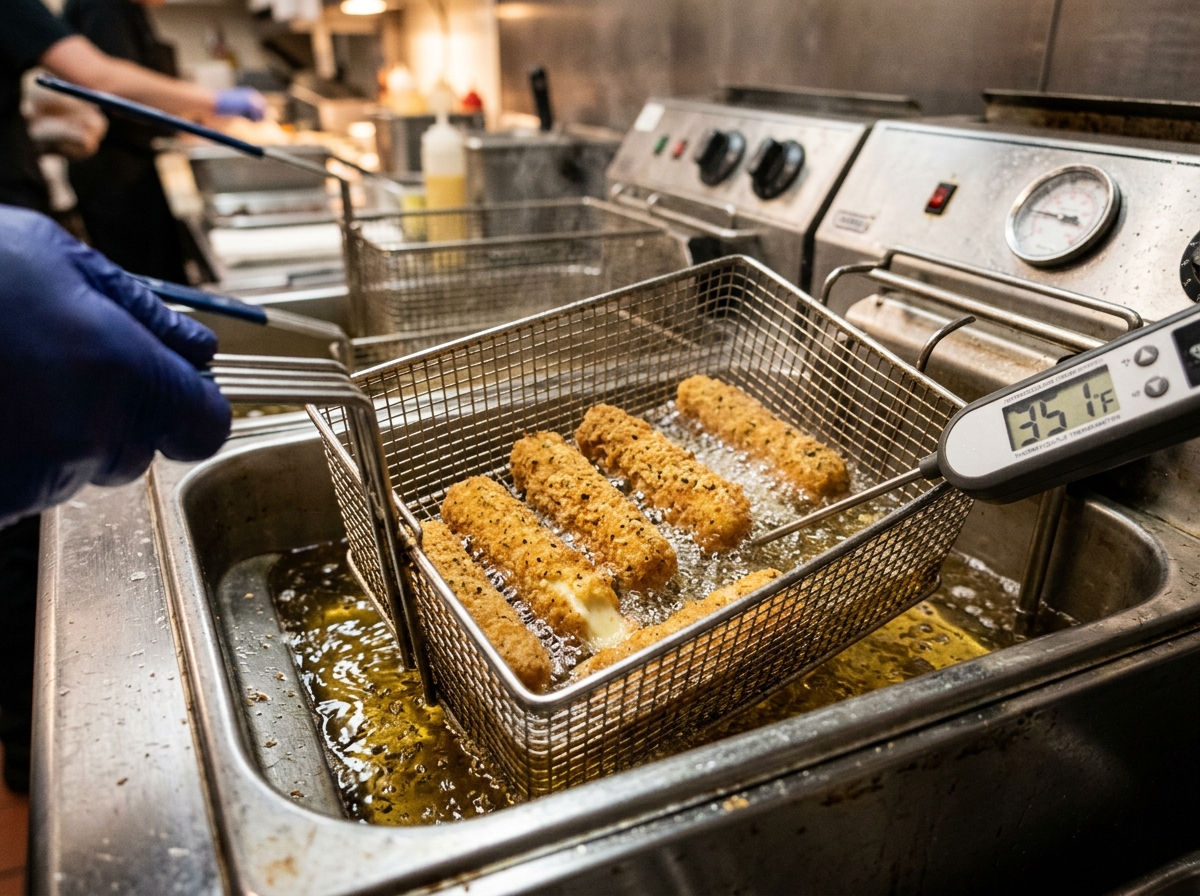
That sweet spot? 350°F to 375°F (175°C to 190°C). Most experienced cooks and food science sources land right around 350°F as the ideal frying temperature for mozzarella sticks. At this temperature, the breading crisps in about 60 to 90 seconds — fast enough that the mozzarella melts into a stretchy, gooey consistency without fully liquefying and breaking through the coating.
Pro Tip: Don’t trust the “drop a breadcrumb in the oil” trick for mozzarella sticks. It’s too imprecise. Use a clip-on deep fry thermometer or an instant-read thermometer. A $12 thermometer is the single best investment you can make for consistent frying results — not just for mozzarella sticks, but for homemade french fries, corn dogs, and anything else that hits hot oil.
Choosing the Right Oil (And Why It Affects Accuracy)
Not all cooking oils behave the same way at high temperatures, and your oil choice directly impacts how accurately you can maintain your frying temperature. Every oil has a smoke point — the temperature where it starts breaking down, smoking, and giving your food off-flavors.
For deep frying mozzarella sticks at 350°F, you want an oil with a smoke point comfortably above that range. Here’s what works well:
Peanut oil has a smoke point around 450°F and holds temperature remarkably well. It’s the go-to for a lot of professional kitchens. Canola oil sits around 400°F and is a solid, budget-friendly choice. Vegetable oil (usually soybean-based) works similarly to canola. Sunflower oil with a high oleic content pushes past 440°F and produces a very clean, neutral flavor.
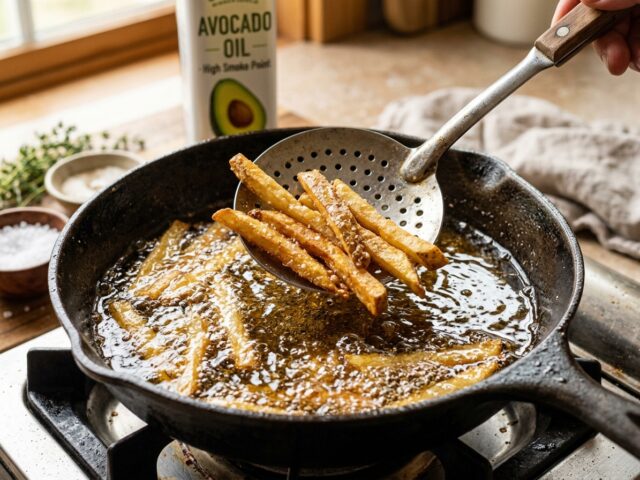
What you want to avoid is extra virgin olive oil (smoke point too low, around 325°F–375°F depending on quality), unrefined coconut oil, or butter — none of these hold up well at sustained deep frying temperatures. If you’re curious about how oil choice affects other fried foods, there’s a detailed breakdown on choosing the best oil for homemade french fries that applies to mozzarella sticks too.
One thing people overlook: oil volume matters for temperature stability. If you’re frying in a small saucepan with only two inches of oil, dropping in cold mozzarella sticks will cause the temperature to plummet — sometimes by 30 to 50 degrees. Use at least 3 inches of oil in a heavy-bottomed pot, and fry in small batches (3 to 4 sticks at a time). A Dutch oven works beautifully for this because cast iron retains heat much better than thin stainless steel.
The Freezing Step You Can’t Skip
Here’s where a lot of home cooks go wrong. They bread their mozzarella sticks, maybe chill them for 15 minutes, and toss them in the fryer. Then they wonder why the cheese leaked everywhere.
Freezing is non-negotiable. You need those mozzarella sticks frozen solid before they touch hot oil. We’re talking at least 2 hours in the freezer, though overnight is even better. The reason is simple physics — frozen cheese takes longer to melt. That extra time gives the breading a crucial head start to set up and form a sealed barrier around the cheese.
Think of it like this: the frozen interior acts as a ticking clock. You’re buying yourself extra seconds in the fryer, and those seconds are the difference between perfectly contained, stretchy cheese and a blowout.
The double-breading method also helps tremendously with containment. Instead of one layer of flour-egg-breadcrumbs, do it twice. Flour, egg wash, breadcrumbs, then back into the egg wash, then breadcrumbs again. That second layer creates a thicker, more resilient shell. After double-breading, straight into the freezer they go.
Quick Fact: Mozzarella cheese starts to soften around 130°F and becomes fully melted and stretchy between 150°F and 170°F. At temperatures above 180°F, it begins to liquify and lose that pull-apart texture. Your frying window is designed to keep the internal temperature of the cheese below that liquifying point.
Exact Frying Time: The 60-to-90-Second Window
This is where accuracy really counts. Once your oil is at a steady 350°F and your mozzarella sticks are frozen solid, you’re looking at a frying time of roughly 60 to 90 seconds. That’s it. Not three minutes. Not five minutes. 60 to 90 seconds.
The visual cues you’re looking for: the breading turns a medium golden brown. Not pale yellow — that means they’re underdone and the coating won’t be crispy. Not dark brown — that means the oil was too hot or they’ve been in too long, and the cheese inside is probably starting to break through.
Here’s a more specific breakdown based on size:
Standard-sized mozzarella sticks (about 3 to 4 inches long, cut from a block of low-moisture mozzarella) will hit that golden zone in about 60 to 75 seconds at 350°F. Thicker sticks, or those made from fresh mozzarella (which has more moisture), might need closer to 90 seconds, but you also run a higher risk of blowouts with fresh mozz.
⚠️ Warning: Don’t walk away from the fryer. Seriously. Mozzarella sticks go from perfect to ruined in about 15 seconds. Stay next to the pot, use a slotted spoon or spider strainer, and pull them as soon as they hit that golden color. Set them on a wire rack over a sheet pan — not paper towels. A wire rack lets air circulate, keeping the bottoms crispy instead of steaming them soggy.
After pulling them out, give them about 60 seconds to rest. The cheese inside will still be extremely hot and will continue to melt slightly from residual heat. Cutting into one immediately is a great way to burn the roof of your mouth and lose all that beautiful melted cheese onto the plate.
What Goes Wrong (And How to Fix It)
Let’s talk about the most common problems people run into, because understanding why things fail is just as important as knowing the correct method.
The cheese completely leaks out. This almost always means one of three things: the oil wasn’t hot enough (below 325°F), the sticks weren’t frozen solid, or there’s a gap in the breading. Check for cracks or thin spots in your coating before freezing. If you see exposed cheese, patch it with a dab of egg wash and more breadcrumbs.
The breading falls off in the oil. Your egg wash layer might have been too thin, or you didn’t let the flour layer set before dipping in egg. Press the breadcrumbs firmly onto the sticks during the breading process. Also, make sure the mozzarella surface is dry before the first flour dredge — moisture creates a slippery layer that prevents adhesion.
The outside is crispy but the cheese inside is still cold and firm. Ironically, this can happen if your oil is too hot — above 400°F. The breading sets and browns so fast that heat doesn’t have time to penetrate to the center. Bring your temperature back down to 350°F and try again.
They taste greasy and heavy. Oil temperature too low. When oil isn’t hot enough, food absorbs it like a sponge. If your thermometer shows anything below 340°F after dropping in a batch, let the oil recover before adding more sticks. This is also why small batches matter — fewer sticks means less temperature drop.
If you’ve dealt with similar frying challenges making other foods, like getting the temperature right for homemade corn dogs, you’ll recognize these patterns. Temperature control is the thread that runs through all successful deep frying.
The Best Cheese for Homemade Mozzarella Sticks
Not all mozzarella is the same, and the type you choose has a major impact on your frying results.
Low-moisture, part-skim mozzarella (the kind you find in blocks at any grocery store — Polly-O, Galbani, store brands) is your best bet. It has less water content, which means it melts more slowly and holds its shape better inside the breading. You can cut it into clean sticks that hold up during breading and freezing.
Fresh mozzarella (the soft, wet balls packed in brine) is delicious on a Caprese salad, but it’s much harder to work with for deep frying. The high moisture content means it melts faster, produces steam inside the breading (which causes blowouts), and makes it difficult to get the coating to stick.
String cheese is actually a perfectly viable shortcut. Each stick is already the right shape and size, and it’s low-moisture mozzarella by default. Many home cooks and even some restaurants use string cheese as their base. It’s consistent, convenient, and works beautifully with the double-breading method.
Did You Know? Low-moisture mozzarella was actually developed in the United States in the mid-20th century specifically for the American market. It was designed to have better melting properties for pizza and a longer shelf life than traditional Italian mozzarella. That same low-moisture quality is exactly what makes it perfect for deep frying.
Oil Temperature Recovery: The Detail Most Recipes Ignore
You’ve got your oil at a perfect 350°F. You drop in six frozen mozzarella sticks. Within seconds, the thermometer drops to 300°F. Now what?
This is what food scientists call “temperature recovery” — how quickly your oil returns to the target temperature after cold food is added. And it’s one of the most overlooked aspects of home deep frying.
Several factors affect recovery time. The amount of oil you’re using (more oil = more thermal mass = smaller temperature drops). The material of your pot (cast iron and heavy stainless steel recover faster than thin aluminum). The heat output of your burner (a powerful gas burner recovers faster than a standard electric coil). And the amount of food you add at once.
For mozzarella sticks specifically, here’s a practical approach. Keep your burner on medium-high, not just medium. Right before you drop the sticks in, bump the temperature up slightly to about 360°F to 365°F, anticipating the drop. Fry only 3 to 4 sticks at a time. Wait at least 60 seconds between batches for the oil to recover.
You can also preheat your oil to 370°F and let it settle back to 350°F with the first batch. This “pre-compensation” technique is used in commercial kitchens all the time, and it works equally well at home.
This same principle applies whether you’re frying mozzarella sticks, making Nashville hot chicken tenders, or perfecting your technique for pan-frying at home without a deep fryer. Temperature management is the backbone of good fried food.
Seasoning and Serving: Making Them Restaurant-Worthy
Golden, crispy, perfectly fried mozzarella sticks are already delicious on their own. But a few finishing touches can take them from “good snack” to “people asking for your recipe” territory.
Season immediately after frying. While the sticks are still glistening with a thin film of oil, hit them with a light sprinkle of fine salt. You can also add garlic powder, dried Italian seasoning, or a dusting of grated Parmesan. The residual oil acts as glue, helping dry seasonings stick.
For dipping sauces, classic marinara is the traditional pairing, and for good reason — the acidity cuts through the richness of the cheese and fried coating. But don’t stop there. Ranch dressing is the American default and works beautifully. A garlic aioli adds a creamy, savory punch. And if you like heat, a drizzle of hot honey (similar to what you’d find on a hot honey pizza drizzler) creates an addictive sweet-spicy contrast.
Mozzarella sticks make excellent appetizers for game day spreads alongside other deep-fried favorites and Southern comfort foods for football watch parties. They’re crowd-pleasers that disappear fast, so plan on at least 4 to 5 sticks per person if you’re serving a group.
Can You Air Fry Mozzarella Sticks Instead?
It’s a fair question, and the honest answer is: yes, but the results are different.
Air fryers work by circulating superheated air around food, and they can produce a reasonably crispy coating on mozzarella sticks. Set your air fryer to 390°F and cook frozen mozzarella sticks for about 6 to 8 minutes, flipping halfway through.
The trade-off? You won’t get the same deep, even golden color or the shatteringly crispy texture that oil-fried sticks have. Air-fried versions tend to be slightly drier on the outside and can have uneven browning. They’re a good option if you’re looking for a lighter version or don’t want to deal with a pot of hot oil, but they’re not a 1:1 replacement for the real thing.
A middle-ground approach that some cooks use: shallow frying. About an inch of oil in a heavy skillet at 350°F. Roll the frozen sticks in the oil, turning every 20 to 30 seconds for about 90 seconds total. You use less oil than deep frying but still get that authentic fried texture. Just make sure the oil comes at least halfway up the sides of each stick.
Quick-Reference Frying Guide
If you want to pin something to your fridge or save on your phone for next time, here are the numbers that matter:
Oil temperature: 350°F (175°C) — use a thermometer, every time.
Frying time: 60 to 90 seconds per batch.
Batch size: 3 to 4 sticks at a time.
Freeze time before frying: Minimum 2 hours, overnight is best.
Oil depth: At least 3 inches in a heavy pot.
Rest time after frying: 60 seconds on a wire rack.
These aren’t suggestions — they’re the parameters that consistently produce perfectly fried mozzarella sticks with a crispy coating and stretchy, melted cheese inside.
FAQ
What temperature do you deep fry mozzarella sticks?
The ideal temperature is 350°F (175°C). This allows the breading to crisp up in 60 to 90 seconds while the frozen cheese inside melts to a stretchy, gooey consistency without bursting through the coating. Always use a thermometer to confirm your oil temperature before frying.
Why do my mozzarella sticks explode in the fryer?
Three common causes: the sticks weren’t frozen solid before frying, the oil temperature was too low (giving cheese too much time to melt and expand), or there were gaps or thin spots in the breading. Double-breading and freezing for at least 2 hours will dramatically reduce blowouts.
How long should you fry mozzarella sticks?
Frozen mozzarella sticks need about 60 to 90 seconds in 350°F oil. They should be a medium golden brown when you pull them out. Don’t leave them in longer hoping for a darker color — the cheese will liquify and escape. If you want a deeper color, the better approach is to use seasoned breadcrumbs with a touch of paprika.
Can you deep fry mozzarella sticks from the fridge instead of the freezer?
You can, but the results won’t be as reliable. Refrigerated (not frozen) sticks give you a much smaller frying window because the cheese reaches its melting point faster. If you’re in a rush, at least freeze them for 45 minutes to an hour. Fully frozen is always the safer choice.
What’s the best oil for deep frying mozzarella sticks?
Peanut oil and canola oil are both excellent choices. They have high smoke points (450°F and 400°F respectively), neutral flavors, and maintain temperature well during frying. Avoid olive oil or any unrefined oil — their lower smoke points can cause off-flavors and inconsistent results.
The gap between a soggy, cheese-leaking mess and a perfect golden mozzarella stick really comes down to a handful of precise details. Get your oil to 350°F with a real thermometer. Freeze your sticks solid. Double-bread for a stronger shell. Fry in small batches for 60 to 90 seconds. That’s the formula.
Once you nail this technique, you’ll find it hard to go back to frozen store-bought bags. And the best part? The same temperature control skills transfer directly to everything else you fry — from crispy chicken sandwiches to homemade corn dogs. Master the thermometer, and you master the fryer. Your next batch of mozzarella sticks is going to be your best one yet.