A burger can look done on the outside and still miss the safe temperature in the center. That’s why the answer to what temperature to cook hamburgers isn’t just “until they’re brown.” For ground beef, the number that matters most is 160°F inside. Pair that with medium-high cooking heat, and you’ll get burgers that are safe, juicy, and far more consistent.
What Temperature to Cook Hamburgers: The Short Answer
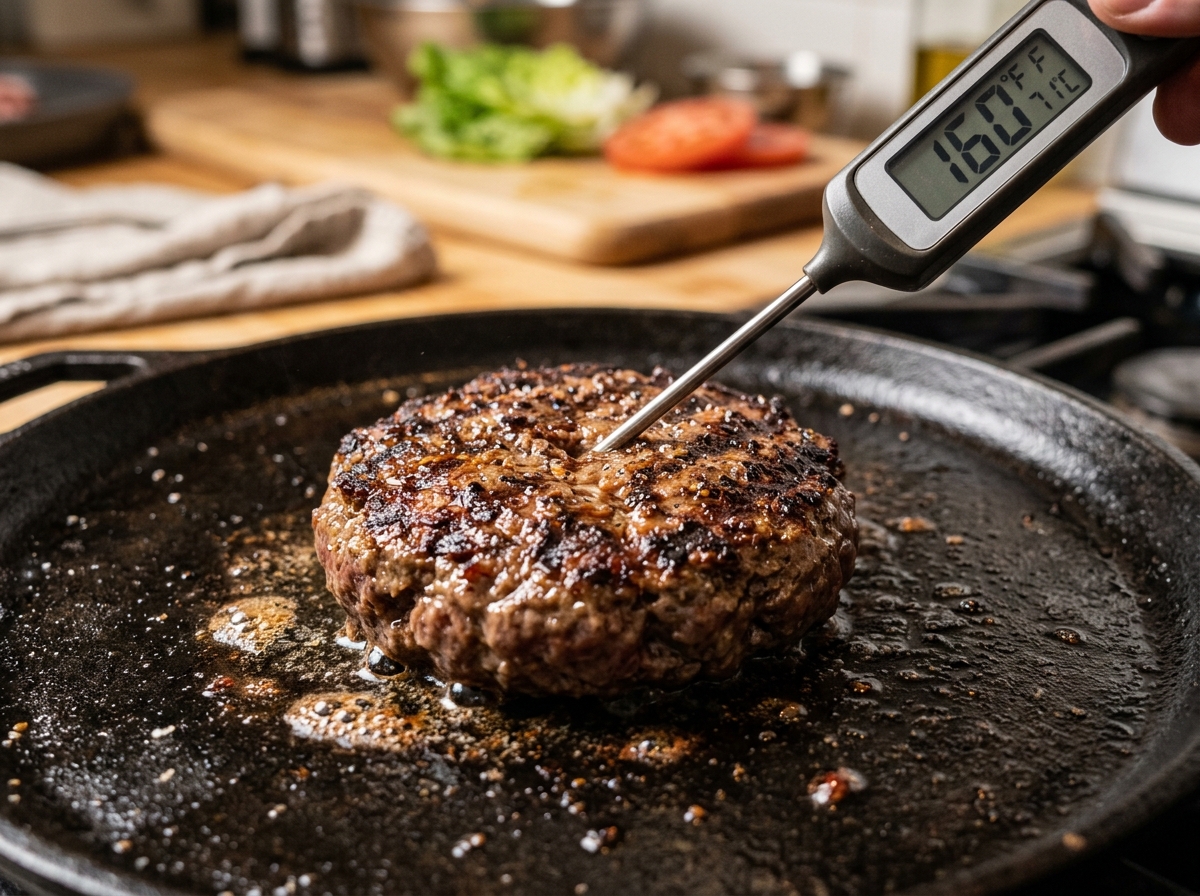
If you want the fast answer, here it is: cook hamburgers to an internal temperature of 160°F. That’s the safe target for ground beef, according to USDA food safety guidance.
For the cooking surface itself, you’ll usually want medium-high heat, which is about 400°F to 450°F on a grill. On a skillet, you want the pan hot enough to sizzle right away, but not so hot that the outside burns before the middle cooks through.
A lot of people mix up two different temperatures:
Safe internal temperature: 160°F
This is the temperature inside the burger, right at the center of the patty. That’s the one that decides whether the hamburger is safely cooked.
Ground beef is different from a steak. With steak, bacteria mostly stay on the outside, so searing the surface does a lot of the work. With hamburger meat, the beef has been ground and mixed, so any bacteria can end up throughout the patty. That’s why the center matters so much.
Best cooking heat: 400°F to 450°F
This is the temperature of your grill grates, griddle, or pan surface. It helps you get a good crust while still giving the center time to reach 160°F.
Too cool, and your burger can turn gray, dry, and oddly chewy. Too hot, and you’ll char the outside while the inside stays underdone.
Quick facts:
- Safe burger temp: 160°F internal
- Best grill temp for burgers: 400°F to 450°F
- Best tool: a digital instant-read thermometer
Why Temperature Matters More Than Color or Cooking Time
A lot of home cooks still use color, juices, or time alone to decide if a burger is done. That works sometimes, but it also causes most burger mistakes.
Ground beef isn’t the same as whole cuts of beef
A whole steak and a hamburger patty may both come from beef, but they don’t behave the same way in the kitchen.
A steak has one solid structure. Ground beef does not. Once beef is ground, the outside gets mixed into the inside. That changes the food safety equation. The safer home-cooking answer stays the same: 160°F.
You’ll also see some restaurant references to 155°F. That can confuse people. Food-service rules often use time-and-temperature combos, such as 155°F held for a specific number of seconds. At home, USDA consumer advice keeps it simpler: cook ground beef to 160°F.
Pink doesn’t always mean raw
Here’s the tricky part. A burger can still look pink and be fully cooked. A burger can also look brown before it reaches a safe temperature.
That color shift depends on things like:
- the meat’s pH
- myoglobin in the beef
- whether the burger was frozen first
- smoke exposure on the grill
Did you know? A smoked burger can keep a pink center even after it reaches 160°F. That’s one reason pitmasters trust thermometers more than eyes.
So if you cut open a burger and see a little pink, don’t panic right away. Check the actual temperature.
Cooking time can fool you too
Search any burger thread on Reddit or Quora and you’ll see the same question again and again: “How many minutes per side?” The honest answer is that time helps, but it can’t be your only test.
Why? Because cooking time changes with:
- patty thickness
- starting temperature of the meat
- grill heat
- wind or weather outside
- fat content
- whether the lid is open or closed
A thin smash burger and a thick pub burger can both spend time on the same grill and finish very differently. Two minutes per side might be perfect for one and nowhere near enough for the other.
That’s why a thermometer beats guesswork every time.
Hamburger Temperature Chart: Doneness vs Safety
A lot of people don’t just want “safe.” They want the burger to feel juicy, tender, or restaurant-style. That’s where doneness levels come in.
Here’s the key thing to remember: doneness levels and food safety aren’t always the same for hamburgers.
Burger temperature chart
| Doneness level | Internal temp | What to know |
|---|---|---|
| Rare | 120°F to 125°F | Not recommended for ground beef |
| Medium-rare | 130°F to 135°F | Not recommended for ground beef |
| Medium | 140°F to 145°F | Still below USDA safe temp |
| Medium-well | 150°F to 155°F | Closer, but still below 160°F |
| Well-done | 160°F and above | Safe target for hamburgers |
If you want a faster reference while cooking, this hamburger internal temp chart can help.
So why do restaurant burgers sometimes come medium?
Restaurants often let guests choose burger doneness. That doesn’t change the food safety risk. It just means the customer is making that choice, and many restaurants use consumer advisories on the menu.
At home, especially if you’re cooking for kids, older adults, pregnant women, or anyone with a weaker immune system, don’t go below 160°F.
Want juicy burgers without undercooking them?
This is where many articles fall short. They say “cook to 160°F” but don’t explain how to keep burgers from drying out.
The fix isn’t undercooking. The fix is technique.
Use 80/20 ground beef if you can. That means about 80% lean meat and 20% fat. It gives you a better shot at a juicy burger even when you cook it fully.
Then stop cooking right when the center reaches 160°F. Not 170°F. Not “just a bit longer to be safe.” That extra time is often what turns a good burger dry.
How to Check Burger Temperature the Right Way
A good thermometer takes most of the stress out of burger night.
Use a digital instant-read thermometer
If you cook burgers often, a digital instant-read thermometer is worth it. It’s one of those tools that feels small until you use it, and then you wonder why you waited so long.
You don’t need anything fancy. You just need a model that reads fast and gives a clear number.
A slow dial thermometer can work, but it’s harder to use with thin patties, and you’ll leave the burgers open longer while waiting for a reading.
Put the probe in the center
The center of the patty is usually the last part to finish cooking. That’s the spot you care about.
For thicker burgers, insert the probe straight down from the top into the middle.
For thinner burgers, go in from the side. That often gives a more accurate reading because the tip of the probe can sit right in the center instead of slipping too close to the surface.
Pro tip: If your patties are under 3/4 inch thick, the side-entry method is usually the easiest.
Start checking a little early
Don’t wait until you think the burger is done. Start checking a minute or two before that point.
That helps you avoid overshooting the temperature. A burger that climbs from 160°F to 170°F very quickly can go from juicy to dry before you realize it.
Burgers also have a little carryover cooking, but not a lot. Since patties are fairly thin, the rise after cooking is usually small. So don’t count on resting alone to bring an undercooked burger up to a safe temp.
Let burgers rest, but keep it short
A short rest helps juices settle. Three minutes is usually enough.
That said, resting is not a rescue plan for raw centers. Your burger should already be at 160°F before you pull it for serving.
Best Cooking Temperatures by Method
The safe internal temperature stays the same, but the cooking setup changes how you get there.
On a gas or charcoal grill
A good target for grilling burgers is 400°F to 450°F, which most people call medium-high heat. That gives you nice browning without scorching the outside too fast.
For standard patties around 1/2 to 3/4 inch thick, you’ll often land somewhere around 4 to 6 minutes per side. That’s a useful starting point, not a promise.
Need more detailed timing? Check this article on how long to grill burgers.
If you’re using propane at home, this step-by-step piece on grilling burgers on a gas grill makes the setup easier.
A few grill notes make a big difference:
- Preheat fully before the burgers go on
- Oil and clean the grates if sticking is a problem
- Use two heat zones if your grill runs hot
- Close the lid between flips if you want steadier heat
If your grill thermometer is hovering around 400°F, you might also like this timing breakdown for how long to grill burgers at 400°F.
In a skillet or on a griddle
A cast-iron skillet is one of the easiest ways to make burgers indoors. You want medium-high heat, which usually means preheating the pan for a few minutes until it’s hot enough for a strong sizzle.
Don’t crank the burner to max unless you’re making very thin smash burgers. That level of heat can burn standard patties before the center is ready.
For skillet burgers:
- preheat the pan
- add the burger
- let it develop a crust before flipping
- check the center near the end
- remove at 160°F
If the pan is smoking hard before the burger even goes in, back the heat down a little.
In the oven, on a pellet grill, or from frozen
Oven burgers work best around 375°F to 400°F. They won’t get the same grilled flavor, but they can still come out well if you use a rack or finish them under the broiler for a minute.
Pellet grills usually do well in the 400°F to 425°F range for burgers. You still want the same final internal temperature of 160°F. If that’s your setup, here’s a full look at how to cook hamburgers on a pellet grill.
Frozen patties need more patience. The outside can brown fast while the center stays cold, so a steady 375°F to 400°F is often easier to control than blasting them at very high heat. If you start from frozen often, this piece on how to grill frozen burgers will save you some trial and error.
A Simple Method for Juicy, Safe Hamburgers
Knowing the right temperature is half the battle. The other half is using a method that gets you there without drying the meat out.
Start with patties that cook evenly
Try to shape patties so they’re even in thickness. Around 3/4 inch thick works well for many home cooks.
A burger that’s thin on one side and thick on the other will cook unevenly. One end can hit 160°F while the other lags behind.
A small thumb dent in the center can help the patty stay flatter as it cooks. That means more even contact with the pan or grill and fewer giant domes in the middle.
Cold meat is fine, but ice-cold centers slow things down. If the patties came straight from the fridge, that’s normal. If they’re stiff and half-frozen, expect longer cooking and less even results.
Season simply and cook over steady heat
Salt and pepper are enough for a classic burger. Season the outside right before cooking so the salt doesn’t start pulling moisture out too early.
Then cook over steady heat. Don’t keep moving the burgers around. Don’t mash them flat with a spatula unless you’re intentionally making smash burgers from the start.
Warning: Pressing burgers while they cook pushes flavorful juices onto the grill or skillet. It feels satisfying, but it usually gives you a drier burger.
A 6-step routine that works almost every time
- Preheat your grill, pan, or griddle to medium-high heat.
- Season the patties right before they go on.
- Cook the first side until you get good browning.
- Flip and cook the second side until the center gets close.
- Check the middle with an instant-read thermometer.
- Pull the burgers at 160°F, rest briefly, then serve.
That’s the routine. Simple beats fancy here.
The most common mistakes
One mistake is trusting time alone. A burger that “always takes five minutes per side” is fine until the day it doesn’t.
Another mistake is cooking too hot because you want a quick sear. High heat sounds smart, but it often gives you a burnt crust and an undercooked middle.
A third mistake is leaving the burgers on well past 160°F because you’re nervous. That’s understandable. Still, once you confirm the center has reached the target, keeping them on longer usually only hurts texture.
The last big mistake is skipping the thermometer. People will spend good money on beef, buns, cheese, and toppings, then guess the one number that matters most. That’s like baking a cake with the oven light off and hoping for the best.
If you want a cheeseburger, time it near the end
Add cheese during the last minute or two of cooking, once the burger is nearly done. That way the cheese melts without forcing you to overcook the meat.
For example, if the burger is reading around 150°F to 155°F, top it with cheese, close the lid or cover the pan briefly, then check again. Once it reaches 160°F, it’s ready.
4. FAQ Section
FAQ
What temperature should hamburgers be cooked to?
Hamburgers should be cooked to 160°F internal temperature. That’s the standard safe temperature for ground beef. Use a digital instant-read thermometer and check the center of the patty.
What temperature should the grill be for burgers?
A grill temperature of 400°F to 450°F works well for most burgers. That’s medium-high heat. It gives you good browning on the outside while helping the center cook through to 160°F.
Can a hamburger be pink at 160°F?
Yes, it can. Color is not a perfect safety test. A burger may stay pink because of myoglobin, smoke, or the way the meat was handled before cooking. If the thermometer says 160°F in the center, it’s safely cooked.
Is 145°F safe for hamburgers?
For home-cooked hamburgers made from ground beef, 145°F is below the USDA safe target. The safer number is 160°F. If you’re cooking for children, pregnant women, older adults, or anyone with a weaker immune system, don’t guess and don’t go under that temperature.
How long do burgers take at 400°F?
At 400°F, many burgers take about 8 to 12 minutes total, depending on thickness. Thin patties cook faster. Thick pub-style burgers take longer. Time is only a rough guide, so always confirm with a thermometer. If you want a tighter timing breakdown, see how long to grill burgers at 400°F.
Should I cook hamburgers to medium or medium-rare?
Some people prefer medium or medium-rare burgers, but ground beef is safest at 160°F. That’s different from steak. A medium burger may taste juicy, but it does not meet the standard home safety target for hamburger.
5. Conclusion
The simplest answer to what temperature to cook hamburgers is still the best one: 160°F inside, cooked over medium-high heat. Once you stop guessing by color and start checking the center with a thermometer, burgers get a lot easier to nail. Next time you cook, keep that one number in mind, and you’ll serve burgers that taste better and feel safer too.