One minute too long at 400°F can turn a juicy burger into a dry one. The good news? Most fresh burgers only need about 6 to 10 minutes total. If you’re trying to figure out how long to grill burgers at 400°F, the real answer depends on patty thickness, grill type, and internal temperature.
A lot of articles throw out one cooking time and stop there. That’s why people end up with burgers that look done outside but stay raw in the middle. You don’t need guesswork. You need the right timing, the right temperature, and a few small grill habits that make a big difference.
How Long to Grill Burgers at 400°F: The Quick Answer
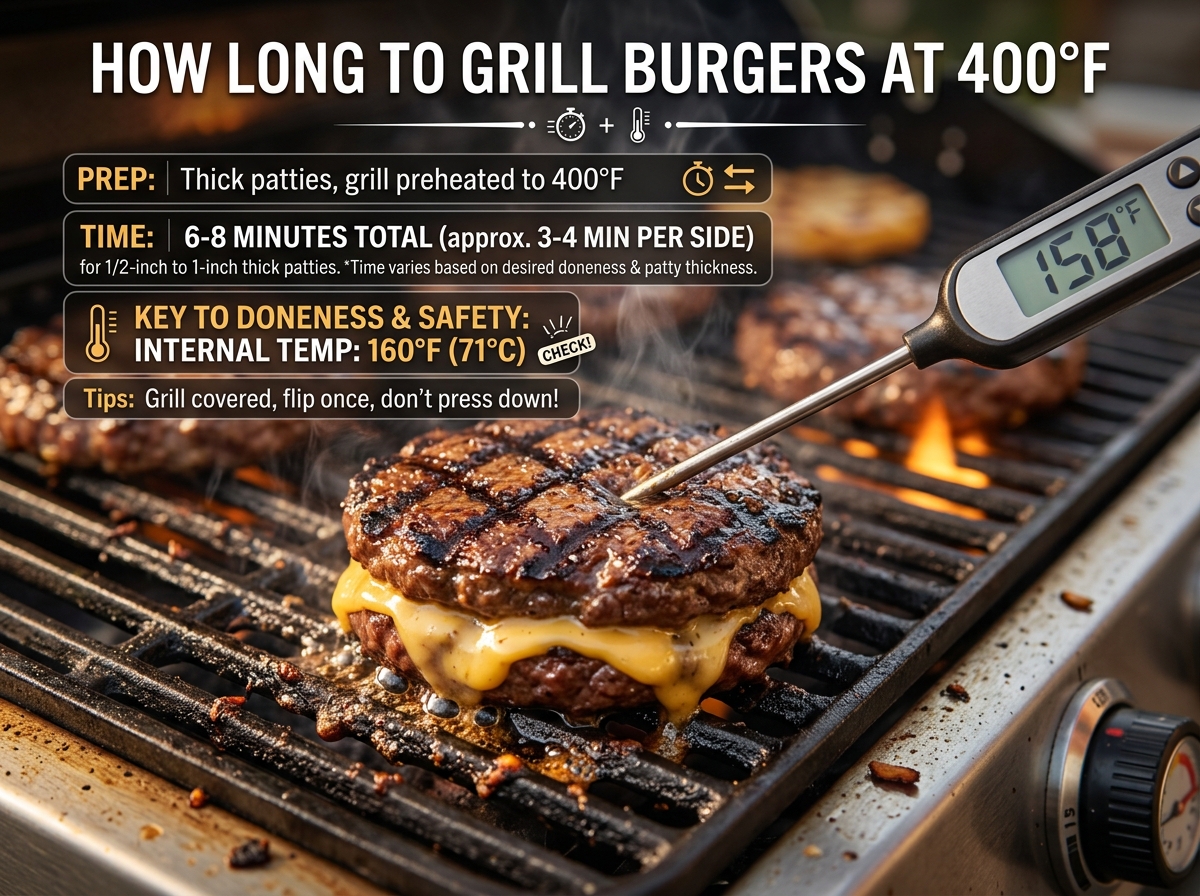
At 400°F, most fresh beef burger patties cook in about 3 to 6 minutes per side. For the standard backyard burger, that usually means 6 to 10 minutes total.
Here’s a simple timing chart you can actually use:
| Patty Style | Approx. Thickness | Time Per Side at 400°F | Total Time |
|---|---|---|---|
| Thin smash-style patty | 1/4 to 1/3 inch | 2 to 3 minutes | 4 to 6 minutes |
| Standard burger patty | 1/2 inch | 3 to 4 minutes | 6 to 8 minutes |
| Thick backyard burger | 3/4 inch | 4 to 5 minutes | 8 to 10 minutes |
| 1-inch pub-style burger | 1 inch | 5 to 6 minutes | 10 to 12 minutes |
| Frozen patty | 1/2 to 3/4 inch | 5 to 7 minutes | 10 to 14 minutes |
These times assume:
- the grill is fully preheated to 400°F
- the burgers start cold from the fridge
- you flip them once
- the lid stays mostly closed for standard or thick patties
Quick facts:
- 1/2-inch burgers: usually 6 to 8 minutes total
- 3/4-inch burgers: usually 8 to 10 minutes total
- Safe internal temp for ground beef: 160°F
If you want timings at other heat levels too, this full guide on how long to grill burgers gives a broader picture.
Why the answers online seem all over the place
You’ve probably seen one site say 4 minutes per side and another say 6. Both can be right.
A thin quarter-pound patty and a thick one-third-pound patty don’t cook the same way, even if they look close at first glance. Grill lids, grate heat, wind, flare-ups, and frozen vs. fresh meat also change the clock.
That’s why time helps, but temperature finishes the job.
What Changes How Long to Grill Burgers at 400°F?
If your burgers don’t match the chart exactly, there’s usually a good reason. A few things control cook time more than people think.
Patty thickness matters more than patty weight
Most people focus on ounces. Your grill cares more about thickness.
A wide, flat quarter-pound burger can cook faster than a tall, dense quarter-pound burger. Same weight. Different shape. Different timing.
Here’s a real example. A patty that’s about 1/2 inch thick can hit 160°F in around 7 minutes. Make that same amount of meat 3/4 inch thick, and now you may need 9 or 10 minutes.
If you want even cooking, shape all your patties about the same thickness before they hit the grill. That way, you’re not pulling one burger early and drying another one out while you wait.
Fresh burgers cook more evenly than frozen ones
Fresh patties are easier to control. The center and outside heat up at a more even pace.
Frozen burgers need more time because the middle has to thaw before it can fully cook. That’s why frozen patties can get dark on the outside while the center still lags behind.
You can grill frozen burgers at 400°F, but expect a longer cook and check the internal temperature more often. If that’s what you’re making tonight, this guide to grilling frozen burgers will save you a lot of trial and error.
Grill type, lid position, and hot spots change the clock
A gas grill, charcoal grill, and pellet grill can all hit 400°F, but they don’t always behave the same way.
A gas grill usually holds 400°F more steadily. Charcoal often gives stronger direct heat and hotter pockets. Pellet grills tend to cook more evenly, though they may brown a bit differently.
The lid matters too. For standard burgers, keep the lid mostly closed. That helps heat move around the burger, not just up from the grates. Thin patties are more forgiving, so you can leave the lid open if you want a closer eye on them.
One thing many people miss: your grill lid thermometer may say 400°F, but the grate right over the burners can be hotter. If your first batch browns too fast, your cooking surface may be running above the number on the lid.
If you’re working on a propane setup, this gas grill burger tutorial can help you manage heat and avoid flare-ups.
How to Grill Burgers at 400°F Step by Step
Knowing the minutes helps. Knowing the method helps even more.
Prep the patties for even cooking
Start with 80/20 ground beef if you want juicy burgers. That little bit of extra fat gives you a bigger margin for error. Very lean beef can dry out fast at 400°F.
Shape the patties gently. Don’t pack them tight like meatballs. Dense patties feel heavy and cook up firm.
Aim for patties that are about 1/2 to 3/4 inch thick. That size works really well at 400°F because the outside gets nice browning before the inside overcooks.
Press a shallow thumbprint or dimple in the center of each patty. That small trick helps stop the burger from puffing up like a dome.
Season the outside right before grilling with salt and pepper. Then preheat the grill for about 10 to 15 minutes until it holds steady around 400°F. Clean the grates and oil them lightly so the burgers release cleanly.
Pro tip: Cold patties from the fridge are fine. Don’t leave ground beef sitting out too long while you chat or prep toppings.
Grill the first side and let the crust form
Place the burgers on the hot grates over direct heat. Then leave them alone for a few minutes.
That part matters more than it sounds. If you keep nudging or lifting them every 30 seconds, they won’t build a good crust and they’re more likely to stick.
Use this rough timing for the first side:
- 1/2-inch patties: about 3 to 4 minutes
- 3/4-inch patties: about 4 to 5 minutes
- 1-inch patties: about 5 to 6 minutes
Close the lid for standard and thick burgers. You’ll get better heat circulation and more even cooking.
If flames jump up from dripping fat, don’t panic. Move the burger to a cooler part of the grill for a moment instead of crushing it with the spatula.
Warning: Don’t press burgers down while they cook. That sizzling juice isn’t “extra grease.” It’s moisture leaving your dinner.
Flip once and finish the second side
Once the burger releases easily and has solid browning underneath, flip it.
Cook the second side for about the same amount of time. It may finish a little faster, especially if your grill runs hot after the lid has been closed for a while.
A standard 1/3-pound burger, about 3/4 inch thick, often lands in the 8 to 10 minute total range at 400°F.
Add cheese in the last 60 to 90 seconds. Close the lid so it melts instead of just softening.
This is also the stage where you should start checking internal temperature. Don’t wait until the burger looks “totally done.” By then, you may already be past juicy.
If you want a clearer breakdown of safe targets, this article on what temperature to cook hamburgers makes it simple.
Rest the burgers before serving
Once the burgers reach the right internal temperature, pull them off the grill and let them rest for about 3 minutes.
Resting gives the juices a little time to settle back through the meat. It won’t turn a bad burger into a great one, but it does help protect the texture you worked for.
While they rest, toast the buns cut-side down for 30 to 60 seconds. That tiny step makes a burger feel more finished and keeps the bun from getting soggy fast.
How to Tell When Burgers Are Done at 400°F
A timer gets you close. A thermometer tells you the truth.
Use a thermometer, not just the clock
The best tool for grilled burgers is an instant-read thermometer.
Slide the probe in from the side of the burger, aiming for the center. That gives you a more accurate reading than poking straight down from the top, especially on thinner patties.
Start checking about 1 to 2 minutes before the expected finish time. If your burgers usually take 8 to 10 minutes, check around minute 7 or 8.
That small habit saves burgers from overcooking. It also saves you from cutting one open and spilling the juices out just to “see if it’s done.”
You can keep this hamburger internal temp chart handy if you like seeing the numbers in one place.
What temperature should burgers reach?
For ground beef, the USDA recommends 160°F in the center.
That’s the safest target for home cooks because grinding mixes surface bacteria all through the meat. A steak and a burger don’t play by the same rules.
Here’s the quick version:
| Doneness Level | Internal Temp | Good Choice for Ground Beef at Home? |
|---|---|---|
| Medium | 140 to 145°F | No |
| Medium-well | 150 to 155°F | Still below USDA guidance |
| Well-done / safe | 160°F | Yes |
Some people still ask for burgers cooked medium. That’s your choice, but for home grilling, 160°F is the safest finish.
If you want the full rare-to-well breakdown for reference, this burger temperature guide for all doneness levels explains it clearly.
Visual signs can help, but don’t trust them alone
You can use looks as a backup, not as your main test.
A burger often looks done when:
- the edges are browned
- the center feels firmer than raw meat
- juices rise to the top
Still, those signs can fool you.
Did you know? The red color in burger juices isn’t blood. It’s mostly water and myoglobin, a protein in meat. A burger can stay a little pink and still be safe, or it can turn brown before it actually reaches 160°F.
That’s why color alone is a shaky judge.
If you’re cooking for kids, older adults, pregnant guests, or anyone with a weaker immune system, don’t guess. Go straight to 160°F.
Common Mistakes at 400°F That Dry Out Burgers
A lot of burger problems don’t come from the grill temperature. They come from small habits that seem harmless.
Pressing the patties with a spatula
This one is everywhere.
You hear the sizzle and think, “That must be doing something good.” It isn’t. Pressing the burger squeezes out juices that you can’t get back.
Save the spatula for flipping. If grease causes flare-ups, move the burger to a cooler zone instead of flattening it.
Cooking only by the clock
Time charts help, but they aren’t a promise.
A cold, windy evening slows things down. A grill that runs hotter near the back speeds them up. Thicker patties need more time even if the recipe says otherwise.
Use time as your starting point, then let the thermometer make the final call. That’s the difference between a burger that’s “probably fine” and one you know is right.
Using very lean beef or overworking the meat
If you use 90/10 ground beef and pack it firmly, the burger has less room for error. At 400°F, it can go from okay to dry pretty fast.
That doesn’t mean lean beef is bad. It just means you need tighter timing and a gentler hand while shaping.
For the easiest juicy result, 80/20 ground chuck is still the sweet spot for most grilled burgers.
Skipping the rest or cutting the burger open
You spent all that time protecting the juices, then cut the burger in half over the plate to check the center. We’ve all done it.
The better move is simple: check with a thermometer, then rest the burgers for a few minutes.
Also, don’t count too much on carryover cooking. Burgers are smaller than roasts or thick steaks, so carryover heat is modest. A burger pulled at 150°F usually won’t coast all the way to a safe 160°F on its own.
4. FAQ Section
Frequently Asked Questions
How long do you grill 1-inch burgers at 400°F?
Most 1-inch burgers take about 10 to 12 minutes total at 400°F. Cook them for around 5 to 6 minutes per side with the lid mostly closed, then check the center with an instant-read thermometer. Pull them once they hit 160°F for ground beef.
Do you grill burgers at 400°F with the lid open or closed?
For standard and thick burgers, keep the lid mostly closed. That helps the burgers cook more evenly from top and bottom. For very thin patties, you can leave it open if you want to watch them closely. If flare-ups start, open the lid and move the burgers to a cooler spot.
Is 400°F a good temperature for burgers?
Yes, 400°F is a great temperature for burgers. It’s hot enough to build a browned crust but not so hot that the outside burns before the middle catches up. It works especially well for patties that are 1/2 to 3/4 inch thick, which is the size most people grill at home.
Can you grill frozen burgers at 400°F?
Yes, you can. Frozen burgers usually need about 10 to 14 minutes total at 400°F, depending on thickness. They cook best if you keep the lid closed more often and check the internal temperature early. The outside can brown before the center is fully cooked, so don’t rely on color alone.
How long do burgers take on a gas grill at 400°F?
On a gas grill set to 400°F, most fresh burgers still take about 6 to 10 minutes total. Thin patties cook closer to 6 minutes. Thicker ones may need 10 or a little more. The big advantage of gas is steady heat control. If you want setup details, this gas grill burger tutorial is worth a look.
Should you flip burgers more than once?
You can, but for most backyard burgers, one flip is enough. Leaving the burger alone for a few minutes helps it build a crust and release from the grates more easily. Too much flipping won’t always ruin the burger, but it usually doesn’t help either.
5. Conclusion
If you want the short version, here it is: most burgers at 400°F take 6 to 10 minutes total, and thicker patties can take 10 to 12 minutes. The best burgers come from matching the time to the patty thickness, then checking the center for 160°F.
So the next time you fire up the grill, skip the guesswork. Start with evenly shaped patties, keep the lid mostly closed, and check the temperature a minute or two early. That one habit alone can take your burgers from “pretty good” to the kind people ask you to make again.