A perfectly fried corn dog has a golden, slightly crunchy shell that cracks open to reveal a juicy hot dog wrapped in soft, sweet cornmeal batter. Sounds simple, right? But anyone who’s actually tried making them at home knows the frustration — batter slides right off the hot dog, the outside burns while the inside stays raw, or the whole thing falls apart in the oil. The secret isn’t really about having a special recipe. It’s about understanding your frying temperature and nailing a few small techniques that most recipes skip over.
Let’s walk through everything you need to know to make corn dogs at home that taste like the real deal — maybe even better than what you’d grab at a county fair.
Why Temperature Is the Single Most Important Thing
You can have the best corn dog batter recipe on the planet, but if your oil temperature is off, it won’t matter. Temperature controls everything — how fast the batter sets, how deep the color gets, and whether the hot dog inside actually heats through.
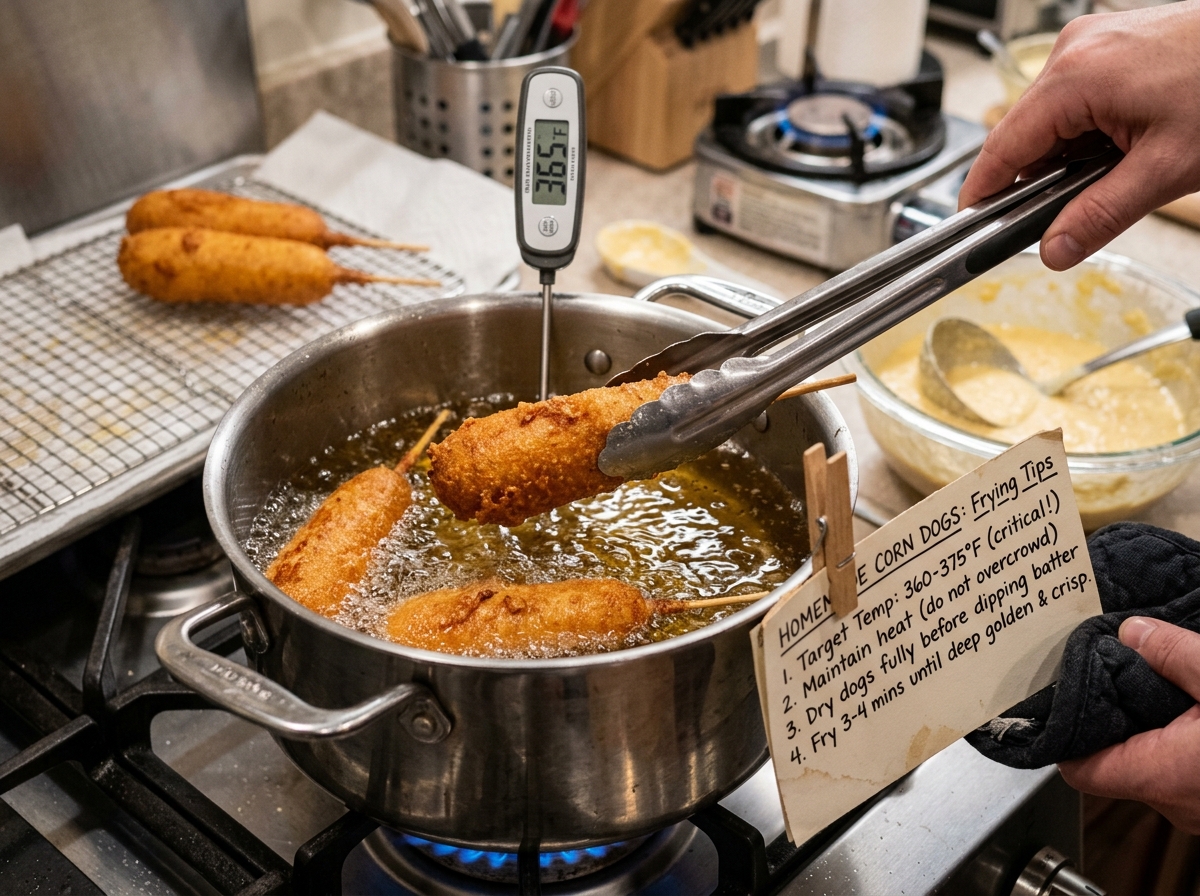
The sweet spot for frying corn dogs is 350°F to 375°F (175°C to 190°C).
Here’s what happens outside that range. If your oil is below 325°F, the batter absorbs too much oil before it crisps. You’ll end up with a greasy, heavy corn dog that feels soggy. If you push the oil above 400°F, the outside darkens fast — sometimes within 60 seconds — while the batter near the hot dog stays raw and doughy.
At 350°F to 375°F, the batter hits the oil and immediately starts to set on the surface. That quick “seal” reduces oil absorption and creates the signature crunch. Meanwhile, the heat transfers inward at just the right pace, cooking the batter evenly and warming the hot dog all the way through.
Pro Tip: If you don’t own a deep-fry thermometer, you’re essentially guessing. A basic clip-on candy/deep-fry thermometer costs under $10 and makes a huge difference. Digital instant-read thermometers work too — just check the oil before each batch.
Picking the Right Oil for Corn Dogs
Not every cooking oil behaves the same at high heat. You need an oil with a high smoke point, a neutral flavor (so it doesn’t compete with that sweet cornmeal taste), and enough stability to hold temperature while you’re frying multiple batches.
Peanut oil is the classic choice for a reason. It has a smoke point around 450°F, stays stable at frying temperatures, and adds a subtle richness without overpowering the batter. Fair vendors and food trucks often use peanut oil for exactly this reason.
Vegetable oil and canola oil work perfectly fine too. They’re cheaper, widely available, and have smoke points in the 400°F–450°F range. If you’re frying for a crowd and don’t want to spend a lot, these are your go-to options. If you’ve ever deep-fried homemade French fries and wondered about the best oil, the same logic applies here.
Corn oil is an interesting option since you’re already working with cornmeal batter. It has a mild flavor that complements the corn dog without clashing.
Avoid olive oil (especially extra virgin) — the smoke point is lower, and the flavor is too strong. Coconut oil works in some frying scenarios, but it can introduce a slight sweetness that changes the overall taste profile.
How Much Oil Do You Actually Need?
This part trips people up. You need enough oil for the corn dogs to float freely, fully submerged, without touching the bottom of the pot. For most home setups, that means filling your pot or Dutch oven with at least 3 to 4 inches of oil.
A heavy-bottomed Dutch oven is ideal because it holds temperature better than a thin-walled pot. When you drop cold batter-coated hot dogs into hot oil, the temperature drops temporarily. A heavy pot recovers faster, which means more consistent results.
If you’re using a countertop deep fryer, follow the manufacturer’s fill line. Most home deep fryers hold enough oil to fry 2 to 3 corn dogs at a time — and honestly, that’s about the maximum you should fry in one batch anyway. Overcrowding drops the oil temperature dramatically.
The Batter: Getting It to Actually Stick
Let’s talk about the part that causes the most headaches. You dip your hot dog into the batter, lower it into the oil, and watch the batter slide right off into a sad, floating blob. Sound familiar?
There are a few reasons this happens, and fixing them is pretty straightforward.
Dry your hot dogs. Seriously, pat them dry with paper towels before you do anything else. Moisture on the surface of the hot dog creates a barrier that prevents batter from gripping. This is the number one reason batter slides off.
Dust them with flour or cornstarch. After drying, roll each hot dog in a light coating of all-purpose flour or cornstarch. This gives the batter something to cling to. Think of it like priming a wall before you paint — the primer helps the paint stick, and the flour helps the batter stick.
Make the batter thick enough. Corn dog batter should be noticeably thicker than pancake batter. If it drips off the hot dog quickly, it’s too thin. You want it to coat and cling. The consistency should be closer to a thick cake batter — it should slowly fall off a spoon rather than pour.
Use tall containers for dipping. Here’s a trick that changes everything. Pour your batter into a tall, narrow glass or container instead of a wide bowl. When you skewer your hot dog on a stick and dip it vertically, the batter coats evenly and stays put. A wide bowl forces you to roll the hot dog sideways, which creates uneven coverage and makes a mess.
The Corn Dog Batter Recipe That Works
Most corn dog batters follow a similar formula. Here’s a reliable base:
Mix together ¾ cup yellow cornmeal, ¾ cup all-purpose flour, 2 tablespoons sugar, 1½ teaspoons baking powder, and ¼ teaspoon salt in a bowl. In a separate container, whisk 1 egg, ¾ cup milk (or buttermilk), and 1 tablespoon honey or melted butter. Combine wet into dry and stir until just blended — don’t overmix or the batter gets tough.
The sugar and honey might surprise you, but that touch of sweetness is what gives corn dogs their signature flavor. It’s a subtle sweetness that plays off the salty hot dog inside. You’re not making dessert — you’re balancing flavors.
Buttermilk instead of regular milk adds a slight tang and makes the batter fluffier thanks to its reaction with baking powder. It’s not mandatory, but if you have it, use it.
Let the batter rest for about 10 minutes before dipping. This lets the cornmeal hydrate and the gluten relax, which improves texture and makes the batter cling better.
Skewering: Sticks, Technique, and Stability
You’ll need wooden sticks — popsicle sticks, bamboo skewers (with pointed ends trimmed), or actual corn dog sticks you can buy online in bulk. Push the stick about two-thirds of the way into the hot dog. You want it secure enough to hold during dipping and frying, but you also need a handle to hold onto.
Here’s something a lot of people don’t think about: dry and flour the hot dogs AFTER skewering, not before. If you flour them first and then jam a stick in, you’ll disturb the coating. Skewer, dry, flour, dip. That’s your order of operations.
If you’re making mini corn dogs (and honestly, these are fantastic for parties), cut your hot dogs into thirds, skewer each piece with a toothpick or short skewer, and follow the same process. Minis cook faster — about 2 to 3 minutes instead of 4 to 5.
Frying Step by Step
Alright, you’ve got your oil at 350°F–375°F, your batter is resting, and your hot dogs are skewered, dried, and dusted. Here’s how to fry them.
Dip a prepared hot dog into the batter, turning it to coat completely. Let excess batter drip off for a few seconds — you don’t want a massive thick layer on one side and nothing on the other.
Lower it gently into the hot oil. Don’t drop it. Gently lower it in at an angle, holding the stick. You can let go of the stick once the corn dog floats and the batter starts to set — usually within 10 to 15 seconds.
Fry for 4 to 5 minutes, turning once or twice with tongs so it browns evenly on all sides. You’re looking for a deep golden-brown color. If it’s hitting dark brown in under 3 minutes, your oil is too hot — pull the corn dog out and reduce the heat.
Remove with tongs or a slotted spoon and place on a wire rack set over a sheet pan. Don’t use paper towels as your primary draining surface — the corn dog sits in its own steam on paper towels and the bottom gets soggy. A wire rack lets air circulate underneath.
Check your oil temperature before every batch. Adding corn dogs drops the temperature. Wait for it to climb back to 350°F before adding more. This patience is what separates mediocre corn dogs from perfect ones.
Troubleshooting the Most Common Problems
Even with the right temperature and technique, things can go sideways. Here’s what to do when they do.
Batter is cracking or splitting open during frying. This usually means the batter was too thick or had too much leavening. A big air pocket forms inside as the baking powder activates, and the crust can’t expand fast enough. Try reducing baking powder slightly or thinning the batter just a touch.
Corn dogs are browning unevenly. You’re probably not turning them during frying. Corn dogs float, and the top side stays out of the oil. Gently roll them with tongs every 60 to 90 seconds for even color.
The hot dog inside is still cold. This happens more often with hot dogs straight from the fridge. Cold hot dogs take longer to heat through, and by the time the center warms up, the batter might be overcooked. The fix is easy — bring your hot dogs to room temperature for about 15 minutes before skewering. They’re pre-cooked, so food safety isn’t a concern during that short window.
Batter keeps falling off in the oil. Go back to basics. Are the hot dogs dry? Did you flour them? Is the batter thick enough? Is the oil hot enough? If the oil is too cool, the batter doesn’t set quickly and slides off before it can form a shell.
If you’ve ever deep-fried mozzarella sticks at home, you know how much frying accuracy matters. The same principles of proper temperature and coating technique apply to corn dogs.
Can You Use an Air Fryer or Oven Instead?
Sure, but let’s be honest about what you’re getting. Air-fried corn dogs work, but the texture isn’t quite the same. You won’t get that full immersion crunch that deep frying provides. The batter tends to be drier and less evenly golden. Still, if you’re avoiding deep frying, preheat your air fryer to 375°F and cook for about 8 to 10 minutes, turning halfway.
Oven-baked corn dogs are another option. Place them on a greased baking sheet at 400°F for 15 to 18 minutes. You can spray them with cooking oil before baking for a slightly crispier finish. They’ll look different — less golden, more matte — but they taste decent.
That said, if you’re going through the effort of making batter from scratch and skewering hot dogs, you might as well go all in with the frying. The texture difference is noticeable. And if frying at home intimidates you, check out this guide on how to fry at home without deep frying — it covers shallow frying methods and safety tips that might make you more comfortable.
Choosing the Right Hot Dogs
Not all hot dogs are created equal, and your choice matters here more than you’d think.
All-beef franks give you the best flavor and snap. Brands like Hebrew National and Nathan’s Famous are popular picks. They hold up well on the stick and have that satisfying bite when you crunch through the batter.
Standard mixed-meat hot dogs work fine, but they tend to be softer and can sometimes bend on the stick. If you go this route, make sure they’re well-chilled (but not frozen) so they stay firm during dipping.
Size matters for even cooking. Regular-sized hot dogs (about 6 inches) need 4 to 5 minutes of frying. Jumbo or foot-long dogs need more time — closer to 6 to 7 minutes — and you’ll need a deeper pot. If you’re curious about making your own franks from scratch for this, take a look at this piece on homemade hot dogs — it’s a fun weekend project that pairs perfectly with homemade corn dogs.
Avoid using frozen hot dogs. They’ll cause the oil temperature to plummet, and the temperature difference between the frozen center and hot oil can cause splattering. Always thaw completely.
Serving and Dipping Sauces
A great corn dog deserves more than just a squirt of yellow mustard — though there’s nothing wrong with the classic.
Pair your corn dogs with honey mustard, spicy ketchup, or a cheese dip for something more interesting. Ranch dressing works surprisingly well with the sweet cornmeal batter. If you like heat, a drizzle of hot honey over the top adds a sweet-spicy kick that’s addictive.
For a full spread, corn dogs fit right in alongside other fried favorites. They’re perfect for game day, kids’ birthday parties, or a football watch party menu with Southern comfort food vibes.
Storing and Reheating Leftover Corn Dogs
If you somehow have leftovers (unlikely, but it happens), store them in an airtight container in the fridge for up to 3 days. You can also freeze them — lay them flat on a baking sheet to flash-freeze, then transfer to a freezer bag. They’ll keep for about 2 months.
Reheat in the oven at 375°F for 10 to 12 minutes for the best results. The oven crisps the batter back up nicely. Microwaving works if you’re in a rush, but the batter goes soft and loses its crunch. An air fryer at 360°F for 5 to 6 minutes is actually the best reheating method — it revives the crispiness almost like fresh.
Quick Reference: Corn Dog Frying Cheat Sheet
Oil Temperature: 350°F–375°F
Frying Time: 4–5 minutes (regular size), 2–3 minutes (minis)
Oil Depth: Minimum 3–4 inches
Best Oils: Peanut, vegetable, canola, or corn oil
Batch Size: 2–3 corn dogs at a time
Internal Visual Cue: Deep golden-brown all over, batter fully opaque
FAQ
What temperature do you fry homemade corn dogs at?
The ideal frying temperature for homemade corn dogs is between 350°F and 375°F. This range allows the cornmeal batter to cook evenly, develop a golden crust, and avoid absorbing excess oil. Always use a thermometer to confirm the temperature before adding corn dogs to the oil.
Why does my corn dog batter fall off when I fry it?
The most common reasons are moisture on the hot dog’s surface, batter that’s too thin, or oil that isn’t hot enough. Pat your hot dogs completely dry, roll them in flour before dipping in batter, and make sure the oil is at 350°F–375°F so the batter sets quickly on contact.
How long do you fry corn dogs?
Regular-sized corn dogs take about 4 to 5 minutes at 350°F–375°F. Mini corn dogs cook faster — roughly 2 to 3 minutes. Turn them once or twice during frying for even browning. The batter should be deep golden-brown all over when they’re done.
Can you make corn dogs ahead of time?
Yes. Fry them, let them cool completely, and freeze them on a baking sheet before transferring to a freezer bag. Reheat in the oven at 375°F for 10 to 12 minutes or in an air fryer at 360°F for 5 to 6 minutes. Avoid microwaving if you want to keep the crunch.
Do you need a deep fryer to make corn dogs at home?
Not at all. A heavy-bottomed Dutch oven or deep pot works perfectly. Just fill it with 3 to 4 inches of oil, clip on a thermometer, and you’re set. The key is maintaining steady temperature — a thick pot does that better than a thin one.
There’s something genuinely satisfying about biting into a corn dog you made yourself — especially when the batter cracks just right and the hot dog inside is perfectly warm. It’s one of those foods that sounds complicated but really comes down to a few basics: right temperature, right batter consistency, and a little patience between batches. Get those three things dialed in, and you’ll be making corn dogs that don’t just compete with the fair — they beat it. Your kitchen, your rules, your perfectly golden corn dogs.