A single degree can be the difference between a burger that makes you close your eyes in satisfaction and one that feels like chewing on cardboard. That’s not an exaggeration — the internal temperature of your burger patty controls everything from juiciness to texture to safety.
Yet most home cooks still eyeball it. They press the patty with a spatula, cut it open (letting all those juices escape), or just guess based on time. The result? Inconsistent burgers that swing between raw-ish and overdone.
This guide breaks down every doneness level — from rare to well done — with exact temperatures, visual cues, and honest advice on what’s safe and what’s risky. Whether you’re grilling beef, turkey, or a plant-based patty, you’ll know exactly what number to hit and why it matters.
Why Burger Temperature Actually Matters
You might think temperature is just about preference. Pink center or no pink center — simple, right? Not quite.
With a steak, the surface searing kills most bacteria because contamination sits on the outside. A burger is different. When beef gets ground, any bacteria on the surface gets mixed throughout the entire patty. That means the center of your burger could harbor harmful pathogens like E. coli O157:H7 or Salmonella if it doesn’t reach a safe temperature.
The USDA has set 160°F (71°C) as the safe internal temperature for ground beef. That’s not a suggestion — it’s based on food science research showing that 160°F destroys the bacteria most commonly found in ground meat.
Does that mean you have to cook every burger to 160°F? We’ll get into that. But understanding the “why” behind the number helps you make informed choices rather than just rolling the dice.
Temperature also directly affects something you care about even more than safety: how your burger tastes. The proteins in ground beef start contracting and squeezing out moisture as heat rises. At 130°F, your patty is still soft and extremely juicy. By 170°F, it’s lost a significant amount of its moisture and fat. That’s why a well-done burger often feels dry unless you’ve taken specific steps to prevent it.
So temperature isn’t just a safety checkbox. It’s the single biggest factor determining whether your burger is something you actually enjoy eating.
Understanding Doneness Levels: The Full Breakdown
Let’s walk through each doneness level one by one. For every level, you’ll get the internal temperature range, what it looks and feels like, and some straight talk about safety and flavor.
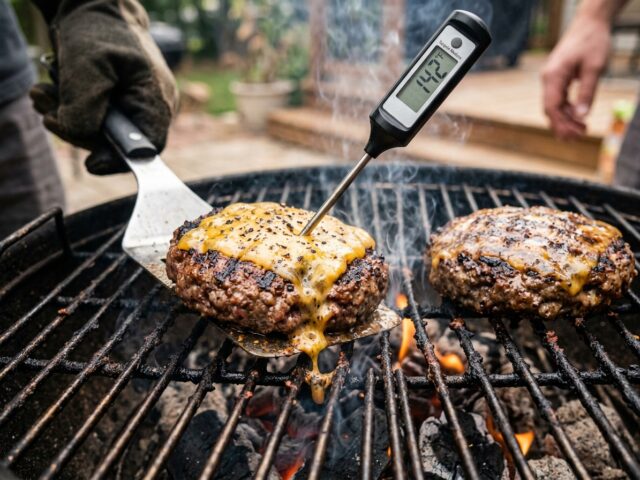
One quick note before we start: always use an instant-read meat thermometer. Insert it into the thickest part of the patty, going in from the side for the most accurate reading. If you’re serious about your grilling game — and you’re reading this, so clearly you are — a good thermometer is a $15 investment that changes everything. For a deeper look at grilling temperatures and timing, check out this detailed breakdown of how long to grill burgers.
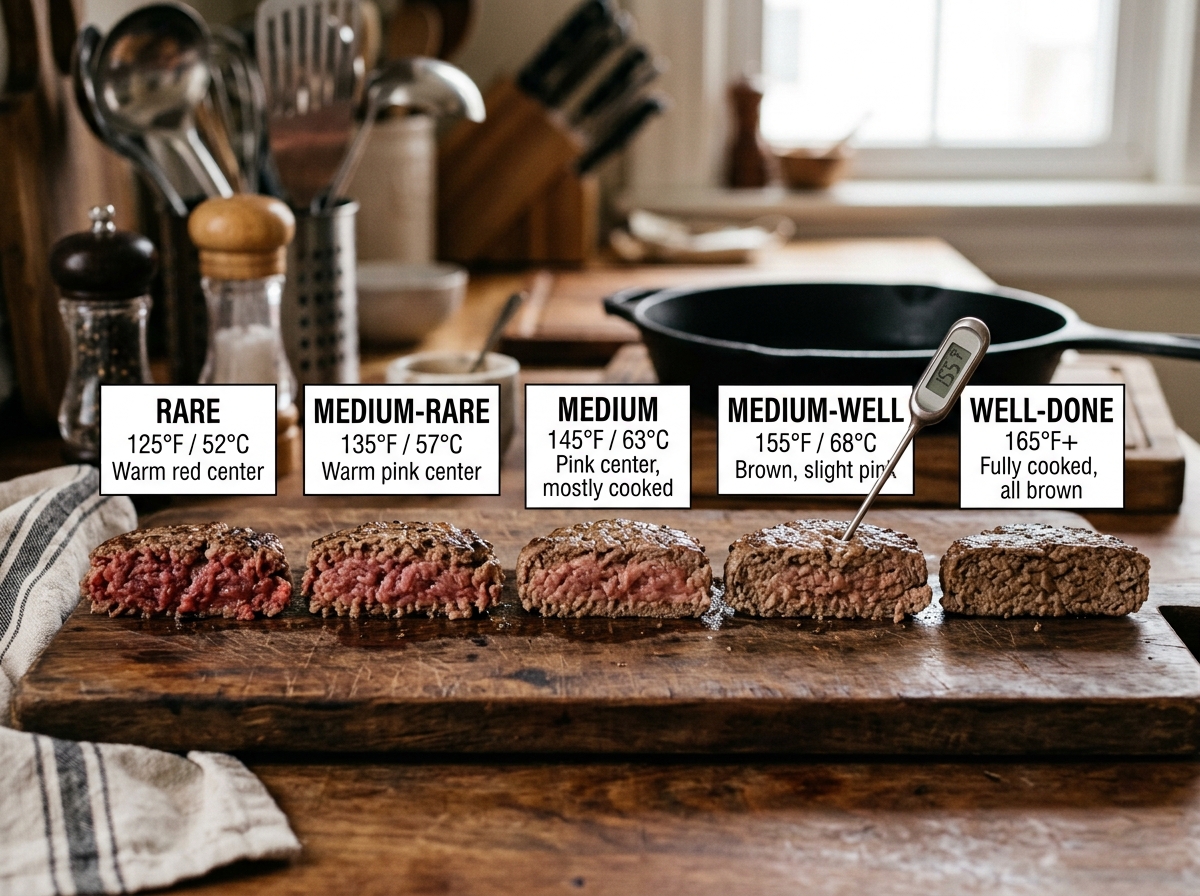
Rare Burger (120°F–125°F / 49°C–52°C)
A rare burger has a cool, deep red center. The outside develops a thin brown crust, but the interior is barely cooked. The texture is very soft — almost mushy in some spots — and incredibly juicy.
Here’s the honest truth: rare burgers carry real risk. Because ground beef mixes surface bacteria throughout the meat, a 120°F center hasn’t reached the temperature needed to kill most harmful pathogens. Some high-end restaurants serve rare burgers, but they typically grind their beef in-house from whole cuts, using strict sourcing and hygiene protocols.
If you’re cooking at home with pre-ground supermarket beef, a rare burger isn’t recommended. The USDA advises against it, and most food safety experts agree.
Who orders it: Very few people, honestly. Even burger enthusiasts who love pink centers usually go medium-rare rather than full rare.
Medium-Rare Burger (130°F–135°F / 54°C–57°C)
This is where flavor chasers live. A medium-rare burger has a warm, red-to-pink center that’s incredibly juicy. The proteins haven’t tightened enough to squeeze out much moisture, so every bite feels rich and buttery. The outer layer has a nice sear with good Maillard reaction browning.
Texture-wise, a medium-rare patty is tender and gives easily when you press it. It holds together on a bun but doesn’t feel dense or firm.
The safety question: At 130°F–135°F, you’re still below the USDA’s recommended 160°F. The risk is lower than rare, but it’s still there. If you want to go this route, your best bet is buying whole cuts of beef and grinding them yourself right before cooking, or sourcing from a butcher you trust. Some people also use the “cook to 140°F and hold” method — holding the burger at a lower temperature for a longer period can reduce bacteria, though this is harder to execute on a home grill.
Medium-rare is the most debated doneness level in the burger world. Chefs love it. Food safety agencies don’t endorse it. You’ll need to make your own call.
Medium Burger (140°F–145°F / 60°C–63°C)
If you want a balance between juiciness and safety, medium is the sweet spot that satisfies most people.
A medium burger has a pink center — not red, not grey, but a warm rosy pink. It’s noticeably juicier than medium-well or well-done but won’t alarm anyone who’s squeamish about underdone meat. The texture is firmer than medium-rare, with a bit more chew, but it still feels moist and satisfying.
At 145°F, you’re close to the temperature the USDA recommends for whole cuts of beef like steaks (which is 145°F with a 3-minute rest). You’re still 15 degrees below the ground beef guideline, but the bacterial kill rate at this temperature is significantly higher than at 130°F.
Pro Tip: If you’re cooking for a crowd and want to keep everyone happy, medium is your safest bet for balancing flavor with broad appeal. It’s the “everybody nods” doneness level.
For those grilling at a specific heat setting, this guide on how to grill burgers at 400°F walks through exact timing to hit medium.
Medium-Well Burger (150°F–155°F / 66°C–68°C)
A medium-well burger has just a slight hint of pink — barely there, almost like a blush in the very center. The rest of the interior is grey-brown. It’s firmer, denser, and noticeably less juicy than a medium patty.
A lot of people default to medium-well because it feels “safe enough” while still having a whisper of softness in the middle. And they’re not wrong — at 150°F–155°F, most harmful bacteria are destroyed, though you’re still technically under the USDA’s 160°F recommendation.
The biggest challenge with medium-well is keeping it from tasting dry. The proteins have contracted enough to push out a good amount of moisture by this point. A few things help:
Choose ground beef with a higher fat content — 80/20 (80% lean, 20% fat) works well here. The extra fat keeps things lubricated even as the meat tightens up. You can also mix in a tablespoon of cold butter or a splash of Worcestershire sauce into the raw patty before forming it. These little tricks add moisture from within.
Don’t press the burger with your spatula while it cooks. That’s basically squeezing the juice out like a sponge. Let it be.
Well-Done Burger (160°F+ / 71°C+)
This is the USDA’s officially recommended temperature for ground beef, and it’s where you’ll find zero pink. The interior is fully grey-brown, firm, and has a drier texture compared to every other doneness level.
Let’s address the elephant on the patio: well-done gets a bad reputation. Burger purists roll their eyes at it. But here’s the thing — if it’s cooked right, a well-done burger doesn’t have to be a hockey puck.
The key is not overshooting. There’s a big difference between 160°F and 175°F. Pull your burger at 160°F and let carryover cooking bring it up a few more degrees while it rests. If you leave it on the grill until your thermometer reads 175°F or higher, that’s where you get into true dry, crumbly territory.
A well-done burger is the right choice in several situations. If you’re cooking for kids, elderly family members, pregnant guests, or anyone with a compromised immune system, 160°F is the responsible target. It’s also what most fast-food chains aim for, and let’s be honest — a well-seasoned Smashburger cooked to well-done can be absolutely delicious.
Did You Know? Smash burgers — thin patties pressed hard onto a screaming hot griddle — are technically well-done but taste incredible because of the extreme crust-to-meat ratio. The Maillard reaction creates so much flavor on the surface that the thinness of the patty doesn’t allow it to dry out.
If you want to understand how different cooking methods affect your burger’s final temperature, take a look at this resource on what temperature to cook hamburgers.
Temperature Guide for Non-Beef Burgers
Beef isn’t the only patty on the grill anymore. Turkey burgers, chicken burgers, and plant-based options all have different temperature needs.
Turkey and Chicken Burgers
Ground poultry is a completely different ballgame from beef. Salmonella is far more common in raw poultry, and there’s no debate here — turkey and chicken burgers must reach 165°F (74°C). No exceptions, no “medium-rare turkey burger” trend. That’s a food safety line you don’t want to cross.
The good news is that turkey and chicken burgers can taste great at 165°F if you build moisture into the patty. Mix in grated onion, a splash of olive oil, or some finely diced mushrooms to keep things from getting chalky. A little trick: add a tablespoon of mayonnaise into the ground meat before forming patties. It sounds odd, but the fat and eggs in mayo work wonders for moisture.
For timing specifics with turkey patties, here’s a helpful guide on how long to grill turkey burgers.
Plant-Based and Meatless Burgers
Brands like Impossible and Beyond Meat have their own recommended temps, usually around 165°F (74°C), though safety concerns are different since there’s no raw meat involved. The temperature here is more about texture and taste than food safety.
Cook a plant-based burger to 135°F and it’ll be mushy and underset. Get it to 165°F and the proteins (usually pea or soy-based) firm up properly, the fats render, and you get a better overall bite.
If you’re curious about how temperature affects meatless patties specifically, this article on meatless burger temperatures goes deeper into the topic.
The Carryover Cooking Effect: Why You Should Pull Early
Here’s something that trips up even experienced grillers: your burger keeps cooking after you take it off the heat.
This is called carryover cooking. The residual heat in the outer layers of the patty continues to push inward, and the internal temperature can rise by 3°F to 5°F during the resting period. For a thick, half-pound patty, the carryover can be even more — up to 7°F or 8°F.
What does this mean practically? If you want a final temperature of 160°F, pull your burger off the grill at about 155°F–157°F. If you’re aiming for medium at 145°F, take it off closer to 140°F–142°F. Let it rest on a plate or cutting board for 3–4 minutes. The temperature will coast upward on its own.
This small adjustment is the difference between hitting your target and overshooting it. It’s especially important for medium and medium-well, where just a few extra degrees can push your burger from juicy to dry.
What About the Squeeze Test and Visual Cues?
You’ve probably seen the “press your patty to check doneness” trick. Some grilling guides even compare the firmness to different parts of your hand — touch your thumb to your index finger, poke the fleshy base, and that’s supposed to be medium-rare. Thumb to ring finger? Medium-well.
Here’s the reality: the hand test is unreliable for burgers. It might work as a rough guide for steaks, where you’re dealing with a consistent whole muscle. But ground beef patties vary in fat content, thickness, how tightly they’re packed, and how cold they were when they hit the grill. All of these factors change how firm the patty feels at any given temperature.
Cutting into the burger is slightly more reliable — you can see the color — but you lose precious juice every time you slice it open. And color itself can be misleading. Ground beef treated with certain gases during packaging can stay pink even when fully cooked. Conversely, some beef turns grey-brown before it’s actually reached a safe temperature. The USDA has confirmed that color is not a reliable indicator of doneness for ground meat.
The only tool that gives you consistent, trustworthy results is a digital instant-read thermometer. They’re fast (reading in 2–3 seconds), accurate, and cheap. If you own a grill, you should own a thermometer. Period.
For a visual reference chart that you can keep near your grill, this hamburger internal temp chart is worth bookmarking.
How Patty Thickness and Fat Content Affect Temperature
Not all burger patties cook the same way, even at identical grill temperatures. Two big variables change the game: how thick the patty is and how much fat is in the grind.
Thickness Matters More Than You Think
A thin patty (about ¼ inch, like a smash burger) cooks in 2–3 minutes and doesn’t give you much control over doneness. It’s going to be well-done almost by default, and that’s fine — the crispy crust carries the flavor.
A standard patty (about ¾ inch) is the most versatile. You can hit any doneness level from medium-rare to well-done with good control. This is the thickness most temperature guides (including this one) assume.
A thick pub-style patty (1 inch or more) is where things get tricky. The outside can char before the center reaches your target temperature. For thick patties, use a two-zone setup on your grill: sear over high heat for a minute on each side to build crust, then move to the cooler zone to let the interior come up to temperature gradually. This approach gives you the best of both worlds.
If you’re working with a gas grill, this guide on how to grill burgers on a gas grill covers two-zone grilling setup in detail.
Fat Content and Doneness
The fat ratio in your ground beef directly impacts how forgiving your burger is at higher temperatures.
90/10 (90% lean): Very little fat buffer. These patties dry out quickly past medium. If you prefer well-done, this isn’t the grind for you.
80/20: The gold standard for burgers. Enough fat to keep things juicy even at medium-well. This is what most burger restaurants use, and for good reason.
73/27: Extra fatty, extra forgiving. Even at well-done, a 73/27 patty retains decent moisture. The trade-off is a greasier burger, which can make buns soggy if you’re not careful.
Your choice of grind should match your preferred doneness level. Going well-done? Use fattier beef. Cooking to medium or below? Leaner grinds work fine because the lower temp preserves moisture naturally.
Cooking Method and Its Impact on Temperature Control
The way you cook your burger changes how easy (or hard) it is to nail a specific temperature.
Grilling (gas or charcoal): High heat, fast cooking. Great for getting a sear, but temperatures can vary across the grate. Use a thermometer and watch carefully. Flare-ups from dripping fat can char the outside while the center stays underdone.
Cast iron / flat top griddle: More consistent heat than a grill. You get great crust development, and it’s easier to control the cooking pace. This is the preferred method for smash burgers and diner-style patties.
Pellet grill / smoker: Lower, more even heat with the bonus of smoke flavor. Pellet grills give you precise temperature control, which makes hitting an exact internal temp easier than any other method. If you haven’t tried burgers on a pellet grill, this guide on cooking hamburgers on a pellet grill is a great starting point.
Oven (broil or bake): Gentler heat from all directions. Good for thick patties where you want even cooking. Preheat a sheet pan under the broiler, place patties on the hot pan, and broil for even browning.
Frozen patties: Yes, you can grill them straight from the freezer. They take longer to cook and you’ll need to adjust your timing, but the final temperature targets remain the same. Here’s a full walkthrough on how to grill frozen burgers without drying them out.
No matter which method you use, the internal temperature targets don’t change. A medium burger is 140°F–145°F whether it’s cooked on charcoal, gas, cast iron, or in the oven. The method just changes how you get there.
Quick Reference: Burger Temperature at a Glance
For those times when you’re standing at the grill and just need the numbers fast:
Rare: 120°F–125°F — Cool red center. Not recommended for ground beef.
Medium-Rare: 130°F–135°F — Warm red/pink center. Use freshly ground meat if you go this route.
Medium: 140°F–145°F — Pink center. Great balance of flavor and safety.
Medium-Well: 150°F–155°F — Slight pink. Nearly safe by USDA standards.
Well-Done: 160°F+ — No pink. USDA recommended for ground beef.
Ground Turkey/Chicken: 165°F — Non-negotiable.
Plant-Based Patties: 165°F — For best texture and taste.
Pull your burger 3°F–5°F before your target and let it rest. Carryover cooking does the rest.
For a printable version of these temps, the burger temperature chart for grilling page has a clean, easy-to-reference layout.
FAQ
Is it safe to eat a burger that’s pink in the middle?
It depends on the temperature, not the color. A burger at 160°F is safe even if it still has a slight pink tinge (which can happen due to certain proteins or packaging gases). A burger at 130°F isn’t considered safe by USDA standards, even if it looks grey. Always go by thermometer readings, not visual color alone.
What’s the best doneness level for a juicy burger?
Medium (140°F–145°F) gives you the best combination of juiciness and broad safety. If you’re using high-quality, freshly ground beef and you’re comfortable with the risk, medium-rare (130°F–135°F) delivers the juiciest result. For maximum juiciness at higher temps, use 80/20 or 73/27 ground beef and avoid pressing the patty while cooking.
How do I check burger temperature without cutting it open?
Use a digital instant-read thermometer. Insert the probe into the side of the patty horizontally so the tip reaches the center. You’ll get an accurate reading in 2–3 seconds without losing juices. They’re inexpensive, widely available, and far more reliable than the touch test or visual guessing.
Do burger temperatures change for different meats?
Yes. Ground beef’s safe minimum is 160°F (USDA recommendation). Ground turkey and chicken require 165°F because of higher Salmonella risk. Ground pork follows the same guideline as beef at 160°F. Plant-based patties are best at around 165°F for texture reasons, though food safety concerns differ since they don’t contain raw animal protein.
Should I rest my burger after cooking?
Yes. Resting for 3–4 minutes allows the juices — which get pushed toward the edges during cooking — to redistribute throughout the patty. It also accounts for carryover cooking, where residual heat raises the internal temperature by another 3°F–5°F. Place your burger on a clean plate, don’t wrap it tightly (or the crust will steam and soften), and use the resting time to prep your bun and toppings.
Your Next Burger Should Be Your Best One
Knowing the right temperature for your preferred doneness isn’t complicated — it’s just specific. And specificity is what separates a great burger from a “good enough” one.
Grab a thermometer if you don’t already have one. Pick your doneness level based on what you now know about flavor, texture, and safety trade-offs. Remember to pull a few degrees early and let carryover cooking finish the job.
And if you’re still figuring out the rest of your setup — the right grill temp, how long per side, what kind of bun holds up best — explore the burger temp on grill guide for a broader look at the whole process.
Your patties deserve better than guesswork. Give them a number and hit it.