Every taco you’ve ever eaten carries centuries of history in it. The corn tortilla folded around seasoned meat, the sprinkle of cilantro, the squeeze of lime — none of that happened by accident. It’s the result of thousands of years of indigenous farming, colonial trade, waves of immigration, and the kind of everyday creativity that only comes from feeding hungry people on a budget.
Tacos didn’t start in a restaurant. They didn’t start with a chef. And they definitely didn’t start with a crunchy shell from a fast-food chain. The real story is far more interesting — and it begins long before “taco” was even a word anyone used.
Before the Word “Taco” Existed: Ancient Mesoamerican Roots
The taco’s origin story starts with corn, and corn’s story in Mexico goes back roughly 9,000 years. The ancient peoples of Mesoamerica — including the Olmec, Maya, and later the Aztec — had already mastered the art of turning dried corn into masa (dough) through a process called nixtamalization. This is the same process used today: soaking and cooking corn kernels in an alkaline solution, typically lime water, to soften them and dramatically increase their nutritional value.
From masa came the tortilla — flat, thin, and cooked on a clay griddle called a comal. These weren’t side dishes. They were the plates, the spoons, and the food itself. You’d wrap them around whatever was available: beans, peppers, insects, small fish, squash. The folded tortilla as a food vessel is arguably one of the oldest “technologies” in culinary history.
The Aztecs, who dominated central Mexico from the 14th to the early 16th century, ate something very close to what we’d recognize as a taco today. Spanish missionaries and colonizers in the 16th century documented indigenous people eating these folded tortillas filled with small fish, insects like chapulines (grasshoppers), and various stews. Whether they called it a “taco” at the time is a different question entirely.
Where Did the Word “Taco” Actually Come From?
This is where things get genuinely interesting — and a little debated.
The most widely accepted theory among food historians, including researcher Jeffrey Pilcher who wrote Planet Taco: A Global History of Mexican Food, is that the word “taco” originated in the silver mines of 18th-century Mexico. Silver miners used the word “taco” to describe small explosive charges — thin pieces of paper wrapped around gunpowder — used to extract ore from rock. The shape? Very similar to a filled, folded tortilla.
The theory suggests that Mexican mine workers began using the same word for the food they ate on the job: tortillas wrapped around fillings, easy to eat with your hands underground. Simple, portable, sustaining. The word stuck.
There’s also a simpler linguistic argument. In many Spanish dialects, “taco” just means a plug, a wad, or a snack. Mexican Spanish adopted it to describe this specific street food — the same way “tapa” evolved in Spain to mean a small bite.
The first documented written use of “taco” referring to food appears in late 19th-century Mexican texts, though the food itself is obviously far older. By the early 1900s, the word was widely used in Mexico City street food culture.
Tacos in 19th and Early 20th Century Mexico
By the late 1800s, tacos had become firmly associated with working-class Mexican street food. They were fast, cheap, and filling — exactly what factory workers, market vendors, and laborers needed. Mexico City’s urban growth during this period created a massive demand for quick, portable meals, and taco vendors filled that gap.
Tacos de canasta — “basket tacos” — became especially popular. Vendors would fill large baskets with pre-made, steam-softened tacos and carry them through neighborhoods, selling them for just a few centavos each. This tradition still exists today in Mexico City and is considered one of the purest surviving forms of historical taco culture.
The fillings of this era reflected what was available and affordable:
- Beans and chili peppers for the very poor
- Organ meats like tongue, brain, and tripe — cuts that were cheaper and often more flavorful than prime cuts
- Chicharrón (fried pork skin) dissolved in salsa
- Potatoes and chorizo
These weren’t “lesser” options. They were the product of a cooking culture that knew how to transform humble ingredients into something genuinely delicious. Many of these traditional fillings are still among the most beloved in Mexico today, which tells you something about how good the cooking actually was.
The regional diversity of tacos also solidified during this period. Each region of Mexico developed its own signature style — Yucatán had its cochinita pibil (slow-roasted pork in achiote), Oaxaca had its tasajo and chapulines, the northern states developed their beef-heavy traditions due to the cattle ranching culture there. If you want to understand the types of Mexican tacos that exist today, this regional divergence in the 1800s is exactly where that variety was born.
How Tacos Crossed the Border: The American Story
Tacos didn’t arrive in the United States through some grand cultural ambassador. They came with people — specifically, Mexican immigrants and workers who crossed into the American Southwest and California during the late 19th and early 20th centuries.
Texas, New Mexico, Arizona, and California had all been part of Mexico before the Mexican-American War (1846–1848). Mexican food culture, including tacos, was already embedded in those regions. But the massive wave of Mexican immigration during the early 1900s — driven by the turmoil of the Mexican Revolution (1910–1920) — brought taco culture deeper into American urban centers.
By the 1920s, taco stands were operating in Los Angeles, San Antonio, and other cities with significant Mexican-American communities. These weren’t restaurants — they were street operations run by women who became known as “Chili Queens” in San Antonio, setting up open-air food stalls that drew working-class crowds. Authorities eventually shut many of these down under health regulations (a decision that historians view with some criticism, given the clear cultural bias involved), but the food had already taken root.
The Mission-style burrito and the California-style taco both developed from this border-crossing tradition, adapting to local ingredients and preferences while keeping the essential structure alive. You can see some of this regional American adaptation in California-style tacos that are served today — they reflect decades of Mexican-American culinary evolution, not just recent trends.
Quick Fact: Los Angeles has one of the most vibrant taco cultures outside of Mexico. The city’s deep Mexican-American roots mean that taco traditions here go back well over a century, and finding the best tacos in Los Angeles means tapping into that living history.
The 20th Century: Tacos Get Americanized (For Better and Worse)
The most significant — and controversial — moment in taco history in the United States came in 1962, when Glen Bell founded Taco Bell in Downey, California. Bell had been selling a version of tacos from his earlier restaurant stands since the 1950s, and his core innovation wasn’t the recipe. It was the hard-shell taco.
The crunchy, pre-formed taco shell was designed for speed and scalability. It didn’t get soggy. It was easy to fill quickly on an assembly line. And it was entirely alien to traditional Mexican taco culture, where corn tortillas are almost always used soft and fresh.
Taco Bell made tacos accessible to millions of Americans who had never encountered them before. Whether that was a good or bad thing depends on who you ask. Mexican-American communities largely viewed it as a pale imitation — and sometimes as an outright distortion — of their food culture. But the chain also introduced “tacos” as a concept to parts of America where Mexican food was basically nonexistent.
The 1970s and 1980s saw the hard-shell taco become the dominant American image of what a taco was supposed to be. Ground beef, shredded cheddar cheese, sour cream, iceberg lettuce — none of these are remotely traditional, but they became deeply embedded in American taco identity.
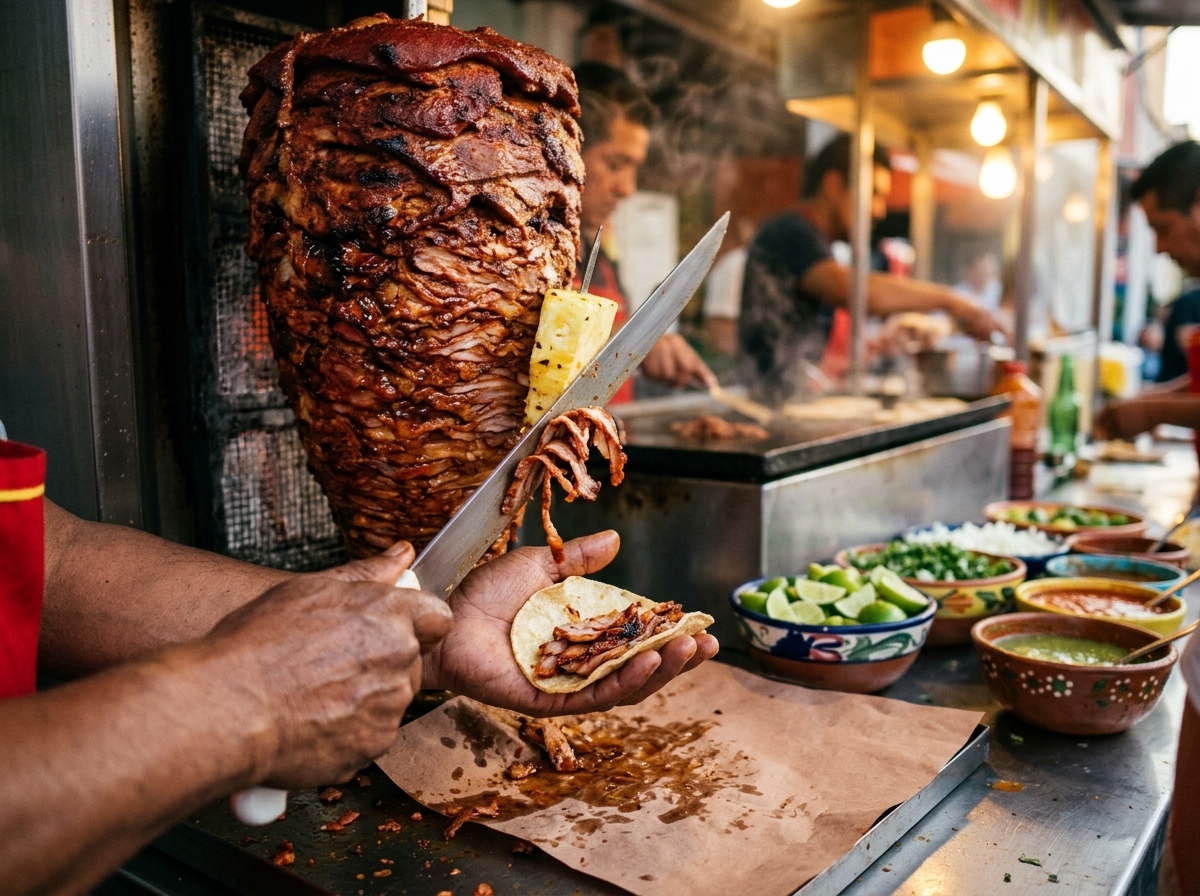
Meanwhile, something else was happening in Mexican-American kitchens and taquerias across the Southwest and California. Traditional taco culture was being preserved, celebrated, and evolved on its own terms. Tacos al pastor — developed in central Mexico in the mid-20th century with influences from Lebanese immigrants who brought shawarma-style spit-roasting techniques — became enormously popular. If you’ve never understood what makes tacos al pastor so distinctive, the Lebanese connection is the key detail: the vertical spit, the marinated pork, the combination of savory meat with pineapple — all of it traces back to that cross-cultural collision.
The Taco Renaissance: Street Food Goes Global
Starting in the 1990s and accelerating dramatically through the 2000s, tacos began a serious cultural rehabilitation in America. A few forces drove this:
The rise of the taqueria: Authentic Mexican taquerias, serving soft corn tortillas with simple, high-quality fillings, began expanding beyond traditional Mexican-American neighborhoods into broader American food culture. People who’d only known hard-shell tacos tried a proper street taco and understood the difference immediately.
The food media revolution: Food writers, TV shows, and later food bloggers began documenting authentic Mexican food culture seriously. Anthony Bourdain’s televised visits to Mexican street food stalls probably did more for the reputation of authentic tacos among American foodies than any single restaurant opening.
Immigration patterns: Continued immigration from different Mexican regions brought more regional taco varieties into American cities. Suddenly you could find tacos de birria, tacos de barbacoa, and Oaxacan-style tacos in cities like Chicago, New York, and Dallas.
The evolution of taco fillings over the past 30 years reflects this shift — from the Americanized ground beef and cheddar era back toward traditional preparations, and then forward into genuinely creative fusion territory.
The Tortilla Question: Corn vs. Flour
No history of tacos is complete without addressing the tortilla debate, because it directly reflects historical and regional differences within Mexico itself.
Corn tortillas are older — they’re the direct descendant of the ancient Mesoamerican tradition and are considered by most food historians (and most Mexican cooks) as the authentic base for a traditional taco. They have a distinctive earthy flavor, a slightly rough texture, and they’re typically smaller and thinner than flour tortillas.
Flour tortillas came later, a product of Spanish colonial influence. When Spanish colonizers arrived, they brought wheat cultivation with them. Northern Mexico — where the climate was better suited to wheat farming and where Spanish influence was strong — adopted flour tortillas extensively. States like Sonora, Chihuahua, and Baja California developed taco traditions built around flour tortillas, which is why American Tex-Mex food (heavily influenced by northern Mexican and border food culture) defaults to flour.
So the corn vs. flour tortilla debate isn’t really about which is “better” — it’s about which regional tradition you’re representing. Both are legitimate. Both are delicious. But if someone serves you a fish taco from Baja or a carnitas taco from Mexico City on a flour tortilla, something has gone sideways.
Did you know? Many street tacos in Mexico use two small corn tortillas stacked together rather than one. This isn’t a mistake or extra food — it’s practical. Soft corn tortillas can tear under the weight of wet, saucy fillings. Two tortillas give you the structural integrity you need. Here’s the full reason why tacos have two tortillas if you’ve ever wondered.
Tacos Today: A Living Tradition
Right now, in 2025, tacos occupy a genuinely interesting cultural position. They’re simultaneously ancient and modern, hyper-local and global, street food and fine dining.
In Mexico, the taco remains fundamentally working-class food — eaten standing at a taqueria counter, from a paper plate, with a plastic cup of agua fresca on the side. The best ones are often the simplest: excellent carne asada on a fresh corn tortilla with a spoonful of salsa and some chopped onion and cilantro. Nothing else required.
In the United States, tacos have fractured into multiple identities. You have the traditional street taco served at authentic taquerias. You have Tex-Mex interpretations. You have the fusion taco — Korean BBQ, fried fish, roasted cauliflower — that chefs have had fun with for the past two decades. And you have the fast-food taco, which continues to exist in its own separate universe.
What ties all of these together — from the ancient Mesoamerican corn flatbread to the $18 truffle taco at a trendy restaurant — is the fundamental simplicity of the form. A folded or rolled piece of bread with something inside. That idea is so practical, so good, that it’s survived 9,000 years and shows no sign of stopping.
The toppings have changed. The best taco sauces range from ancient chili-based preparations to modern pickled jalapeño cremas. The best taco toppings debate is ongoing and genuinely passionate. But the core of the taco — the tortilla, the filling, the hand — remains exactly what it’s always been.
FAQ
Q: What is the oldest known form of a taco?
The oldest form is the simple folded corn tortilla filled with whatever was locally available — insects, fish, beans, or game. Spanish colonial accounts from the 16th century describe indigenous people in central Mexico eating exactly this. The specific word “taco” came much later, but the food format predates it by thousands of years.
Q: Did Taco Bell invent the taco?
No — and by a wide margin. Tacos existed in some form for thousands of years before Taco Bell opened in 1962. What Glen Bell created was a specific, heavily Americanized version of a taco built around a pre-formed hard shell, designed for fast-food production. It’s a distinct product from a traditional Mexican taco, even if it shares the name.
Q: Why are authentic Mexican tacos so simple compared to American versions?
Traditional Mexican tacos prioritize the quality of two or three components — the tortilla, the meat preparation, and a well-made salsa — rather than layering on multiple toppings. The simplicity isn’t a lack of effort; it’s a different philosophy. When your carnitas are braised perfectly or your al pastor is marinated and charred just right, adding sour cream and shredded cheese would just get in the way. The authentic Mexican taco tradition is built on getting the fundamentals right.
Q: When did tacos become popular in the United States?
Tacos have been part of Southwestern American food culture since the mid-1800s, carried by Mexican communities in Texas, New Mexico, Arizona, and California. But widespread mainstream American familiarity with tacos as a concept — even in their Americanized form — really accelerated after Taco Bell’s rapid expansion in the 1960s and 1970s. Authentic taco culture began reaching broader American audiences through the 1990s and 2000s food media boom.
Closing
The taco’s 9,000-year journey — from ancient corn fields to Mexican silver mines to American fast-food chains to the street food stall you probably have within a mile of where you’re sitting right now — is one of the more remarkable stories in food history. What’s surprising isn’t that tacos became globally popular. What’s surprising is how long it took the rest of the world to figure out what Mesoamerican civilizations already knew: a fresh tortilla, a good filling, and the right salsa is one of the most satisfying things a human being can eat.
If this history has made you hungry (and it probably has), the best next step is simple. Find the most authentic taqueria near you, order something you’ve never tried before — maybe tacos al pastor or a regional specialty — and eat it the way it’s meant to be eaten: standing up, with both hands, and no apologies.