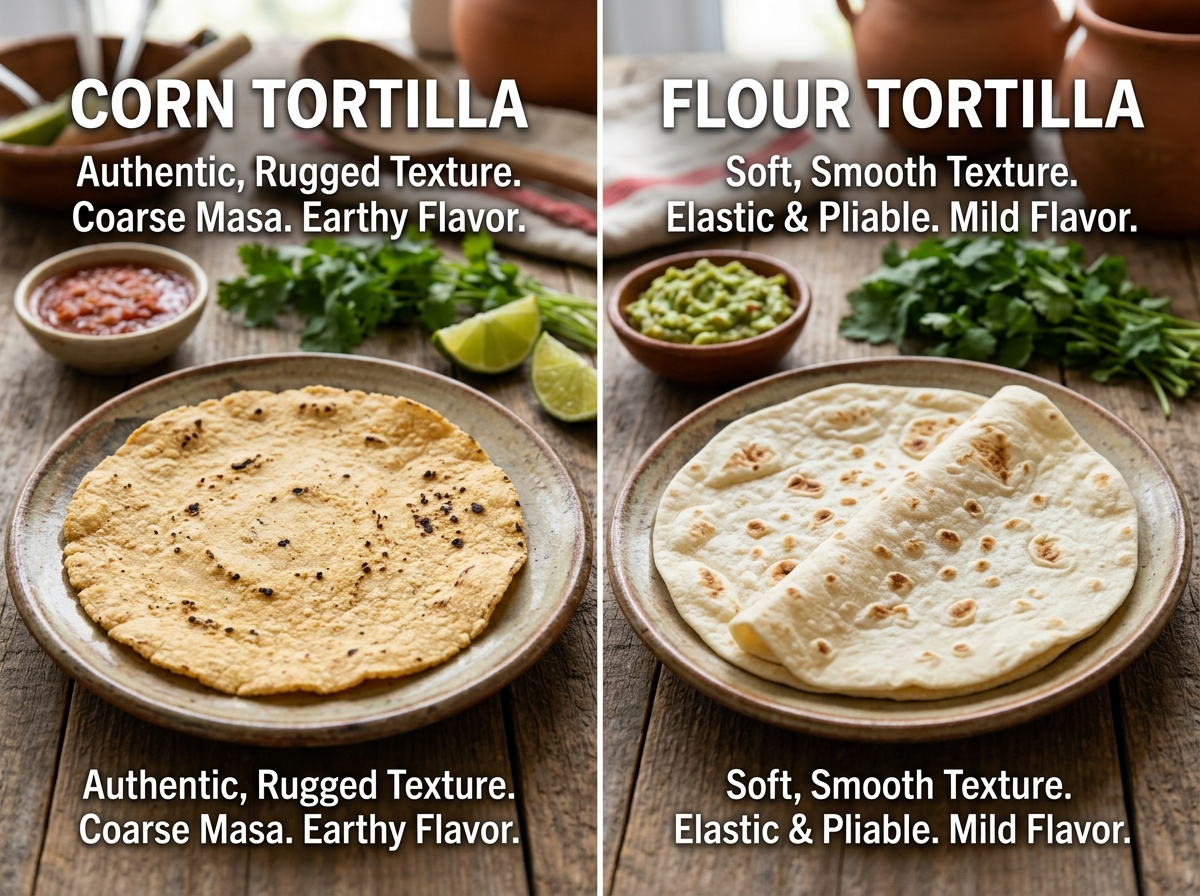
You’re standing in the grocery aisle, staring at two packs of tortillas. One’s corn, one’s flour. They look similar enough, but pick the wrong one for your recipe and the whole meal feels off — too chewy, too bland, falling apart in your hands. It’s a small choice that makes a surprisingly big difference.
Corn and flour tortillas aren’t interchangeable. They come from different ingredients, behave differently when heated, and honestly, they belong in different dishes. Whether you’re making street-style tacos, rolling a fat burrito, or just trying to eat a little healthier, knowing the real differences between these two will change how you cook and eat.
Let’s break it all down — flavor, texture, nutrition, best uses, and the stuff most articles skip over.
What Are They Actually Made Of?
This sounds obvious, but the ingredients tell you everything about how these tortillas act on your plate.
Corn tortillas use just three things: masa harina (a special corn flour treated with lime water through a process called nixtamalization), water, and sometimes a pinch of salt. That’s it. This ancient process dates back thousands of years to Mesoamerican civilizations — the Aztecs and Maya were making these long before anyone thought about wheat flour. The nixtamalization process isn’t just tradition; it actually makes the corn more nutritious by releasing niacin (vitamin B3) and making the proteins easier for your body to absorb.
Flour tortillas use wheat flour, water, fat (usually lard or vegetable shortening), salt, and sometimes a leavening agent like baking powder. The fat is what gives them that soft, pliable, almost pillowy quality. Flour tortillas showed up much later in Mexican cuisine, after Spanish colonizers brought wheat to the Americas in the 1500s. They became especially popular in northern Mexico, where wheat grew well in the drier climate.
So right from the start, you’ve got two fundamentally different foods. One is a three-ingredient ancient staple. The other is a richer, more modern creation with added fat. That difference ripples through everything — taste, texture, nutrition, and how you should use them.
Taste and Texture: The Differences You’ll Actually Notice
Let’s talk about what matters most at the dinner table — how they taste and feel.
Corn tortillas have an earthy, slightly sweet, distinctly “corny” flavor. There’s a rustic quality to them that pairs beautifully with bold, savory fillings. Think of them as the tortilla that adds flavor to your meal rather than just wrapping around it. Texture-wise, they’re firmer, a bit grainy, and smaller in size — typically around 6 inches in diameter. When fresh and warm, they’re pliable and tender. When cold or overhandled, they crack and break. That’s just their nature.
Flour tortillas taste milder, with a subtle butteriness from the fat. They’re neutral enough to work with almost anything, but they don’t contribute much flavor on their own. Their texture is where they shine — soft, stretchy, and forgiving. You can fold them, roll them, stuff them to the brim, and they hold together without complaining. They also come in bigger sizes, often 10 to 12 inches, which is why they’re the go-to for burritos and wraps.
Quick fact: If you’ve only ever eaten store-bought corn tortillas and found them dry or crumbly, you haven’t really experienced a proper corn tortilla. Freshly made ones — warm off the comal — are soft, fragrant, and genuinely special. It’s like comparing a fresh-baked baguette to a three-day-old slice of sandwich bread.
Nutrition: Which One Is Actually Healthier?
This is probably the question that brings most people to this comparison. And the honest answer? Corn tortillas win on most health metrics, but the gap isn’t always as dramatic as some articles make it sound.
A standard corn tortilla (about 30 grams) typically has around 60–70 calories, 1.5 grams of fat, 12 grams of carbs, and roughly 1.5 grams of fiber. A comparable flour tortilla (about 45 grams for a similar-sized one) packs around 140–150 calories, 4–5 grams of fat, 22–24 grams of carbs, and about 1 gram of fiber.
Here’s what those numbers actually mean for you:
If you’re watching calories, corn tortillas give you a real advantage. Two corn tortillas still have fewer calories than a single flour tortilla of comparable size. That adds up fast if you’re eating tacos a few times a week.
If you’re avoiding gluten, corn tortillas are naturally gluten-free, since they’re made from corn, not wheat. That makes them safe for people with celiac disease or gluten sensitivity — just double-check the label to make sure they weren’t processed in a facility that also handles wheat.
If you’re managing blood sugar, corn tortillas have a lower glycemic index than flour tortillas. They won’t spike your blood sugar as quickly, which matters for anyone dealing with diabetes or insulin resistance.
If you care about whole grains, corn tortillas are typically made from whole-grain corn, while most flour tortillas use refined white flour (unless the package specifically says “whole wheat”).
Where flour tortillas have a slight edge is in iron and protein content — wheat flour is often enriched with iron, and flour tortillas tend to have a gram or two more protein per serving.
But here’s the thing nobody talks about: the size difference skews the comparison. Flour tortillas are almost always bigger and heavier, so you’re inherently eating more per tortilla. If you’re comparing gram for gram, the nutritional gap narrows. But in real life, you eat tortillas by the piece, not by the gram — and that’s where corn tortillas come out ahead.
Pro Tip: Don’t fall into the trap of thinking “healthier tortilla = healthy meal.” What you put inside matters just as much. A corn tortilla loaded with sour cream and cheese isn’t automatically healthier than a flour tortilla filled with grilled chicken and fresh salsa.
Which Tortilla Works Best for What?
This is where things get practical — and where a lot of people make their mistakes. The right tortilla depends entirely on what you’re making.
Tacos
For authentic Mexican tacos, corn tortillas are the standard. Street taco vendors across Mexico use small corn tortillas, and there’s a good reason many serve two stacked together — the double layer prevents the tortilla from falling apart under juicy fillings like al pastor, carnitas, or barbacoa. The earthy corn flavor complements savory meats and sharp salsas in a way that flour just can’t replicate.
That said, flour tortillas are common for tacos in northern Mexico and parts of Texas. If you’re making carne asada tacos Sonoran-style, a warm flour tortilla is completely traditional and absolutely delicious.
Burritos
Flour tortillas. No contest. You need that large, stretchy surface to wrap around rice, beans, meat, cheese, and everything else that goes into a proper burrito. A corn tortilla simply can’t hold that much filling without tearing apart. The soft texture of flour also creates that satisfying first bite where everything stays intact.
Enchiladas
Corn tortillas are the classic choice here. They absorb sauce beautifully without turning into mush — at least not immediately. Their firmer texture holds up during baking, and their flavor pairs perfectly with rich mole or tangy red chili sauce. Flour tortillas in enchiladas feel wrong to most people who’ve had the real thing.
Quesadillas
Both work, and this really comes down to preference. Flour tortillas give you that crispy-on-the-outside, gooey-on-the-inside experience that most Americans associate with quesadillas. Corn tortillas create something more rustic and snacky — think of those small, thick, griddle-pressed quesadillas you’d find at a Mexican market.
Chips and Tostadas
Corn, always. Flour tortillas don’t fry into chips the same way — they puff up and get flaky instead of crispy. Every tortilla chip you’ve ever eaten started as a corn tortilla, and tostadas (flat, crispy tortillas used as a base for toppings) are exclusively a corn tortilla thing.
How to Handle Each Tortilla Like a Pro
One of the biggest reasons people prefer flour tortillas is that corn tortillas can be frustrating to work with if you don’t know the tricks. Let’s fix that.
Warming Corn Tortillas the Right Way
Cold corn tortillas crack. That’s not a flaw — it’s just what happens when the starches are cold and rigid. You have to warm them before using them, and how you do it matters.
The best method is a dry skillet or comal over medium-high heat. Lay the tortilla flat, let it heat for about 30 seconds per side. You’ll see a few small brown spots appear, and the tortilla will start to puff slightly. That’s when it’s ready — warm, pliable, and lightly toasted.
You can also wrap a stack of tortillas in a damp paper towel and microwave them for 30–45 seconds. It’s not as good as the skillet method, but it works when you’re feeding a crowd and need speed.
Did you know? Wrapping warm corn tortillas in a clean kitchen towel or a tortilla warmer traps steam and keeps them soft for 15–20 minutes. Skip this step and they’ll dry out and crack within minutes.
Working with Flour Tortillas
Flour tortillas are more forgiving, but they still benefit from a quick warm-up. A dry skillet for 15–20 seconds per side makes them softer and brings out that buttery aroma. For burritos, warming is essential — a cold flour tortilla is stiff and can tear when you try to fold it tight.
If you’re storing homemade flour tortillas, separate them with parchment paper before stacking. They tend to stick together, and pulling them apart can cause tears.
The “Authenticity” Question
People love to debate which tortilla is more “authentic.” Here’s the honest answer: both are authentic, but in different contexts.
Corn tortillas are the original, the foundation of Mexican cuisine stretching back thousands of years. If you’re talking about the history of tacos and traditional Mexican cooking, corn is the OG. Central and southern Mexico still overwhelmingly favor corn tortillas for everyday meals.
Flour tortillas are legitimately Mexican too, but they’re regional. Northern Mexican states like Sonora, Chihuahua, and Nuevo León adopted wheat after Spanish colonization, and flour tortillas became deeply rooted in those regional cuisines. Calling flour tortillas “not authentic” ignores centuries of Mexican culinary tradition.
The different types of Mexican tacos reflect this diversity beautifully. Tacos al pastor from Mexico City? Corn. Burritos from Sonora? Flour. Both are as Mexican as it gets.
How Tortillas Interact with Fillings
Here’s something most comparison articles completely ignore: the tortilla you choose affects how your filling tastes.
Corn tortillas have a stronger personality. Their earthy flavor creates a contrast with rich, fatty meats and bright, acidic salsas. A juicy al pastor taco with pineapple on a corn tortilla hits different because the corn provides a grounding, savory base that balances the sweet and spicy elements. Similarly, the best taco sauces — from smoky chipotles to fresh green tomatillo — taste more complex against a corn backdrop.
Flour tortillas are more like a blank canvas. They let the fillings do all the talking. That’s why they work so well for burritos and wraps where you’ve got a lot of competing flavors — rice, beans, multiple taco meat types, cheese, guacamole, and sour cream. A flour tortilla holds it all together without adding another flavor layer to an already busy mix.
Think about your taco toppings too. If you’re going minimal — just meat, onion, cilantro, and a squeeze of lime — corn tortillas shine because you can actually taste them as part of the dish. If you’re piling on avocado, cheese, lettuce, and three different salsas, flour might serve you better as a sturdy, neutral vessel.
Shelf Life and Storage
Flour tortillas generally last longer in the fridge — about 7 to 10 days after opening — because the fat content helps preserve them. Corn tortillas dry out faster and are best used within 5 to 7 days.
Both freeze well, which is actually the best move if you buy in bulk. Frozen tortillas keep for 6 to 8 months. Just separate them with wax paper before freezing so they don’t turn into one solid tortilla brick.
One thing to watch for: mold. Corn tortillas, because they lack preservatives in their simplest form, can develop mold faster in humid conditions. Always store them sealed and refrigerated once opened.
The Cost Factor
Corn tortillas are almost always cheaper. A standard pack of 30 corn tortillas costs roughly $2 to $4 at most grocery stores. Flour tortillas, especially the larger burrito-sized ones, run $3 to $6 for a pack of 8 to 10.
If you’re feeding a family on a budget, corn tortillas stretch your dollar further. Two corn tortillas per taco, three tacos per person — that’s six tortillas, which costs pennies. Try doing that with flour tortillas and the math changes quickly.
For events like taco nights or catering setups using chicken tacos, corn tortillas make even more financial sense at scale.
Can You Make Them at Home?
Absolutely — and homemade tortillas are a different experience entirely compared to store-bought.
Corn tortillas require just masa harina and water. You mix the dough, press it in a tortilla press (or between two sheets of plastic with a heavy pan), and cook on a hot, dry skillet for about a minute per side. The whole process takes maybe 20 minutes for a batch. The taste difference between homemade and packaged corn tortillas is dramatic — it’s the kind of thing that makes you wonder why you ever bought the bagged ones.
Flour tortillas need a few more ingredients — flour, fat, salt, baking powder, and water. The dough requires resting time (about 20–30 minutes), and you’ll roll each one out with a rolling pin since they’re too soft for a press. They’re a bit more work, but still very doable for a weekend cooking session.
Warning: If you’re making homemade corn tortillas and the dough feels dry or crumbly, add water a tablespoon at a time. If it sticks to your hands, add a bit more masa. The texture should feel like Play-Doh — smooth and pliable without being sticky.
So Which One Should You Actually Choose?
There’s no universal winner here. The right tortilla depends on your dish, your dietary needs, and honestly, your personal taste.
Go with corn tortillas if you’re making traditional street-style tacos, enchiladas, tostadas, or chilaquiles. Also choose corn if you’re gluten-free, watching your calorie intake, or want a tortilla that contributes its own flavor to the dish.
Go with flour tortillas if you’re making burritos, fajita wraps, large quesadillas, or anything that requires a big, flexible, tear-resistant wrapper. They’re also the better choice when your filling is complex and you want the tortilla to stay in the background.
Or just keep both on hand. Most people who cook Mexican food regularly stock both types because they serve different purposes. That’s not a cop-out answer — it’s the practical truth.
FAQ
Are corn tortillas always gluten-free?
Pure corn tortillas made from just masa harina and water are naturally gluten-free. But some commercial brands process their tortillas in facilities that also handle wheat, which creates a cross-contamination risk. If you have celiac disease, always check the packaging for a certified gluten-free label.
Why do my corn tortillas keep breaking?
Almost always because they’re too cold or too dry. Warm them on a skillet or in the microwave before using them. If you’re making them from scratch, your dough might need more water. Another trick: steam them by wrapping a stack in a damp towel after heating. The trapped moisture keeps them flexible.
Can I use flour tortillas for tacos?
Of course you can. Flour tortillas are traditionally used for tacos in northern Mexico and throughout Texas. There’s no rule that says tacos must be on corn. That said, if you’re aiming for the experience of classic Mexican street tacos, corn is the way to go.
Which tortilla is better for weight loss?
Corn tortillas have fewer calories and less fat per serving, so they’re the smarter choice if you’re counting calories. Two corn tortillas still come in under the calorie count of one standard flour tortilla. But remember — the fillings, toppings, and portions matter just as much as the tortilla itself.
Do corn and flour tortillas taste the same when fried?
Not at all. Fried corn tortillas turn crispy and crunchy — that’s how you get tortilla chips, tostadas, and hard taco shells. Fried flour tortillas puff up into flaky, bubbly layers — think sopapillas or flour tortilla chips, which have a completely different texture. Both are delicious, just different.
The tortilla you reach for shapes the entire experience of your meal in ways that go beyond just wrapping food. It affects flavor, texture, nutrition, and even how authentic your dish feels. Neither corn nor flour is “better” in absolute terms — they’re different tools for different jobs.
Next time you’re planning taco night or setting up a spread with your favorite taco toppings and sauces, grab both kinds. Use corn for your street-style tacos and flour for those overstuffed burritos. Your taste buds — and your guests — will thank you for knowing the difference.